


Dead Money
Dead money is the chips already in the pot from players who are unlikely to keep fighting for it — the blinds and antes posted before any voluntary action, limpers who'll release to a raise, callers who give up to a squeeze, and abandoned continuation-bet pots. It is the share of the pot that makes attacking the pot worth attempting at all.
Practice this in Poker Skill. Preflop is where the lessons have you go after it: in the squeeze lesson, ace-king on the button 3-bets over a raise and a call to take the chips those two players already put in.
Get the free appDead Money in No-Limit Texas Hold’em
What dead money is
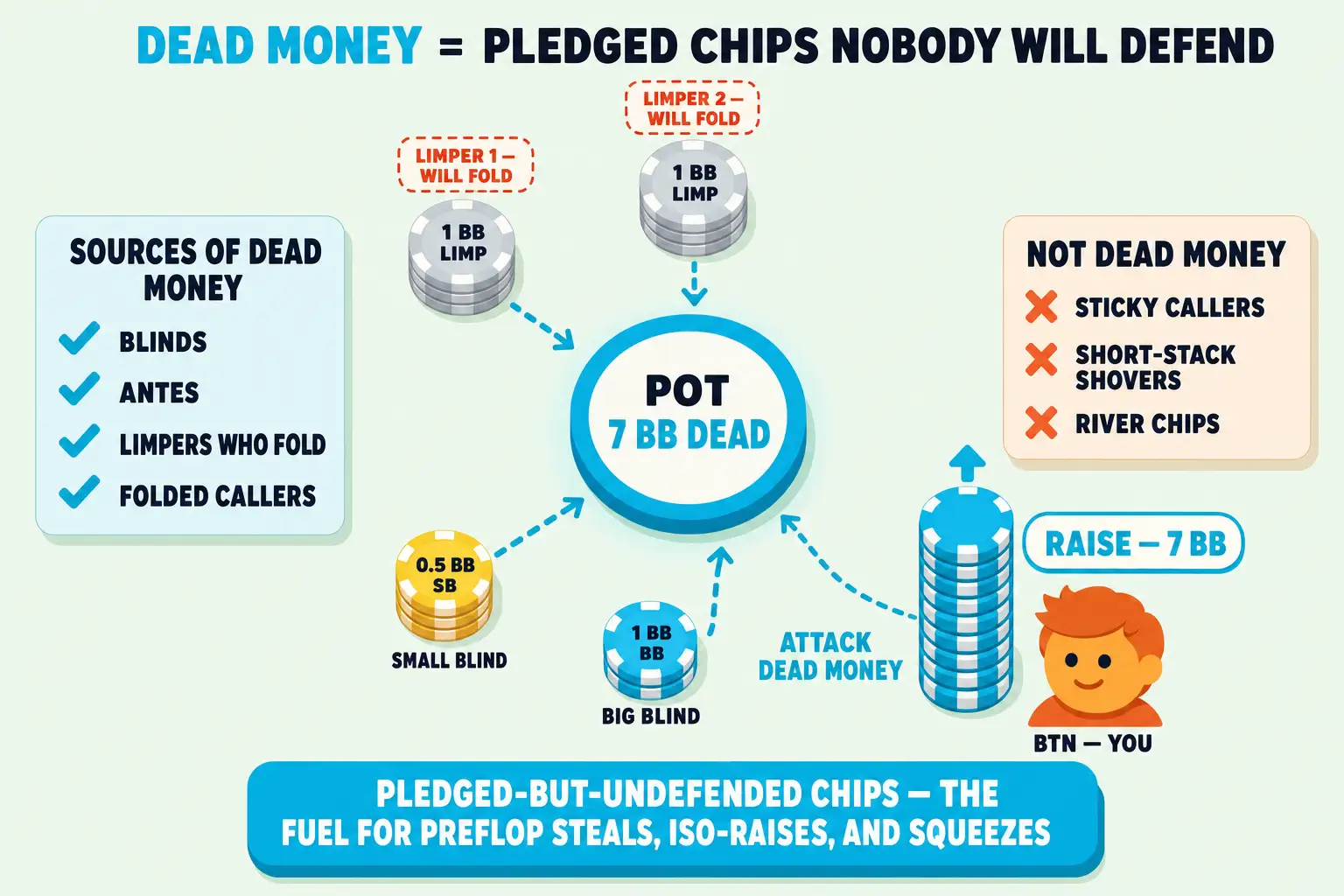
Dead money is chips that are already in the pot but belong to players who are not going to keep fighting for it. The blinds and antes posted at the start of the hand are the cleanest example: they sit in the pot before a single voluntary action. Limpers who fold to a raise, cold-callers who release to a 3-bet, and a flop pot left behind when nobody takes a continuation bet all add to the same pile. Whenever the share of chips in the pot owned by players who won’t continue grows, the pot becomes more attractive to attack.
Where dead money comes from
| Source | When the chips become “dead” | Typical share of pot |
|---|---|---|
| Big blind | Forced bet before the deal | 1 BB |
| Small blind | Forced bet before the deal | 0.5 BB |
| Ante | Forced bet from every seat (or BB ante) | 0.5–1 BB combined |
| Limpers | When they fold to an iso-raise | 1 BB per limper |
| Cold-callers | When they fold to a squeeze | The opener’s raise size per caller |
| Abandoned c-bet pot | When everyone checks the flop and the action dies | The full preflop pot |
A pot can carry several layers of dead money at once. A 6-max hand with antes plus two limpers plus the blinds already has 4–5 BB in the middle before you act. That accumulated stake is what makes the iso-raise, steal, or squeeze worth attempting at all.
Why dead money makes the pot worth attacking
Every chip in the pot you do not have to risk is a chip your bet competes for instead of contributes to. The more dead money is sitting there relative to the cost of your raise or bet, the better your price gets even when opponents fight back occasionally. Three things follow from that:
- Steal lines need less raw fold equity. Fold equity is the chance opponents fold to your bet. With more dead money in the pot, the fold percentage you need to break even on the attempt drops. Antes are the textbook reason late-position opens widen in tournaments.
- Hand selection loosens preflop in late position. When the blinds and antes already total ~2 BB, opening with a 2.5 BB raise risks small chips against a real reward. Suited connectors, suited aces, and broadways become routine opens from the cutoff and button.
- Bigger pots invite bigger sizing. Squeeze sizing rises by roughly 1 BB per limp or caller because you are pricing more dead-money contributors out of the pot. A 9 BB 3-bet versus one opener becomes a 12 BB squeeze versus an opener and one caller, with the same logic and more dead money to claim.
When this matters most
Dead money matters most preflop and on the flop, because the early-street pot is where forced bets and reluctant callers concentrate. It matters less on the river, where the chips in the middle have all been put in voluntarily by players who chose to keep playing.
- Antes turn on: late-position opens widen, steal frequencies climb, and 3-bet sizing trims slightly because the pot is already richer.
- Multiple limpers enter: the iso-raise math improves with each limper. Two limpers plus blinds in a no-ante 6-max game already create roughly 3.5 BB of dead money before you act.
- An open and a caller in front of you: the squeeze spot. The opener’s raise, the caller’s flat, and both blinds are all dead money when both fold to your 3-bet.
- A continuation bet gets checked through: the preflop pot is now an orphaned pot of dead money waiting to be claimed by the next aggressor.
Example: iso-raising over two limpers
Stakes: $1/$2 cash, 6-max, no ante. UTG and middle position both limp for $2. Action is on you on the button with K♠Q♠.
The pot before you act:
- Small blind: $1
- Big blind: $2
- UTG limp: $2
- MP limp: $2
- Total dead money in the middle: $7
You raise to $14 (a 5 BB open, plus 1 BB per limper, plus 1 BB for the button). This is a textbook iso-raise sized to attack the dead money.
Three things can happen from here:
- Everyone folds. You collect $7 in dead money for $14 risked. The dead money paid for the attempt.
- One limper calls; blinds fold. You play heads-up in position with a $14 + $14 + $1 + $2 = $31 pot, of which $3 is still dead money from the folded blinds.
- Both limpers call; one blind defends. This is the warning sign. The pot is now $44+ and 4-way, and very little of it is dead. The limpers committed extra chips voluntarily, which means they are not folding most flops either.
Outcome 3 is the live-game trap. Limpers who call a 7 BB raise are no longer providing dead money; they are buying a flop with a hand they intend to play. The pot looked attackable but isn’t.
These numbers are illustrative; real iso-raise sizing depends on table tendencies, stack depths, and your image. The point is the structure: count the dead money before you act, then size the raise against it.
Common mistakes
1) Treating sticky callers as dead money
Limp-callers and cold-callers at small stakes routinely defend with hands they will never fold preflop and will not fold pair-or-better post-flop. Sizing up your iso-raise against a limper who has called $30 raises with 7♠5♣ for an hour does not buy more fold equity; it builds a bigger pot you have to play. Recategorize sticky players as live money, not dead, and pick value spots instead of pressure spots.
2) Squeezing into a multiway pot that won’t fold
A squeeze needs both the opener and the cold-caller to fold a meaningful share of the time. When the table is full of stations, the dead money in front of you is misleading; the chips read as dead but the players’ hands aren’t. The result is a bloated 4-way pot played out of position with the worst hand-vs-range equity at the table.
3) Overestimating dead money on the river
By the river, the pot is mostly chips that have been put in voluntarily across three streets. The dead-money logic that applies to a preflop steal is largely gone. River bluffs need real combinatorial work, not “the pot is huge so I should attack it.”
4) Ignoring stack depth behind the dead money
A short stack sitting behind a dead-money pot can shove all-in and remove your fold equity. The chips look attackable; the player has reason not to release them. Always read effective stacks before sizing up an attack on a “rich” pot.
FAQ
Is “dead money” the same thing as the pot odds I’m being offered?
Not quite. Dead money is the share of the pot put in by players who will not contest it further. Pot odds are a ratio between the current pot size and the cost of your call or raise. Dead money is one of several reasons preflop pot odds shift in your favor, but pot odds also reflect chips opponents will defend with, which are not dead.
Why do antes change opening ranges so much?
Antes add a fixed chunk of dead money to every hand. Hands that were borderline opens at 1.5 BB of dead money (just the blinds) become clear opens at 2.5 BB of dead money (blinds plus antes). The math hasn’t changed; the pot has. See the ante entry for the structural detail.
Can dead money exist post-flop?
Yes, mostly when the preflop raiser checks back the flop and everyone checks again on the turn. The pot has been abandoned: nobody has put chips in with a continuing range. That kind of orphaned pot is dead money for whoever takes the next bet.