


Delay C-Bet
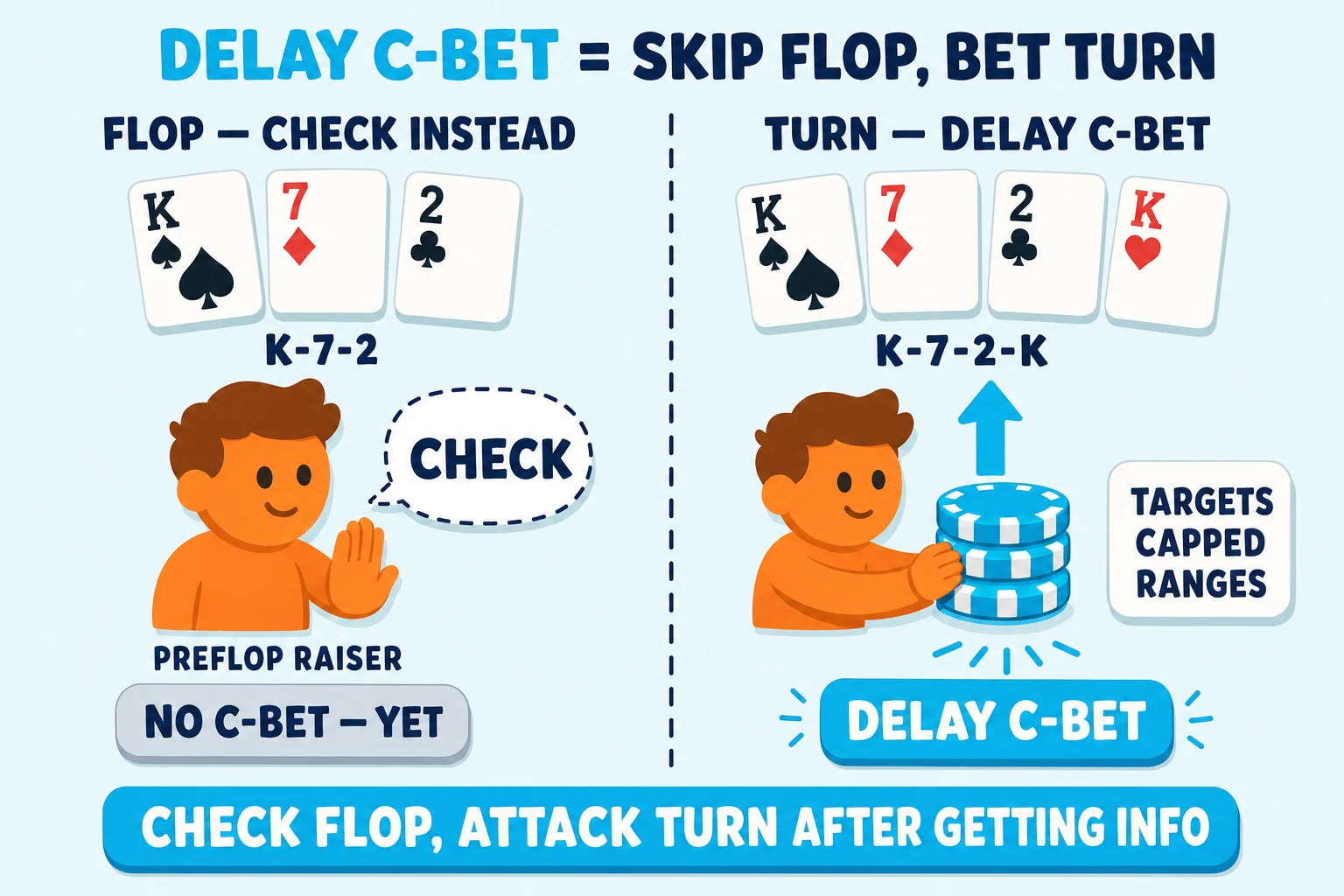
A continuation bet (C-bet) occurs when the pre-flop raiser bets the flop after raising. A delay C-bet happens when that raiser checks the flop, then bets the turn if conditions favor it. You check first to gather information, then attack later rather than betting automatically on the flop. The tactic aims to use opponent reactions, control pot size, and exploit turn-fold equity.
Practice this in Poker Skill. Both reads this line rests on have lessons: When Checking Is Natural deals flops where the raiser’s natural play is a check, and the turn lessons sort the cards that help you from the ones that finish the caller’s draws.
Get the free appDelay C-Bet
What a delay C-bet is
A continuation bet (C-bet) occurs when the pre-flop raiser bets the flop after raising. A delay C-bet happens when that raiser checks the flop, then bets the turn if conditions favor it. You check first to gather information, then attack later rather than betting automatically on the flop. The tactic aims to use opponent reactions, control pot size, and exploit turn-fold equity.
Why you would use a delay C-bet
You delay to exploit modern opponents who float (call to see later cards) or check-raise (check then raise after you bet). Delaying preserves pot control on dangerous boards or when out of position. It also lets you pick targeted turn spots for aggression after seeing opponent reactions on the flop.
When to choose delay vs immediate C-bet
Prefer immediate C-bets versus fit-or-fold or passive players who fold to flop pressure. Choose delay against aggressive defenders or float-prone opponents to avoid check-raise traps. Use delay on coordinated flops or when a likely turn “scare” card (an overcard or a draw-completing card) will increase your fold equity.
How to execute a delay C-bet in practice
- Check the flop to gather reactions. If the opponent quickly checks behind, they’re often weak or pot-controlling. If they bet or check-raise, they’ve shown aggression and you should proceed cautiously.
- Plan a turn stab with appropriate hands - value that improved on the turn, hands with decent equity (for example, second pair plus a backdoor), and selected bluffs that use the turn card as a story.
- On the turn, size your bet to target capped calling ranges. Choose a size that folds marginal hands and draws, yet still extracts value from worse hands. When in position, a delayed bet often hits opponents who limited their ranges to weak pairs and draws. Example: You raised pre-flop with K♠Q♠ and see a flop of 9♣7♠2♦, so you check. Opponent calls. If the turn brings K♦, a delayed bet reads as value and extracts from worse pairs. If the turn is A♥, you might delay-bet as a bluff in the right matchup because that card can force folds.
Balancing range and avoiding predictability
Mix delayed bets with both strong hands and bluffs so opponents can’t exploit your timing. Don’t make every missed hand a delayed bluff; keep some strong hands c-betting on the flop to avoid predictable patterns. Use board texture and opponent tendencies to decide which parts of your range you delay and which you continue on the flop.
Common mistakes and how to avoid them
Don’t delay by default - overuse lets opponents see more cards cheaply and take the initiative. Avoid delaying on boards where the turn rarely changes equity or where immediate flop fold equity is higher. If your delayed bet is called or check-raised on the turn, adjust sizing and range composition instead of auto-bluffing further.
Quick checklist
- Check the flop as pre-flop raiser only when opponent type or board texture favors delay.
- Choose turn bet size to exploit capped calling ranges and preserve balance.
- Prefer immediate C-bets versus fit-or-fold and passive players; delay versus floaters and aggressive defenders.
- Include both value and bluff hands in your delayed betting range.
- Track opponent reactions to refine when delay works and when it becomes predictable.