
Delayed C-Bet
What a delayed continuation bet is
A delayed continuation bet occurs when the pre-flop aggressor checks the flop, then bets the turn. A continuation bet (c-bet) is a bet by the player who raised before the flop.
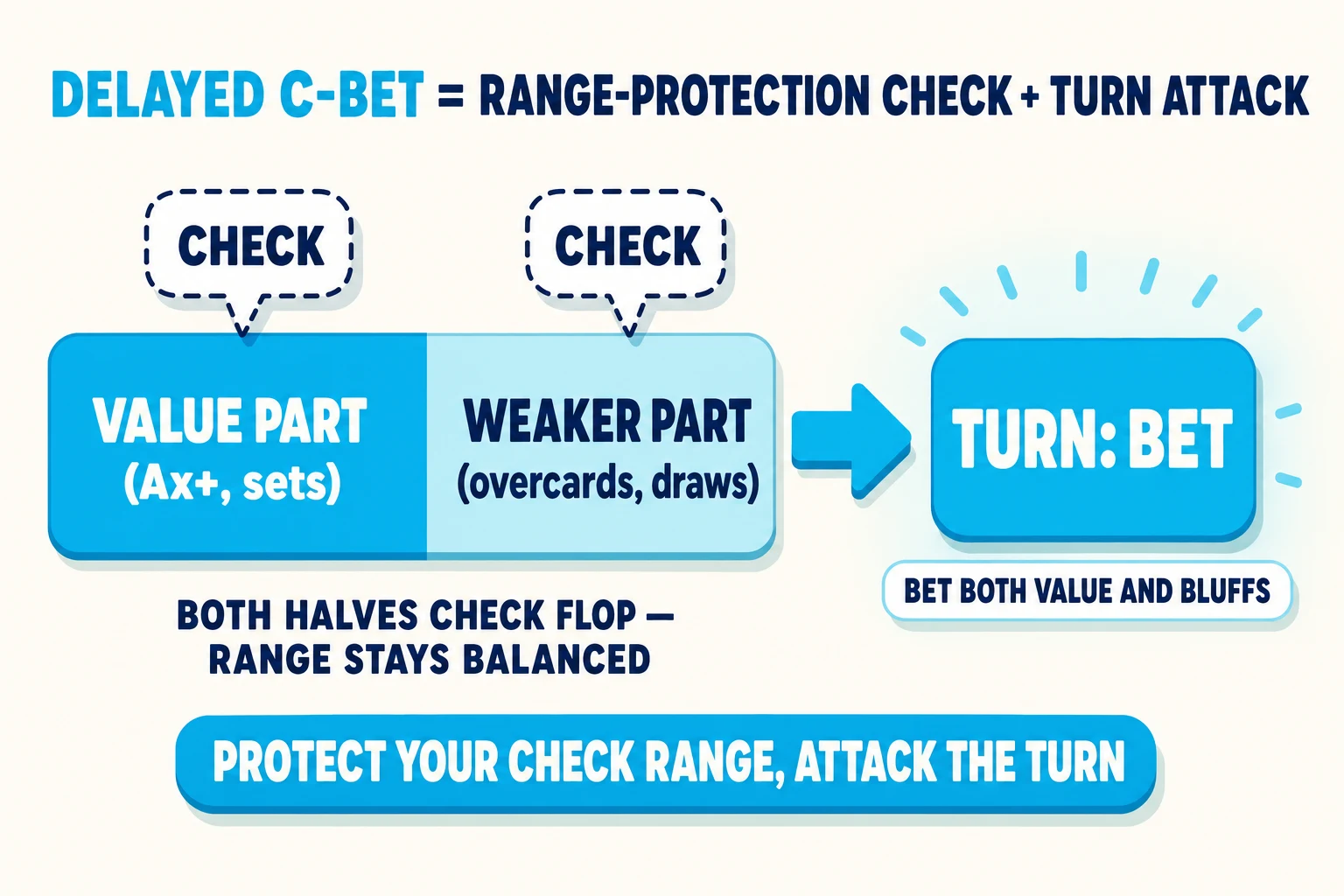
Simple sequence:
- You raise pre-flop and the opponent calls.
- You check the flop instead of betting.
- You bet the turn when you have a better opportunity or more information.
The tactic adapts to board texture, hand strength, and opponent tendencies while managing range dynamics. Delayed c-bets help realize equity and control how information unfolds across streets.
Example: You raise UTG with A♠K♣ and an opponent calls. The flop comes A♥7♣2♦ - a static Axx flop (an ace plus two low cards). Instead of c-betting, you check to keep your checking range balanced, then bet a blank turn to preserve deception and protect stronger hands mixed into your checks.
When to delay: board texture and range considerations
Board texture drives the decision. On static boards, ones unlikely to change relative hand strength, checking the flop and betting the turn preserves a balanced checking range. That lets your check-back range include both strong hands and weaker holdings, so opponents can’t treat a check as automatic weakness.
Mix some strong hands into your flop check-backs to avoid leaking range strength. For example, include some Aces in your checked range on Axx flops so opponents can’t exploit you by bluffing every check.
Delaying a bet also controls pot size and buys another action from the opponent. You may get a free card, induce a bluff, or extract information before committing more chips. Be careful: if the turn completes obvious draws, adjust sizing or avoid delaying entirely.
Position: how IP vs OOP changes delayed c-bet use
In position (IP) - when you act after your opponent - delayed c-bets become more attractive. IP gives extra information and better pot control, letting you realize equity with marginal hands and avoid check-raises on the flop.
Out of position (OOP) - when you act before your opponent - delay less often. Giving free cards OOP costs more because you lose informational advantage. When you do delay OOP, use larger turn bet sizes to deter cheap cards and punish wide calling ranges.
Position determines whether a flop check gathers useful information or simply hands initiative to the opponent.
Adjusting to opponent tendencies
Good spots to delay: versus automatic flop-callers who fold too often on later streets. Check the flop, then seize the pot on the turn.
Bad spots to delay: versus players whose flop calling or raising ranges are strong and likely to continue. Delaying risks getting raised off medium hands or building a pot when behind.
Use delayed c-bets to bait aggressive opponents into bluffing the turn, or to exploit players who overfold to turn aggression.
GTO vs exploitative integration
Delayed c-bets belong in balanced, advanced strategies. Mixing flop checks and turn bets prevents opponents from reading your range too easily. While baseline population strategy often favors frequent immediate flop c-bets, selective delaying can improve both GTO compliance and exploitative value.
Decide spot-by-spot: follow balanced frequencies against capable opponents, and deviate exploitatively when reads show the opponent misplays later streets.
Quick checklist
- Consider delaying when the board is static and you can protect your checking range.
- Prefer delayed c-bets IP with medium-strength hands vulnerable to flop check-raises.
- Avoid delaying versus strong flop calling or raising ranges that continue aggressively.
- Use opponent tendencies (auto-callers, turn-folders, aggressors) to set delayed c-bet frequency.
- Evaluate pot control and information value before giving up the initiative on the flop.