


Raise-or-Fold
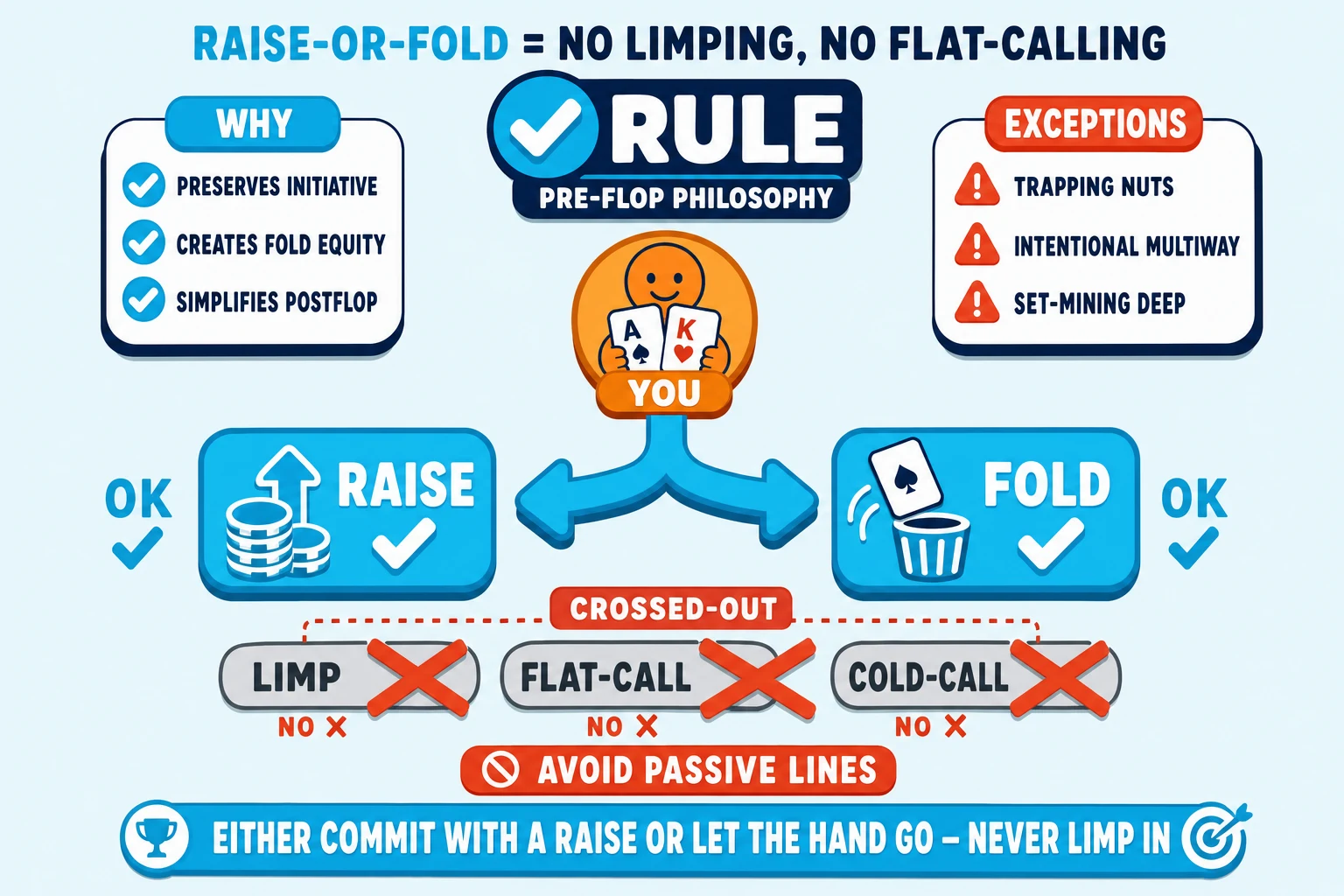
Raise-or-fold is a straightforward preflop philosophy: instead of routinely calling, you usually raise or fold. Flat-calling means calling an open without re-raising; limp means opening the pot with a minimal bet instead of raising. The plan aims to stop passive lines that weaken your range and complicate postflop decisions. Calling still belongs in specific spots - for example, when trapping with a very strong hand or seeking a true multi-way pot - but it should be the exception, not the default.
Practice this in Poker Skill. From the small blind against a cutoff open, the Small Blind vs CO Open lesson makes it 3-bet or fold, 3-betting suited king-jack to push the big blind out and folding king-jack offsuit.
Get the free appRaise-or-Fold
What “Raise-or-Fold” Means
Raise-or-fold is a straightforward preflop philosophy: instead of routinely calling, you usually raise or fold. Flat-calling means calling an open without re-raising; limp means opening the pot with a minimal bet instead of raising. The plan aims to stop passive lines that weaken your range and complicate postflop decisions. Calling still belongs in specific spots - for example, when trapping with a very strong hand or seeking a true multi-way pot - but it should be the exception, not the default.
Preflop Context: When to Prefer Raising Over Calling
Raising defines your range and creates fold equity, the chance opponents fold to your bet. A raise forces opponents to pay to see the flop or concede the pot, and it gives you initiative to bluff later streets. Flat-calling dilutes your opening range and often allows opponents to realize equity cheaply. Example: UTG opens to 3 big blinds. From the cutoff with AJs, raise to about 9-10 bb (a three-bet) to put pressure and clarify your continuing range. Reserve calls for concrete reasons: planned multi-way play, disguised slowplays, or when aggressive opponents make calling profitable.
Stack-Depth Rules: Short Stacks vs Deeper Stacks
Stack size changes the math and your options. At short stacks (roughly 20 big blinds or less in tournaments) the game often becomes push-or-fold: shove all-in or fold. For example, with 18 bb facing a 2.5 bb open, shoving hands like AJo or mid pairs usually beats a tiny raise or flat-call. Deeper stacks allow more nuanced raises and postflop play, but passive flat-calls still tend to underperform versus well-timed aggression. Use effective stack size to guide action, not habit.
Out of Position: Small Blind and Other Vulnerable Seats
Out of position, decisions grow harder because you act before opponents after the flop. From the small blind, cold-calling an open commonly creates difficult postflop spots since you act first on every street. Example: CO opens to 3 bb and you are in the small blind with KTs. Three-betting or folding usually beats cold-calling, as a three-bet forces opponents to work for the pot and keeps your continuing range strong. Flat-calling from the small blind frequently becomes a long-term leak.
Facing Big Raises: 4-bets, 5-bets and Avoiding Passive Calls
Once preflop action escalates to 4-bets or 5-bets, passive calls are rarely correct. A 4-bet is a re-raise after a three-bet and calling it to “see a flop” usually surrenders initiative. Example: you open to 3 bb, three-bet to 10 bb, and villain 4-bets to 30 bb. In many spots you should either 5-bet shove or fold, because calling and playing postflop out of position is often -EV. Use re-raises to protect your range and to leverage fold equity when you have sufficient equity or commitment.
Strategic Benefits and Practical Rules
Raise-or-fold preserves a stronger, less exploitable range, generates fold equity, and forces opponents into tougher decisions. It reduces marginal flat-calls that become long-term chip leaks.
Practical rules:
- Replace routine flat-calls with raises or folds preflop.
- Use effective stack size to choose shove, raise, or fold (push at about 20 bb or less).
- From blinds, favor three-bet or fold over cold-calling.
- Versus heavy preflop aggression: 5-bet shove or fold; avoid passive calls.
- Save calling for traps and true multi-way scenarios only.
Quick checklist
- Replace routine flat-calls with raises or folds preflop.
- Use stack size to choose between shove, raise, or fold.
- From small blind: favor three-bet or fold over cold-calling.
- Versus heavy preflop aggression: commit with a shove or fold, avoid passive calls.
- Save calling for traps and true multi-way scenarios only.