


No Pair
A "No Pair" hand - also called "High Card" - occurs when your best five cards make no pair or higher. The hand's strength depends on the highest card among those five.
Practice this in Poker Skill. In the Check-Fold lesson, ace-high with no draw and two bare overcards both fold to a flop bet, taking the low-cost exit.
Get the free appNo Pair
What a “No Pair” (High Card) means
A “No Pair” hand - also called “High Card” - occurs when your best five cards make no pair or higher. The hand’s strength depends on the highest card among those five.
Example: You hold A♠8♦ and the board is K♥Q♣9♠5♦2♣. You don’t pair anything, so your best five are A-K-Q-9-5 and your hand is Ace-high.
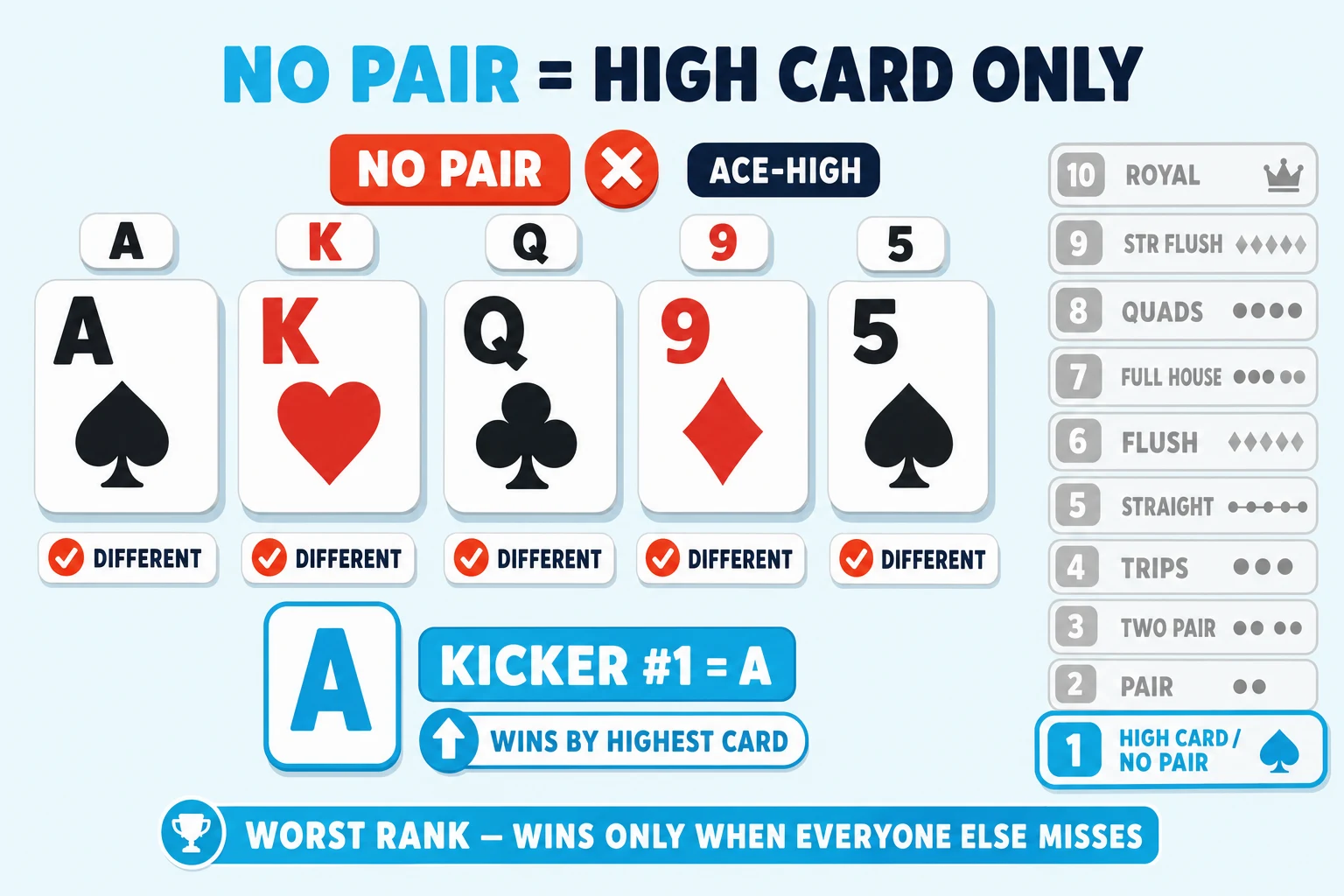
Kickers (the remaining high cards that break ties) matter: if two players both show Ace-high, the next highest cards decide the winner.
How No Pair hands are ranked at showdown
When two or more players reach showdown with No Pair hands, break ties as follows:
- Compare the highest card of each five-card hand. The higher top card wins.
- If top cards tie, compare the second-highest, then the third, and so on.
- If all five cards are identical in rank order, split the pot.
Example: Board K♦Q♠9♣5♥2♦. Player A has A♣8♠ -> A-K-Q-9-5. Player B has A♥7♦ -> A-K-Q-9-5 as well, but Player A’s 8 beats 7, so Player A wins. If both had A8, the pot would split.
When a No Pair hand can realistically win
No Pair hands win mainly in three scenarios:
- Everyone else folds before showdown. Aggressive betting takes pots without a made hand.
- You reach showdown on a dry, uncoordinated board (few straight or flush possibilities) and opponents miss. Example: board 2♣7♦K♠Q♦3♣ can favor Ace-high.
- Multiway pots where several opponents chase draws and miss; the highest high-card among remaining hands wins.
Against made hands (pairs, two pair, etc.), No Pair is rarely competitive. Weigh opponent action carefully.
Preflop and postflop decision principles
Preflop: Fold most low non-Ace hands from early position. A-x hands gain value for Ace-high and blocking effects, especially in late position.
Postflop: Generally fold No Pair holdings unless you have clear reasons to continue:
- You’re in late position and can apply pressure.
- Pot odds (current pot size relative to cost of a call) justify calling.
- You have reads indicating opponents will fold to aggression (fold equity).
Fold to significant betting without a concrete plan to win the pot.
Betting, bluffing, and positional tactics with No Pair
Position is your main weapon. From late position you can c-bet to represent strength and often take the pot.
Bluff selectively: your line must tell a believable story, the board should support that story, and opponents should be fold-prone. Dry boards make bluffing easier.
Mind bet sizing in No-Limit: big bets can force folds but create large losses if called. Size bets to maintain fold equity while limiting downside.
Common mistakes and how to avoid them
- Calling large bets with only high cards. Fix: fold to heavy action unless pot odds or reads justify the call.
- Over-bluffing from early position. Fix: prefer bluffs from late position where you have more information and initiative.
- Ignoring board texture. Fix: assess whether the flop or turn helps typical opponent ranges before committing chips.
Quick checklist
- No Pair = lowest hand; ranked by highest card and subsequent kickers.
- Avoid putting significant money in without a strong strategic reason.
- Prefer bluffing and pressure from position; fold to substantial resistance.
- Pursue No Pair lines only with reliable reads, favorable pot odds, or clear fold equity.