


NLHE
NLHE is the standard short for No-Limit Texas Hold'em. Each player gets two private hole cards, the dealer puts five community cards on the board across the flop, turn, and river, and the best five-card hand at showdown wins the pot. The 'no-limit' part means that on any betting round, any player can bet up to their entire stack. NLHE is the format the modern poker library is written around, and the format Poker Skill's lessons assume by default — 6-max, cash, with every preflop lesson 100 big blinds deep.
Practice this in Poker Skill. You choose the size as well as the action in the c-bet drills, and with A♦ 8♦ on 8♣ 7♦ 3♦, top pair with the nut flush draw, the answer is the big bet.
Get the free appNLHE: No-Limit Texas Hold’em
What NLHE is
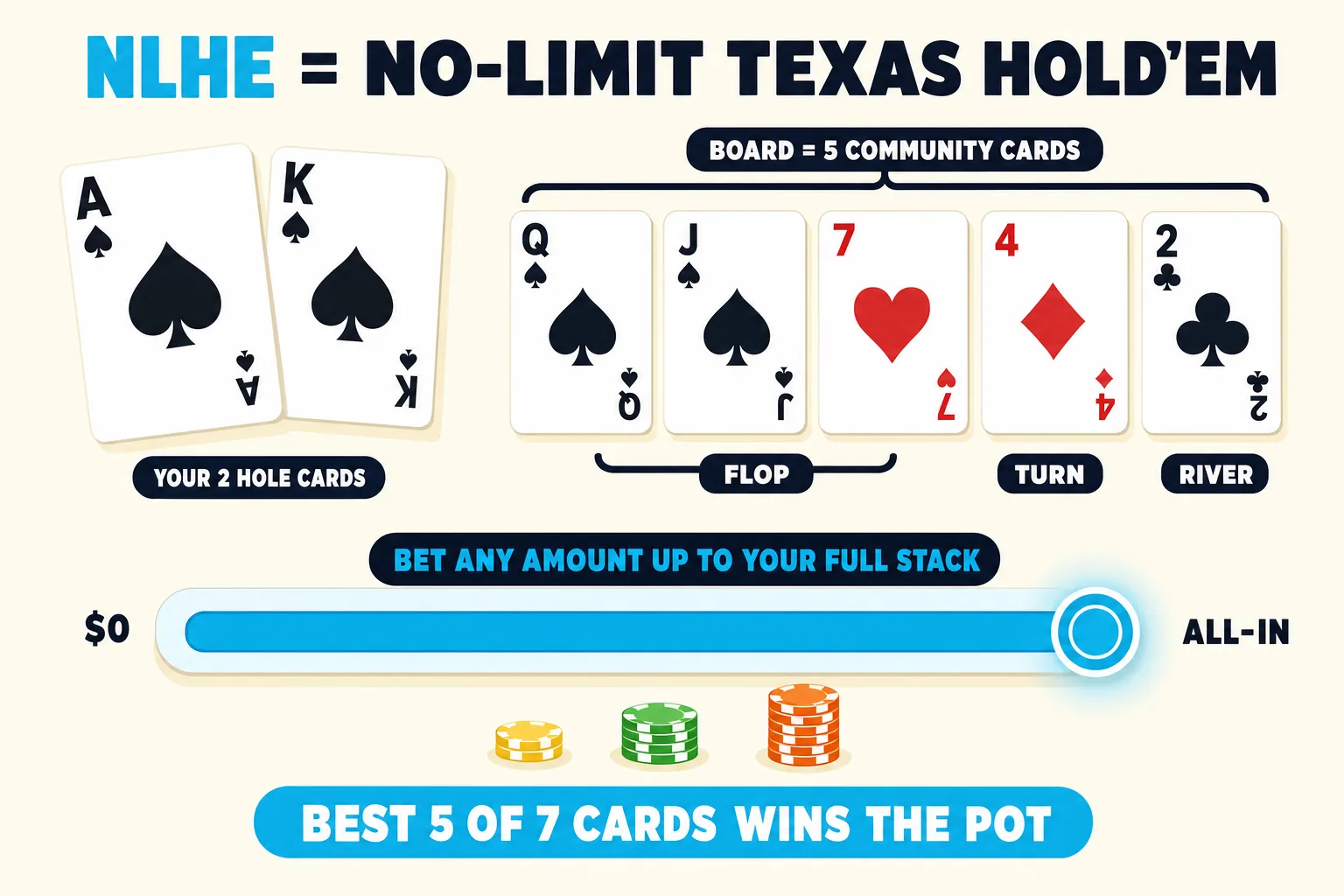
NLHE is the standard short for No-Limit Texas Hold’em. The dealer gives every player two private hole cards, then over four betting rounds reveals five shared community cards on the board: a three-card flop, a one-card turn and a one-card river. At showdown, the player who can build the best five-card hand from any combination of those seven cards wins the pot. The “no-limit” half of the name describes the betting structure, not the cards: on any street, any player can bet anything from the table minimum up to their entire stack.
The four pillars of the format:
- Two private cards. Each player is dealt two face-down hole cards that no one else sees until showdown.
- Five shared cards. The flop (three cards), turn (one card) and river (one card) sit face-up in the middle of the table. Every player still in the hand uses the same board.
- Best five wins. Each player picks the strongest five-card combination from the seven cards available: both hole cards, one of them or even none if the board itself is the best hand. Compare those five-card hands by the standard hand rankings ladder.
- No-limit stakes. On preflop, flop, turn or river, you can bet anywhere from the minimum bet up to all the chips in front of you. There is no cap on a single bet other than your own stack, and there is no cap on the number of raises.
NLHE vs. PLO and limit hold’em
Three games share the same family but feel very different at the table.
| Variant | Hole cards | Betting cap on a single bet | Where you’ll meet it |
|---|---|---|---|
| NLHE (No-Limit Texas Hold’em) | 2 | Your entire stack | Default cash and tournament format almost everywhere |
| Limit Hold’em | 2 | A fixed amount tied to the stake (e.g. $4 on the turn of a $2/$4 game) | Older mixed-game rotations, low-stakes live rooms |
| PLO (Pot-Limit Omaha) | 4 | The current size of the pot | Cash and tournament tables built around four-card poker |
Two of those rows share the cards (NLHE and Limit Hold’em are both Texas Hold’em: same two hole cards, same five community cards). The thing that splits them is the betting structure: limit’s bets are fixed by the stake, no-limit’s are capped only by your stack. PLO swaps both axes: four hole cards instead of two and a pot-limit cap instead of no-limit.
That is why most modern study material picks NLHE as the default. Unrestricted bet sizing turns choices like “how much to bet” and “should I overbet here” into real strategic questions. Limit-style fixed sizes collapse those questions into “bet or check, raise or call.” NLHE’s wider decision space is what made it the natural focus once televised tournaments and online cash games pushed the format mainstream.
Why Poker Skill uses 6-max NLHE cash at 100bb
When a Poker Skill lesson sets up a hand, it deals No-Limit Texas Hold’em at a six-seat cash game table, and every preflop lesson puts each player 100 big blinds deep. The choice follows the format the modern cash-game corpus is written around.
- NLHE is the variant the strategy library has consolidated on. Almost every preflop chart, postflop solver output and bet-sizing heuristic in print assumes no-limit hold’em unless it explicitly says otherwise.
- 6-max is the dominant short-handed online format. Six seats keep more pots two-way and push more decisions into position.
- Cash, 100bb deep is the default training depth. Books and lessons routinely assume “Hero is 100bb deep with all players unless stated otherwise.” Strategies for opening sizes, 3-bet sizing, postflop continuation and river decisions are all calibrated to that depth.
When a chart says “open to 2.5bb on the button,” it is implicitly saying “in NLHE, 6-max, 100bb deep, in a cash game.” Naming the format up front is what lets you transfer the chart to your own table without translating a tournament, a limit game or a deep-stack live cash session into the same language.
Example: a single NLHE hand from preflop to river
You sit down at a $1/$2 NLHE 6-max cash table with $200 in front of you. That puts you at 100bb. The dealer slides you A♠ K♠ as your two hole cards.
The cutoff opens to $6. You are on the button and 3-bet to $20. The blinds fold; the cutoff calls. Pot is $43, both stacks have $180 behind. Right there, two NLHE invariants are already in play: each of you is using two private hole cards, and the bet you just made was a free choice between the table minimum and your full stack.
The flop comes Q♠ J♠ 7♥. Three community cards, face-up, shared with the cutoff. You have ace-high with a flush draw and a gutshot to the nut straight, which means there is a card on the turn that gives you the best possible hand. The cutoff checks. You bet $25. Cutoff calls. Pot is $93.
The turn is the 4♦. Cutoff checks. You barrel for $55. Cutoff calls. Pot is $203.
The river is the 2♣. Cutoff checks. The board is now Q♠ J♠ 7♥ 4♦ 2♣. You did not improve. The no-limit structure still lets you pick any size up to your remaining $100 stack. You go all-in for $100, representing a set or two pair. The cutoff folds, and you scoop the pot.
That hand used every NLHE invariant: two private hole cards, five shared community cards, the best-five-of-seven rule (the cutoff would have shown down their hand against your ace-high if they had called) and a betting structure that lets you put your full stack in on any street. Most other variants change at least one of those four.
Common mistakes when learning NLHE
The format-confusion mistakes show up the most when a player crosses over from a different game.
1) Treating “no-limit” as “always shove”
The “no-limit” in NLHE describes a cap, not a recommendation. The cap on any single bet is your stack; it is not a target. Sound NLHE has small bets, medium bets and overbets in the same hand, sized to the spot. A player who reads “no-limit” and decides to push all-in every flop turns a multi-street game into a one-street game and gives up most of the format’s edge.
2) Confusing NLHE with PLO mid-session
NLHE deals two hole cards. PLO deals four. The hand-strength math, the equity distributions and the way ranges interact with boards all shift hard between two-card poker and four-card poker. Mixing them up, whether by assuming PLO-style nut hand frequencies in NLHE or NLHE-style draw odds in PLO, is one of the fastest ways to misprice a hand.
3) Carrying limit-hold’em sizing into a no-limit table
In limit hold’em, every bet on a given street is a fixed dollar amount tied to the stake. In NLHE, the right size depends on the pot, the stack, the board and your range. Players coming from limit often default to one bet size (often a small one) for everything, which lets opponents see cheap turns and rivers and quietly bleeds chips back across a session.
The fix has a name in Poker Skill’s Value Betting lesson, “Charge the Draws,” where K♣ K♦ bets on Q♣ J♣ 4♦ so the flush and straight draws pay to see the turn.
4) Ignoring stack depth on bet sizing
NLHE strategy is written in big blinds and almost always assumes 100bb. The same preflop hand can be a clear fold at 100bb and a profitable shove at 12bb. The same flop bet that is “small” with a deep cash stack can be “all-in or fold” with a short tournament stack. The format is no-limit, but the right size is anything but arbitrary.
FAQ
What does NLHE stand for?
NLHE is short for No-Limit Texas Hold’em. “No-limit” describes the betting structure: any bet can be sized up to your full stack. “Texas Hold’em” describes the cards: two private hole cards per player and five shared community cards on the board.
Is NLHE the same as Texas Hold’em?
NLHE is one specific betting structure for Texas Hold’em. The cards in NLHE and limit Texas Hold’em are identical: two private hole cards and five community cards across the flop, turn and river. The difference is the cap on a single bet. In NLHE, the cap is your stack. In limit hold’em, the cap is a fixed amount tied to the stake. When most modern players or books say “Texas Hold’em” without qualifying it, they almost always mean NLHE.
Why is NLHE the default in poker training material?
NLHE has more strategic depth than fixed-limit hold’em because every bet size is a real choice. That is why preflop charts, solver outputs and bet-sizing heuristics tend to be written around it. The format also became the standard tournament and online cash variant, and the modern study library formed around it. Together that is enough for “the default” to settle on NLHE, and for Poker Skill’s lessons to assume it unless they call out a different format.