


Hand Rankings
Hand rankings determine who wins each pot by identifying the best five-card hand. In No-Limit Texas Hold'em, you receive two private cards (hole cards) and five shared community cards. Each player makes their best five-card hand from those seven cards.
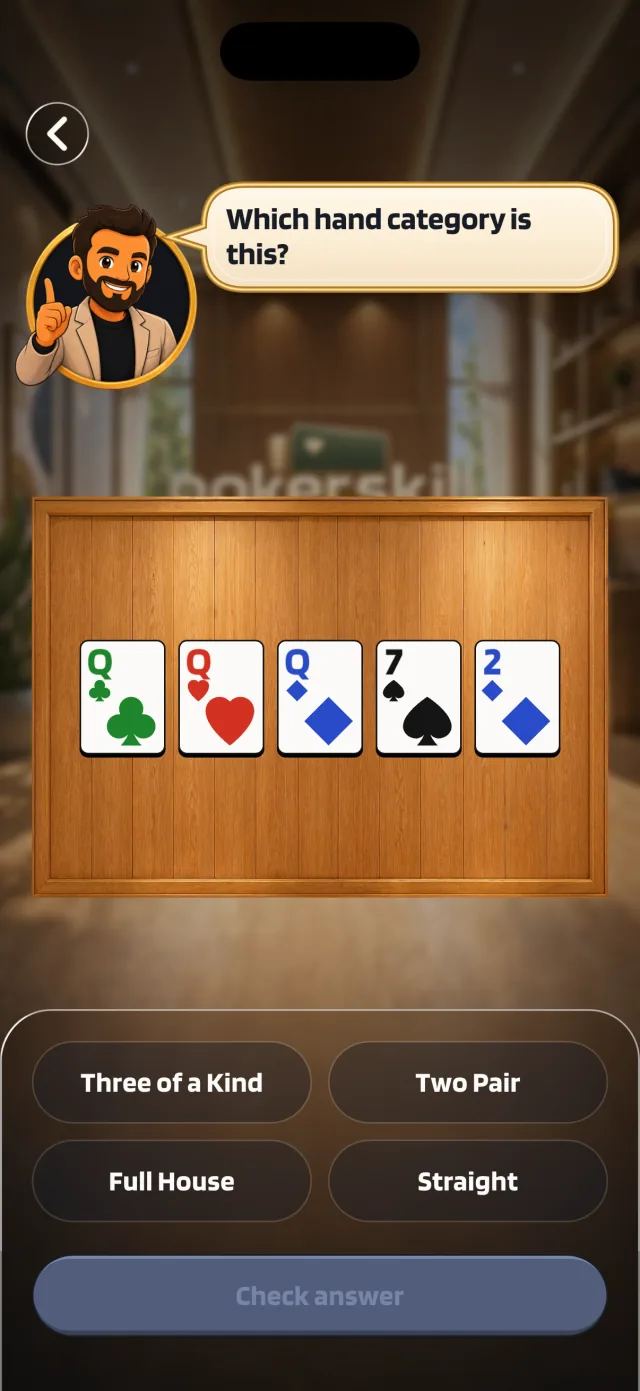
Practice this in Poker Skill. Three of a kind has two names, and the Two Pair vs Three of a Kind (Set vs Trips) lesson sorts them: Q♦ Q♣ in your hand with the Q♠ on the board is a set, and a single queen in hand with two on the board is trips.
Get the free appPoker Hand Rankings in No-Limit Texas Hold’em
Why hand rankings matter
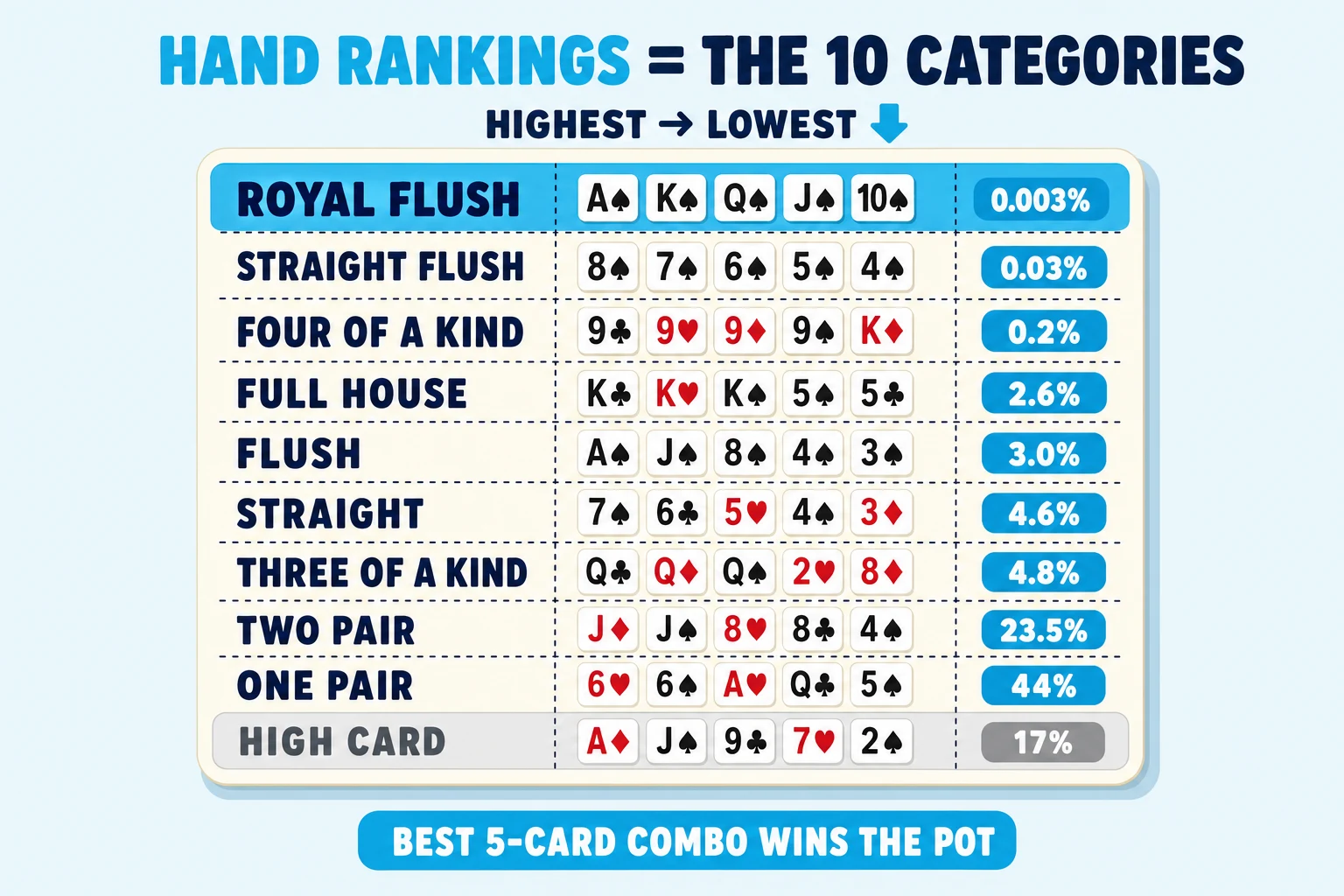
Each player’s best five cards fall into one of ten categories, and a higher category wins the pot whatever the cards in a lower one: the lowest two pair beats a pair of aces.
Quick steps to determine a winner:
- Use any combination of your two hole cards and the five community cards to make the best five-card hand.
- Compare hand ranks, from royal flush down to high card, to decide the winner.
- If players share the same rank, compare the individual card values and kickers to break ties. If the five-card hands are identical, split the pot evenly among winners.
No-limit betting makes hand value affect decisions to bet, call, raise or fold. Strong hands extract value, while weak hands avoid committing large stacks.
For a deeper chart with odds, tie-break examples and sample showdowns, read the poker hand rankings chart.
Top hands: Royal Flush and Straight Flush
A Royal Flush is the best hand: Ace-King-Queen-Jack-Ten of the same suit. Example: A♥ K♥ Q♥ J♥ 10♥. It is extremely rare (about 0.003%) and unbeatable.
A Straight Flush is five consecutive cards of the same suit, for example 8♠ 7♠ 6♠ 5♠ 4♠. Only a higher straight flush or a royal flush beats a straight flush. Straight flushes are very rare (around 0.03%) and rank among the most powerful hands.
Big hands: Four of a Kind and Full House
Four of a Kind, or quads, is four cards of the same rank. Example: 9♣ 9♥ 9♦ 9♠ K♦. Quads usually dominate; only higher quads, a straight flush or a royal flush beat them.
A Full House combines three of one rank and two of another. Example: K♣ K♥ K♠ 5♠ 5♣. Full houses beat straights and flushes but lose to four of a kind and to any straight flush. When comparing full houses, the three-of-a-kind part decides the winner.
Mid hands: Flush and Straight
A Flush is five cards of the same suit that are not consecutive. Example: A♠ J♠ 8♠ 4♠ 3♠. Suits carry no inherent rank; compare the highest cards in each five-card flush to break ties.
A Straight is five consecutive ranks regardless of suit. Example: 7♠ 6♣ 5♥ 4♠ 3♦. A straight ranks below a flush. When two straights meet, the higher top card determines the winner.
Straights and flushes each turn up in a few percent of seven-card hands, often enough that knowing which beats which matters when you commit chips.
Common hands: Three of a Kind, Two Pair, One Pair, High Card
Three of a Kind contains three cards of the same rank. Example: Q♣ Q♦ Q♠ 2♥ 8♦. Trips beat all two-pair hands and lower.
Two Pair has two cards of one rank and two of another, plus a fifth card. Example: J♦ J♠ 8♥ 8♣ 4♠. One Pair holds two cards of the same rank and three unrelated kickers. Example: 6♥ 6♠ A♥ Q♣ 5♠. Both beat high card but lose to trips and higher hands.
High Card wins when no other combination forms; the highest card decides. Example: A♦ J♠ 9♣ 7♥ 2♠.
Memorize the ten ranks, from Royal Flush down to High Card. Always make the best five-card hand from your hole cards and the community cards. Suits do not break ties; compare hand ranks and card values instead. Remember royal and straight flushes are extremely rare, but they dominate when they appear.