


Hand Label
Shorthand names for starting hands like Pocket Aces (AA), Big Slick (AK), and Pocket Tens (TT). Labels speed table talk, hand reviews, and range discussion.
Practice this in Poker Skill. The feedback in the preflop lessons uses this shorthand, calling AKs a strong value 3-bet from the big blind against a wide button open and K4o too weak to defend.
Get the free appHand Label
What a “Hand” Means in No-Limit Texas Hold’em A “hand” in No-Limit Texas Hold’em is the set of cards that determine a player’s result in a single deal. Each player receives two private hole cards, and five community cards are dealt face up on the board. A player’s best five-card poker hand comes from combining any of their hole cards with the community cards. Standard poker rankings determine the winner at showdown: royal flush down to high card. Knowing a hand equals hole cards plus community cards underpins starting-hand and made-hand labels. This applies to postflop stages: flop, turn, and river.
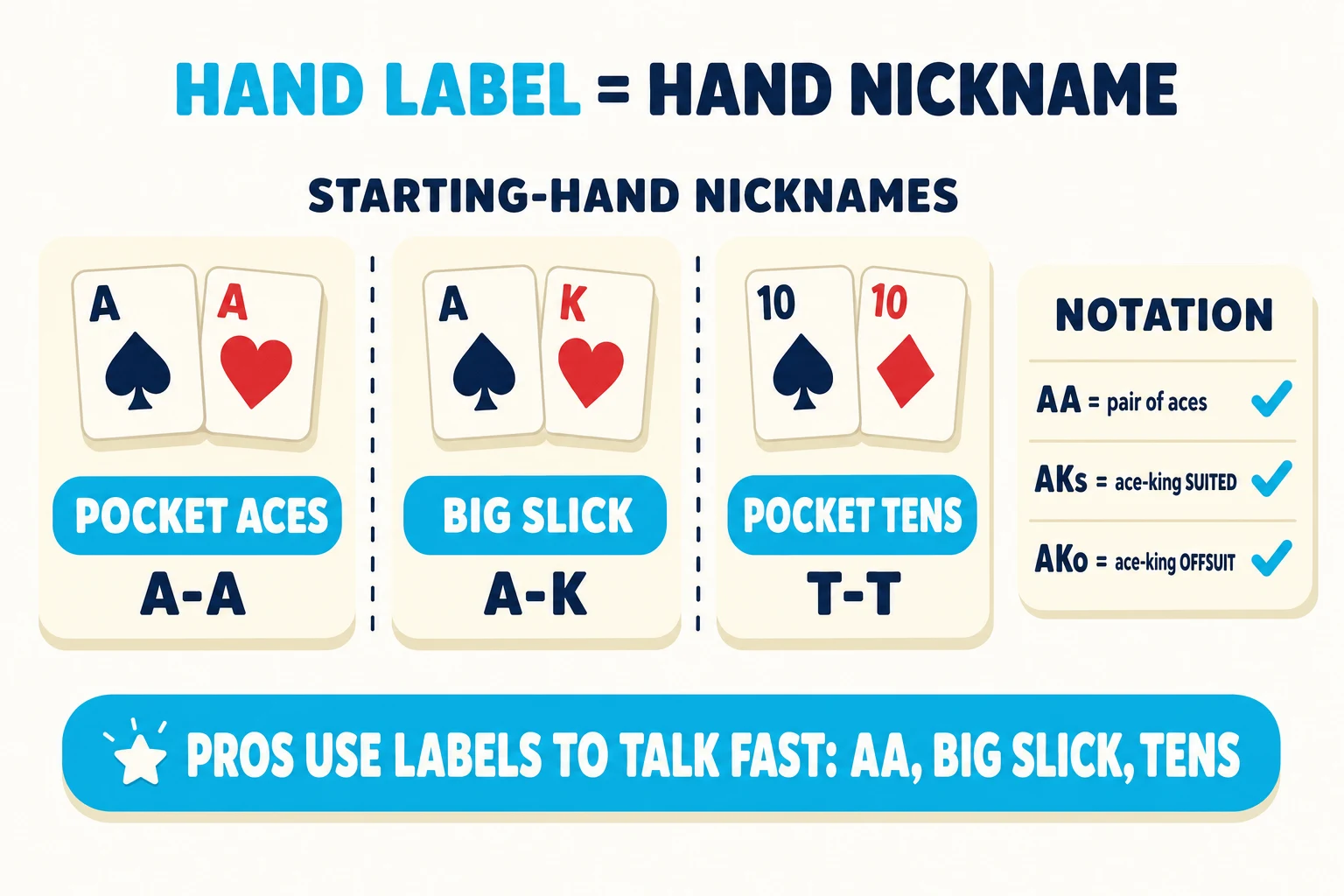
Common Starting Hand Labels and Notation Players use short names to describe starting hands, keeping discussion fast and consistent.
- Pocket Aces - written A-A: A pair of aces in your hole cards and the strongest starting hand.
- Big Slick - written A-K: An Ace and a King in your hole cards, commonly called Big Slick.
- Pocket Tens - written 10-10 or T-T: A pair of tens in your hole cards, often called Tens.
Notation: pairs use X-X (A-A, 10-10); combos like A-K may show suited (A-Ks) or offsuit (A-Ko).
How Labels Communicate Strength and Playing Tendencies Labels summarize baseline strength and indicate typical play patterns. Saying “I had Pocket Aces” signals a top-tier starting hand and often aggressive preflop and postflop play. Saying “I had Big Slick” signals a premium Broadway combo with strong showdown potential but dependent on the board. Labels set expectations and simplify communication among players. Hearing “Tens” tells partners you began with a medium pair and suggests cautious lines when facing overcards. Labels do not replace strategy; they provide a useful shorthand for common lines and goals.
Using Hand Labels in Live Play, Online, and Analysis In live games and online chat, labels speed communication; players say “A-A” or “Big Slick” instead of describing cards. In hand reviews and coaching, labels shorten discussions and keep focus on lines rather than card-by-card detail. Analysis tools and simulators use these same labels to evaluate ranges and equity. A Hold’em Hand Analyzer lists hands like A-A, A-K, and 10-10 when computing equities against ranges.
Practical Steps for Using Hand Labels
- Memorize core labels and notation, starting with A-A, A-K, and 10-10 plus their names.
- Use labels in conversation; when reviewing hands, say “Pocket Aces” or “Big Slick” to stay clear.
- Apply labels consistently in study: tag hands in your database or analysis software to speed pattern recognition.
Quick checklist
- Understand a hand equals hole cards plus community cards, ranked by standard poker hand rankings.
- Memorize key labels: Pocket Aces (A-A), Big Slick (A-K), Pocket Tens (10-10).
- Use labels for communication, strategy discussion, and analysis with tools like Hold’em Hand Analyzer.