


Hand Class
Classifying starting hands shapes both pre-flop (before community cards) and post-flop (after the flop) decisions. Hand classes tell you which holdings to open, call, 3-bet (re-raise) or fold before the flop. They also guide post-flop planning because classes differ in draw potential and showdown value: some win unimproved, others must improve to prevail.
Practice this in Poker Skill. In the preflop lessons, class and seat decide together: A♣ 5♣, a suited ace, raises first in from the hijack, while A♠ 2♥, an offsuit ace, folds there.
Get the free appHand Class
Why hand classes matter
Classifying starting hands shapes both pre-flop (before community cards) and post-flop (after the flop) decisions. Hand classes tell you which holdings to open, call, 3-bet (re-raise) or fold before the flop. They also guide post-flop planning because classes differ in draw potential and showdown value: some win unimproved, others must improve to prevail.
Example: with A♠A♦ you’ll raise and build the pot; with 7♠-8♠ you’ll play more cautiously pre-flop and seek multi-way spots for straights or flushes.
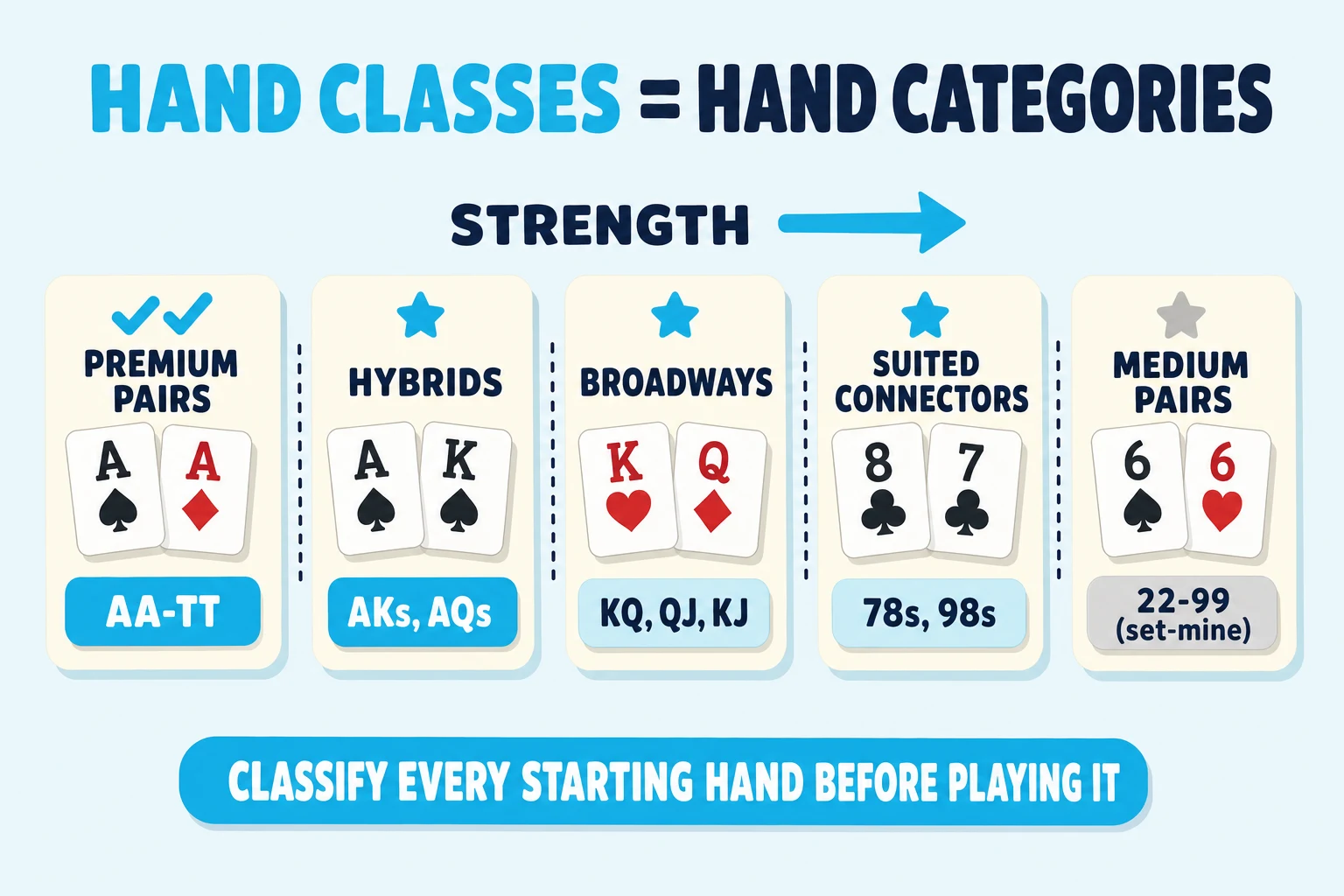
Power hands (premium pairs: A-A through 10-10)
Premium pairs are A-A, K-K, Q-Q, J-J and T-T. These hands often win without improvement and carry large equity against typical ranges. Play them aggressively: open-raise from most positions and 3-bet to isolate opponents. Facing a 3-bet with Q-Q, choose a 4-bet or a flat call based on stacks and opponent tendencies, but favor aggression to extract value. Even when opposed, premium pairs usually fare well when played strongly pre-flop.
Example: you open to 3x with K♦K♣ from the cutoff; a caller and a small blind shove may still be worth calling depending on stack sizes.
Suited hands and suited connectors
Suited hands share a suit; suited connectors are consecutive suited ranks (e.g., 7♠-8♠). These hands gain value from flush and straight potential and perform better in multi-way pots where hidden equity matters. Use them for deception and board coverage-backdoor flushes and straights can win big pots against single overcards. Prefer these hands in late position where you can see more action and enter multi-way pots.
Example: with 9♥-8♥ in late position, calling a limp into a multi-way pot is reasonable because straights and flushes provide strong implied odds.
Broadway cards and hybrid hands
Broadway cards are T, J, Q, K and A. They often make top pair or other strong post-flop hands. Offsuit Broadways still form strong pairs but lack flush potential versus suited Broadways. Hybrid hands-big suited combos like A-K suited, K-Q suited, and big pairs-combine raw pre-flop strength with extra draw potential. Play hybrids aggressively pre-flop and exploit both top-pair possibilities and flush/straight chances post-flop.
Example: A♣K♣ (A-K suited) is a hybrid-raise for value pre-flop and pursue top-pair or flush opportunities post-flop.
Small & medium pairs and unsuited hands
Small and medium pairs (3-3 through 9-9) are mainly set-mining hands: you want to flop a set. They’re valuable when implied odds justify calling into multi-way pots; in short-handed play they lose relative value unless used aggressively. Unsuited hands (different suits) are generally less favorable than suited equivalents because they cannot make a flush. Fold offsuit holdings more often unless they include Broadway cards or pair potential.
Example: 6♦-6♣ is worth calling a small raise in a deep multi-way pot for set-mining, but becomes marginal as stacks and players shrink.
Applying hand classes to no-limit strategy
Combine hand classes with position, stack depth and opponent tendencies.
- Position: Tighten early-favor power and hybrid hands; widen late-add suited connectors and suited Broadways.
- Stack depth: Deep stacks favor suited connectors and set-mining; shallow stacks favor premium pairs and Broadways that realize equity immediately.
- Opponents: Against callers, exploit with aggression using power hands; versus loose, unpredictable players, use suited connectors and deception to extract bigger pots.
Example: in late position with deep stacks, open a wider range including 7♠-8♠. With 40 big blinds and a raise in front, prefer A-K or a premium pair for a 3-bet.
Quick checklist
- Know definitions and typical equities of each class (power, suited, Broadway, small pairs, unsuited).
- Prioritize power and hybrid hands for early-position aggression.
- Open suited connectors and suited Broadways more in late position and multi-way pots.
- Set-mine small/medium pairs only with sufficient implied odds.
- Prefer suited over offsuit when all else is equal.