


Nut Draw
A nut draw is a draw to the best possible version of a made hand on the current board, most often the ace-high flush draw on a two-tone flop. Clean outs, smaller reverse-implied-odds risk, and stronger semi-bluff potential than weaker draws.

Practice this in Poker Skill. The draw review capstone asks whether a flush draw is still the nut draw on a paired board, where a club completes your flush but a full house is still possible, so those outs count as dirty.
Get the free appNut Draw in No-Limit Texas Hold’em
A nut draw is a draw to the best possible version of a made hand on the current board. The most common example is the ace-high flush draw on a two-tone flop: if a third card of that suit hits, no opponent can have a higher flush. The same idea applies to nut straight draws and to nut combo draws that include a nut component.
Nut draws matter because the outs do not just count, they actually win when they hit. A weaker draw can complete and still leave you second-best. The nut version sidesteps that problem and changes how the hand should play on every street.
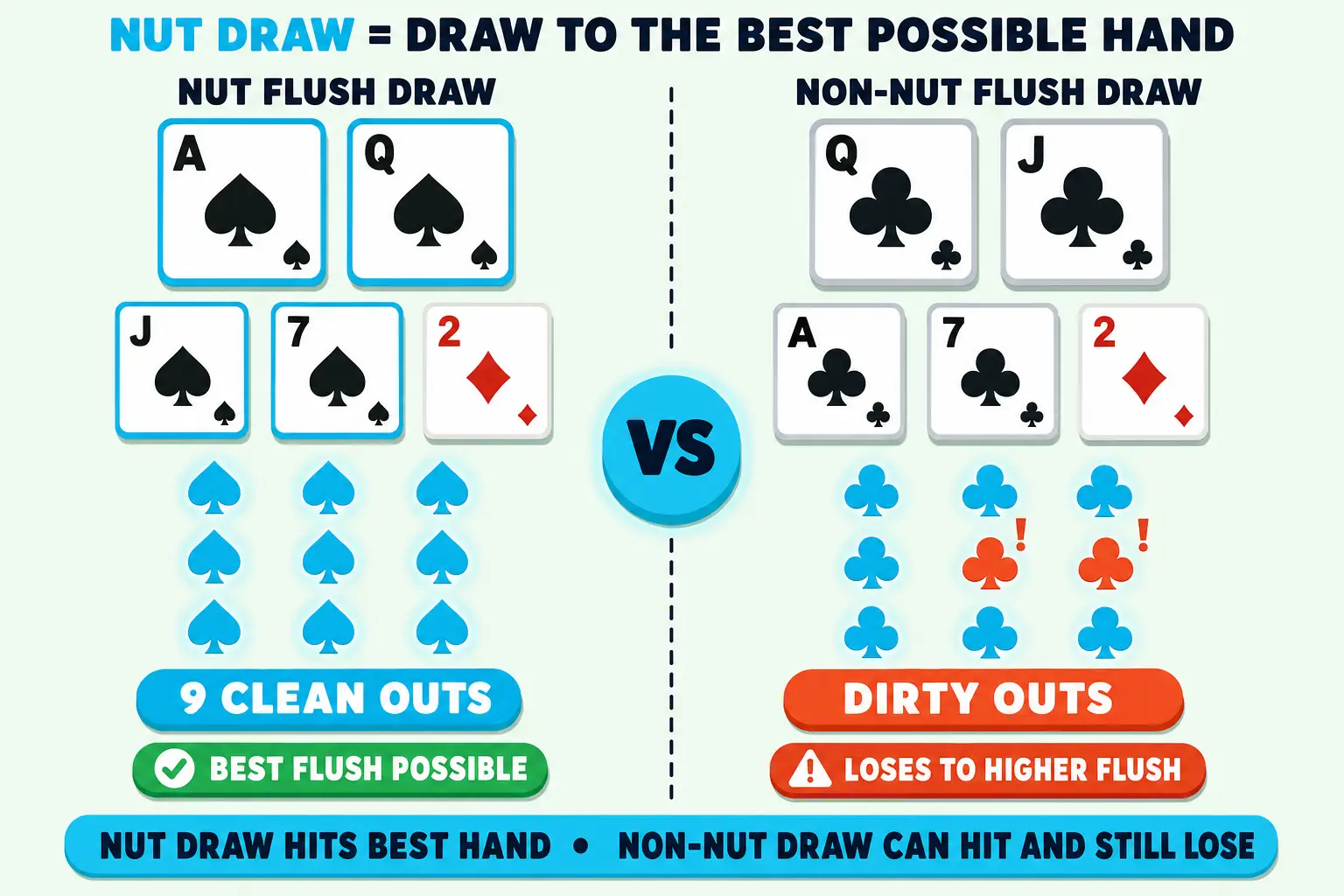
What makes a draw a nut draw
A draw is “the nuts” when the made hand it completes cannot be beaten on the current board. The qualifier on the current board is load-bearing. A board that pairs later, or that runs out a fourth card of the same suit, can change which draw is actually the nuts.
Three common shapes:
- Nut flush draw. You hold the highest unaccounted-for card of the flush suit. Example: A♠Q♠ on J♠7♠2♦. No opponent can hold a higher spade flush.
- Nut straight draw. Your draw makes the highest possible straight on the board. Example: KQ on a JT2 rainbow flop, where any 9 or A makes the nut straight.
- Nut combo draw. A draw that bundles a nut flush draw with a straight draw, like A♥T♥ on Q♥J♥2♣. Hitting either component usually still leaves you ahead.
Compare with a draw that completes to a non-nut version. With Q♣J♣ on A♣7♣2♦ you have a flush draw, but a player with K♣x♣ has a higher draw to the same suit. Some of your apparent flush outs are partly dirty outs: they improve your hand, then still lose.
Why nut draws play differently from weaker draws
Three things separate a nut draw from a non-nut draw:
- Outs are usually clean. When the nut flush draw hits, no higher flush exists. Your clean outs count closer to the raw 9, instead of getting discounted for the times a higher flush is possible.
- Reverse implied odds shrink. A weaker flush draw can hit and still pay off a bigger flush. The nut version does not have that downside, so calls and raises stretch further.
- Stack depth helps you, not the opponent. Deep stacks raise the value of implied odds when you make the best hand. With a non-nut draw, the same stack depth raises your downside instead.
Combined, those three reasons make nut draws stronger candidates for semi-bluffs, more credible cold calls in position, and stronger raises against a flop continuation bet, provided price, position, and fold equity are still there. A nut draw with no fold equity, no implied odds, and a bad price is still not automatic.
Example: A♠Q♠ vs Q♣J♣ on J♠7♠2♦
Same board (J♠ 7♠ 2♦). Two different draws.
| Hero hand | Draw type | Apparent outs | Equity vs typical top-pair range (illustrative) |
|---|---|---|---|
| A♠Q♠ | Nut flush draw + 2 overcards | 9 spades + about 6 overcard outs | Around 50% from flop to river |
| Q♣J♣ | Pair of jacks, no flush draw | About 5 outs to two pair / trips | Around 30% from flop to river |
The exact numbers depend on the opponent’s range, so treat the percentages as examples rather than universal truths. The point holds either way: A♠Q♠ pairs a clean nut flush draw with two overcards, and the spade that completes its draw cannot be beaten by a higher flush. The hand plays as a flop raise against a small continuation bet, a turn semi-bluff, or a call when the price is right.
Now compare to a non-nut version on the same board. Hold Q♣J♣ and you have top pair, decent kicker, and no flush draw. The relative strength can collapse the moment a third club lands, because Q♣J♣ blocks one club and never makes the flush itself. A♠Q♠ (nut draw) and Q♣J♣ (made hand without a draw) look similar on the flop, then play nothing alike from the turn onward.
What still has to be true
A nut draw is not a license to put chips in. Three things still need to line up:
- Price. Compare your hit chance to pot odds. A 35%-equity nut draw still folds against a bet that demands 50% equity, unless implied or fold equity makes up the gap.
- Position. Acting last lets you realize equity, control pot size, and pick the right semi-bluff streets. Out of position, even a nut draw under-realizes its raw equity.
- Fold equity. A semi-bluff works when the bet wins the pot at least some of the time right now. Against a sticky opponent with no folds in their range, the same nut draw plays better as a call than a raise.
Skip any one of those and the “nut” label can lull you into a marginal play.
Common mistakes with nut draws
1. Treating every ace-high flush draw as a nut draw
On a paired board, the nut flush can lose to a full house. Your draw is only the nuts if no better made hand is reachable on the current board.
2. Slow-playing the nut flush draw out of position
A check-call line gives up fold equity and lets the opponent control the pot. Nut draws benefit most from raising on the right boards, not from passive defense.
3. Ignoring the straight half of a combo nut draw
A♥T♥ on Q♥J♥2♣ has a nut flush draw and a gutshot to the nut straight. Counting only the flush outs understates the hand.
4. Assuming nut draws never face reverse implied odds
A nut flush draw on a board that can pair still has the runner-runner full-house problem against a set. The downside is smaller, not zero.
5. Forgetting blockers
Holding the A♠ on a two-spade flop also blocks the opponent’s nut flush draws. That matters for how often a bluff or semi-bluff folds the field.
FAQ
What is a nut draw in poker?
A nut draw is any draw that completes to the best possible made hand on the current board. The most common version is the nut flush draw: an ace-high suited holding on a two-tone flop where no higher flush is possible.
Is a nut draw the same as a nut flush draw?
No. Nut flush draws are the most familiar example, but nut straight draws and nut combo draws also exist. The shared feature is that completing the draw makes the best possible version of that hand on the current board.
How is a nut draw different from a weaker flush draw?
A nut draw has clean outs: when it hits, it almost always wins. A weaker flush draw can hit and still lose to a higher flush, the textbook reverse implied odds problem.
Should you always semi-bluff with a nut draw?
No. A semi-bluff still needs price, position, and fold equity. Against a sticky opponent with very few folds in their range, a nut draw often plays better as a call that aims to realize equity than as a raise.
Final takeaway
“Nut draw” is shorthand for two related ideas: the outs on this draw are clean, and the downside when it hits is small. That makes nut draws stronger continuing hands and stronger semi-bluff candidates than weaker drawing equivalents. The usual checks still apply: count outs, compare to pot odds, factor implied and reverse implied odds, and ask whether position and fold equity make aggression the right play.