


Nut Flush Draw
A nut flush draw is a flush draw that makes the highest possible flush on the current board if the suited card arrives. Almost always an ace-high suited holding on a two-tone or one-tone board, with clean outs and small reverse-implied-odds risk.

Practice this in Poker Skill. On a two-club board, the Nut Flushes & Monotone Boards lesson marks ace-five of clubs as the nut flush draw and ace-queen with a single club as only a backdoor.
Get the free appNut Flush Draw in No-Limit Texas Hold’em
A nut flush draw is a flush draw that, if the suited card arrives, makes the highest possible flush on the current board. In practice that almost always means holding the ace of the draw suit as one of your hole cards, with a second card of that suit, and seeing two more of the suit on the board.
Looking for the made hand rather than the draw? That page is the nut flush. And if you are still on the basics, start with the flush in poker itself.
This is the flush-specific version of a nut draw. The parent term covers nut straight draws and nut combo draws too; this page is only about the flush half. For the full playbook, made hand and draw together, read the nut flush article.
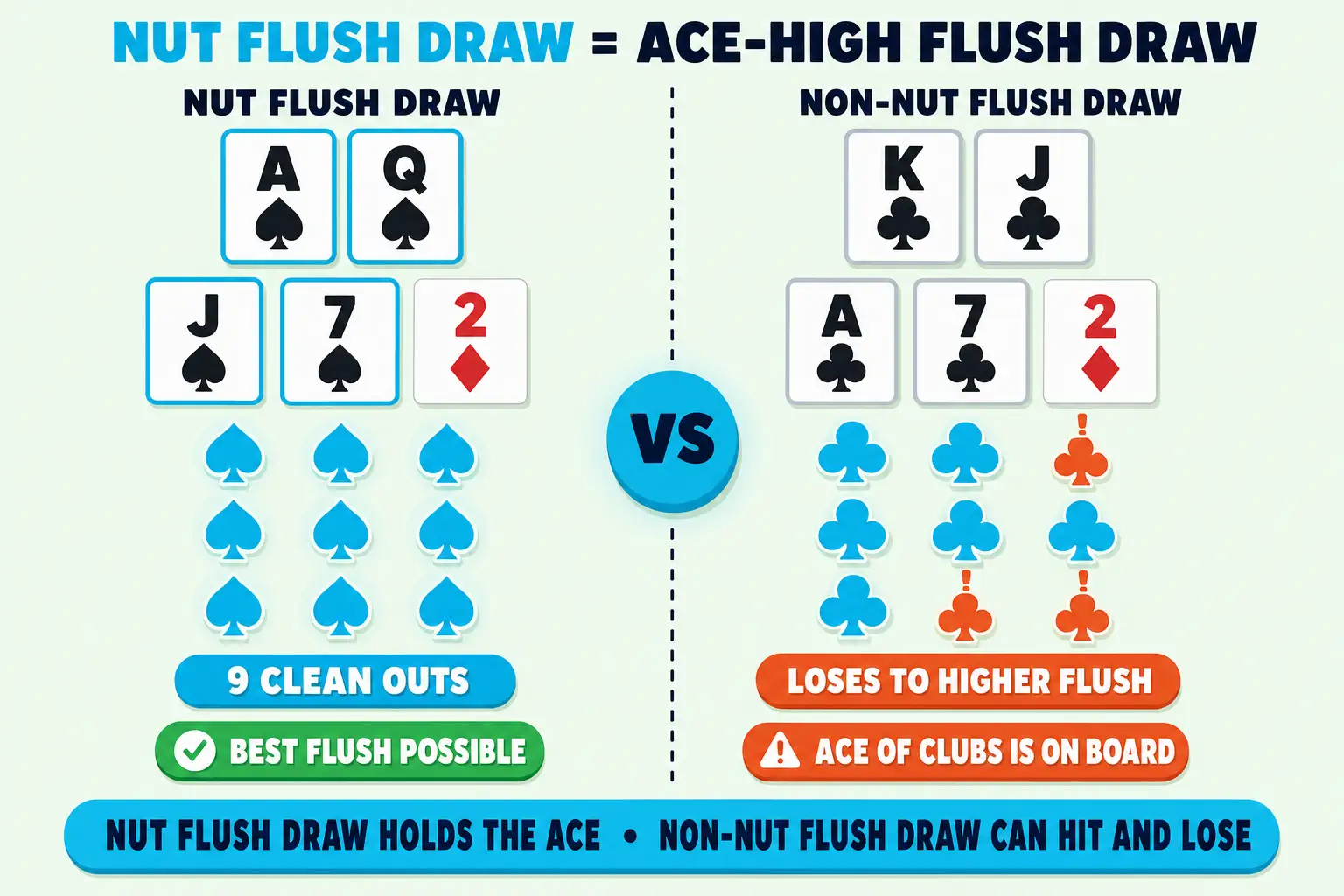
What makes a flush draw the nut flush draw
Three things have to be true at the same time:
- You hold two cards of the draw suit. One in your hand, plus the board, gets you to four of the suit.
- One of your two suited cards is the ace. The ace is the only card that locks out a higher flush of the same suit.
- The board does not already make a stronger hand reachable. A paired flop opens the door to a full house. A monotone flop with a fourth card to come opens the door to a four-flush runout that out-flushes you.
The textbook spot is A♠Q♠ on J♠7♠2♦. You hold the ace of spades, the board has two spades, and no opponent can hold a higher spade flush than yours if the third spade arrives. Compare with K♠Q♠ on the same flop: still a flush draw, still nine apparent outs, but a player with A♠x can already have, or be drawing to, a higher flush. That holding is a strong flush draw, but it is not the nut flush draw.
A side case: on a monotone flop like J♠7♠2♠, holding only the A♠ in hand (with an offsuit second card) is technically the nut flush draw if a fourth spade hits and no opponent already has a higher made flush on the flop. The shape is rarer at the table, and the equity profile is different from the standard two-tone case. Most teaching examples stick to the two-tone version where you hold both an ace and another suited card.
Nut flush draw vs flush draw vs the broader nut draw
These three terms get used loosely. Keeping them separated makes the rest of the page click into place.
- Flush draw: the umbrella term. Four cards of one suit, one more to make the flush, usually 9 outs. Includes both the ace-high version and weaker versions.
- Nut draw: the umbrella term for any draw to the best possible made hand on the current board, including nut straight draws and nut combo draws.
- Nut flush draw: the intersection. A flush draw that is also a nut draw, because it makes the ace-high flush on the current board.
The non-nut flush draw is what most people mean when they warn about chasing flushes. With Q♣J♣ on A♣7♣2♦ you have a flush draw, but the ace of clubs is on the board, and any player holding K♣x already has a higher draw to the same suit. Some of your apparent outs are partly dirty outs: they complete a flush that is still second best.
Why “nut” is board-relative
The “nut” label depends entirely on the current board. The same suited holding can be the nut flush draw on one flop and a non-nut draw on another.
Three runouts shift the picture:
- Paired boards. A♠Q♠ on J♠J♦7♠ still has all the spade flush outs, but the board can complete a full house: any opponent with a jack or with a pocket pair that fills up beats your flush. Your draw is still a flush draw with strong equity, but it is not safely “the nuts” anymore.
- Four-flush runouts. A♠Q♠ on J♠7♠2♦ is the nut flush draw on the flop. If the 2♠ lands on the turn the board now reads J♠7♠2♦2♠. A new fourth-spade situation opens up: if a fifth spade comes on the river, anyone with a single higher spade in their hand makes a higher flush than your queen-high spade flush. The ace still helps as a blocker, but on rivers like that you no longer hold the absolute nuts.
- Straight-flushes. On J♠T♠9♠ you can hold the A♠ and still lose to Q♠8♠ once any spade outside your hand connects to the straight. Rare in practice, real at the math layer.
The takeaway: read the board before you call your draw “the nut flush draw.” Two-tone, non-paired, no straight-flush risk is the clean case. Anything else needs a second look.
Why nut flush draws play differently
Three reasons explain why nut flush draws drive most of the aggressive flush-draw lines you see:
- Clean outs. When the third card of the suit arrives, no higher flush exists. Your nine flush outs count closer to their raw value.
- Small reverse implied odds. A weaker flush draw can hit and still pay off a bigger flush. The nut version sidesteps the dominant version of that downside on most boards.
- Stack depth helps you, not the opponent. Deeper stacks raise the value of the times you make the best hand. With a non-nut draw, the same depth raises your downside.
Combined, those three reasons make nut flush draws better candidates for semi-bluffs, more credible cold calls in position, and stronger flop raises against a continuation bet, when price, position, and fold equity also line up.
Example: A♠Q♠ vs K♣J♣ on similar boards
Same hand category (a flush draw with overcards), different draw quality. Use illustrative numbers; the exact percentages depend on the opponent’s range.
| Hero hand | Board | Draw type | Outs profile | Equity vs typical top-pair range (illustrative) |
|---|---|---|---|---|
| A♠Q♠ | J♠ 7♠ 2♦ | Nut flush draw + two overcards | 9 spades, all clean | Around 50% from flop to river |
| K♣J♣ | A♣ 7♣ 2♦ | Non-nut flush draw + pair of jacks possible on later jacks | 9 clubs, several partly dirty | Around 35% from flop to river |
The percentages are examples rather than universal solver outputs. The point holds either way:
- A♠Q♠ on J♠7♠2♦ is the textbook nut flush draw. Every spade out cleanly wins. The hand can flop-raise against a small continuation bet, turn-barrel as a semi-bluff, or call when the price is right.
- K♣J♣ on A♣7♣2♦ has the same nine raw flush outs, but the ace of clubs is already on the board. Any opponent with a single ace of clubs in their range has the made nut flush draw and is ahead on the flop and ahead on every club river. K♣J♣ should slow down on most lines, especially deep and multiway, and lean on the pair of jacks more than on the flush draw.
The contrast is the lesson. A “9-out flush draw” is not one thing. The nut version is a different hand from the non-nut version even when the raw out count and the surface board are similar.
What still has to be true
A nut flush draw is not a license to put chips in. Three checks still apply:
- Price. Compare your hit chance to pot odds. A nut flush draw with about 35% flop-to-river equity still folds against a bet that demands 50% equity, unless implied or fold equity makes up the gap.
- Position. Acting last lets you realize equity, control pot size, and pick the right semi-bluff streets. Out of position, even a nut flush draw under-realizes its raw equity.
- Fold equity. A semi-bluff works when the bet wins the pot at least some of the time right now. Against a sticky opponent with no folds in their range, the same nut flush draw plays better as a call than a raise.
Skip any one of those and the “nut” label can lull you into a marginal play. This is still the easy version of the hand, though: the gap between strong and weak players shows up on the marginal, non-nut flush draws, where the same three checks get harder to answer. Hunt for those in a poker training app; your own hand histories will supply plenty too.
Common mistakes with nut flush draws
1. Treating every ace-high flush draw as automatically nut
On a paired board, the nut flush can lose to a full house. On a turn that brings a third board card of the suit, your ace-high flush draw is now a single-card draw to a board four-flush, which lets any single higher card of the suit beat you on the river. “Nut” is board-relative, not a property of the hole cards alone.
2. Slow-playing the nut flush draw out of position
A pure check-call line gives up fold equity and lets the opponent control the pot size. Nut flush draws benefit most from raising on the right boards and against the right ranges, not from passive defense.
3. Counting nine clean outs when the board is paired or monotone
A paired flop drops some flush rivers into “you hit, full house wins.” A monotone flop turns the spot into a one-card draw with a different out structure. Both cut into the nine-clean-outs picture and change how the hand should price.
4. Ignoring blockers
Holding the A♠ on a two-spade flop also blocks the opponent’s strongest flush draws. That matters for how often a bluff or semi-bluff folds the field, even when the hand never improves to a flush.
5. Confusing “I have the ace of the suit” with “I have the nut flush draw”
If only one of your two hole cards is suited with the board, you do not have a flush draw. Holding A♠4♣ on J♠7♠2♦ is two cards of different suits; the lone A♠ is a blocker, not a draw.
FAQ
What is the nut flush draw in poker?
A nut flush draw is a flush draw that, if the suited card arrives, makes the highest possible flush on the current board. In the standard case you hold the ace of the draw suit and one other suited card, with two more of the suit on the board.
Is a nut flush draw the same as a flush draw?
No. A flush draw is the umbrella term for any four-card-to-the-flush holding. A nut flush draw is the subset that makes the highest possible flush on the current board. Most flush draws at the table are not nut flush draws.
Does the ace of the suit always give you the nut flush draw?
Not always. Paired boards, monotone boards, and boards that allow a straight flush can shift “the nuts” away from your ace-high flush. The ace gives you the nut flush draw on a clean two-tone, non-paired board with no straight-flush threat.
How is a nut flush draw different from a non-nut flush draw?
A nut flush draw has clean outs: when it hits, it almost always wins. A non-nut flush draw can hit and still lose to a higher flush, the textbook reverse implied odds problem.
Should you always semi-bluff with a nut flush draw?
No. A semi-bluff still needs price, position, and fold equity. Against a sticky opponent with very few folds in their range, a nut flush draw often plays better as a call that aims to realize equity than as a raise.
Final takeaway
“Nut flush draw” is shorthand for two related ideas: the outs on this draw are clean on the current board, and the downside when the third card of the suit hits is small. That makes nut flush draws stronger continuing hands and stronger semi-bluff candidates than the non-nut version. The usual checks still apply: read the board, count outs honestly, compare to pot odds, factor reverse implied odds, and ask whether position and fold equity make aggression the right play.