


Boat
A Boat, slang for Full House, is five cards: three of one rank and two of another. Example: 8-8-8-5-5. You form a Boat using any combination of your two hole cards and the five community cards. Hole cards are private; community cards are the board. Boats are strong and relatively rare compared with pairs, two pair, and trips. When you have a Boat, you are ahead of every single-pair and two-pair holding.
Practice this in Poker Skill. Full houses rank by their trips first, and that settles the Q♦ Q♥ 9♣ 9♠ 2♦ showdown in the pick-the-winner lessons: a player holding a queen makes queens full and beats a player holding a nine, who has nines full.
Get the free appBoat (Full House) in No-Limit Texas Hold’em
Clear definition: what a “Boat” is
A Boat, slang for Full House, is five cards: three of one rank and two of another. Example: 8-8-8-5-5. You form a Boat using any combination of your two hole cards and the five community cards. Hole cards are private; community cards are the board. Boats are strong and relatively rare compared with pairs, two pair, and trips. When you have a Boat, you are ahead of every single-pair and two-pair holding.
Why is a full house called a boat?
Boat and full house are two names for the same hand; older players also say “full boat”. Nobody wrote down where the nickname came from, so every origin story is folklore rather than settled history. The most repeated one traces back to “full boat”, from the riverboat era that spread poker along the Mississippi in the 1800s: a hand holding three of a kind plus a pair was full, no room left to improve, a full boat. In table talk the “full” fell away and the boat stayed. The longer story, plus a drill on which boat beats which, is in why a full house is called a boat.
How Boats are made with hole cards and community cards
You can make a Full House in several common ways. Patterns and examples follow:
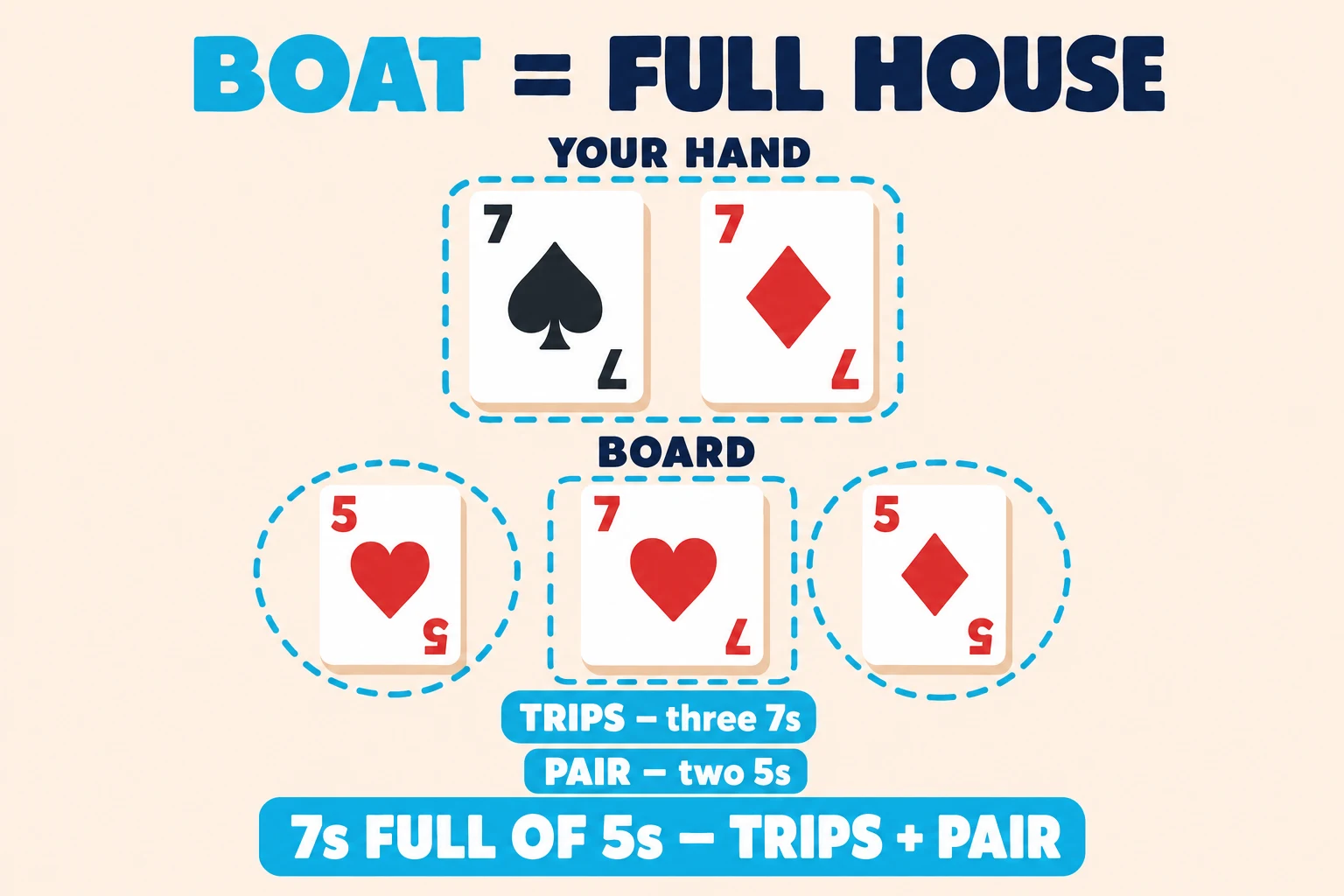
- Pair in hand + trips on the board. Example: You hold 7♠7♦ and the board shows 5♥7♥7♣. Final hand: 7-7-7-5-5 - sevens full of fives.
- Trips in hand + pair on the board. Example: You hold pocket 8-8 and the flop is 8-2-2 - eights full of twos.
- Each hole card contributes on a paired board. Example: You hold 8♠5♠ and the board is 8♥5♥5♦ - fives full of eights.
The five community cards create most Boat opportunities. The flop, turn, or river can turn trips or two pair into a full house.
When the board creates Boats: flop, turn, river timing
Flop (first three community cards): A paired flop, like 6♦6♠K♣, creates full-house possibilities immediately. If you hold a pair or hit trips, the turn or river can complete the Boat.
Turn (fourth card): When the turn pairs the board, it often completes Boats. Example: You hold A-A and the flop is A-7-2; a 7 on the turn gives you aces full of sevens.
River (fifth card): The river can change everything. One river pairing can convert two-pair or trips into different full houses, altering hand strengths before showdown.
Strategic implications: betting, value extraction, and hand perception
A Boat is powerful and usually worth betting for value. Raise or use larger sizes since opponents often call with two pair or trips. The Zeebo theorem takes this one step further: no player folds a full house at any bet size, so when you hold the better boat, size up.
Be cautious: shared community cards let multiple players make full houses. Adjust sizing and your betting narrative accordingly. On heavily paired boards, an opponent may have a higher full house, or the board may provide the winning five cards, creating split pots.
Use board texture and prior betting to decide whether to slow-play (check/call) or build the pot. If action has been light and opponents show two-pair tendencies, focus on extracting value.
Showdown scenarios and ranking between Boats
Compare full houses first by the trips’ rank, then by the pair’s rank. For example, 8-8-8-5-5 beats 5-5-5-8-8 because three eights outrank three fives.
Multiple players can share full houses from the same board. If the board is 8-8-8-5-5, all players use it and split the pot. Review possible full-house combinations on the board and infer opponents’ hole cards from betting.
Quick checklist
- Know the composition: three-of-a-kind plus a pair makes a Boat.
- Track how your hole cards combine with the board on each street.
- Watch for board pairings that create or beat Boats.
- Bet aggressively for value, but respect shared-board threats.
- At showdown, compare the trips’ rank first to determine the winner.