


Range vs Range
Range vs range is the habit of comparing two players' entire hand distributions on a specific board, not your one hand against their one hand. Solvers and modern poker thinking work this way because every action speaks for a whole range, not a single combo. Once you see who is favored on a board, c-bet sizing, bluff frequency, and bluff-catching all change in predictable ways.
Practice this in Poker Skill. Before any c-bet, the Intro to Continuation Betting lesson asks whether the big blind’s calling range connected with the flop, because on a wet board it often won’t fold.
Get the free appRange vs Range in No-Limit Texas Hold’em
Definition: comparing two distributions, not two hands
Range vs range is the habit of comparing two players’ entire hand distributions on a specific board, not your one hand against their one hand. A range is every hand a player can plausibly hold given their actions and position. Range vs range thinking asks a single question: out of every hand I could have, and every hand they could have, who is doing better on this exact board? Your individual hole cards are one combo inside that distribution. The comparison covers all of them at once.
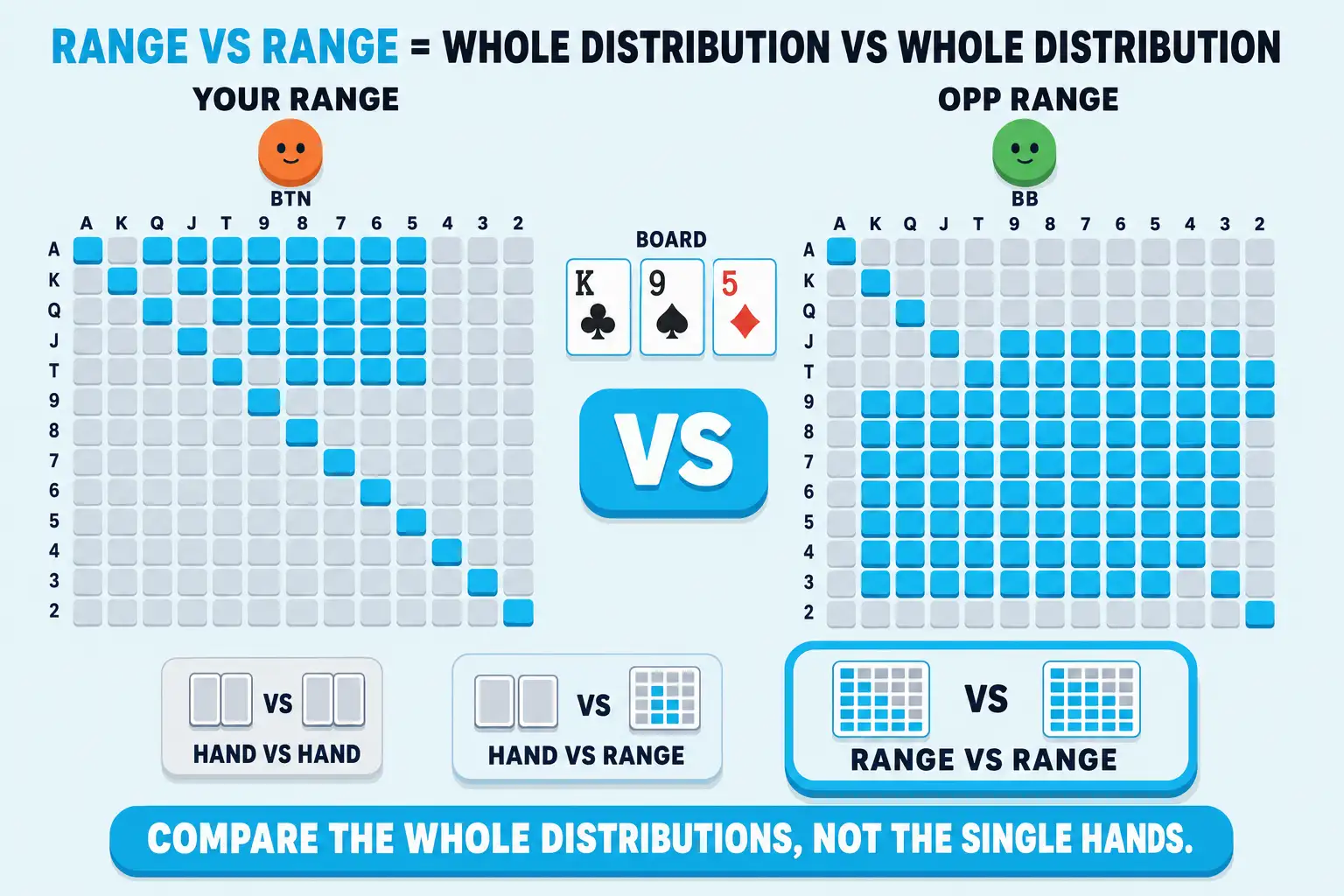
The shortcut: if you are weighing your single hand against an imagined single hand, you are doing hand vs hand. If you are weighing your single hand against the set of hands they can have, you are doing hand vs range. If you are weighing every hand in your range against every hand in their range on this board, you are doing range vs range. Modern poker decisions live at the third level.
Related terms
Hand vs hand, hand vs range, range vs range
The three frames sit on a ladder. Each one keeps the layer below and adds new information.
| Frame | What gets compared | What it answers |
|---|---|---|
| Hand vs hand | Your two cards vs one specific guess | Who wins this exact matchup right now? |
| Hand vs range | Your two cards vs every hand they can have | How often does my hand beat their distribution? |
| Range vs range | Every hand you can have vs every hand they can have | Who is favored on this board with a whole strategy? |
Hand vs hand is what feels natural at the table. It is also the level where most leaks live, because it ignores everything you and your opponent have said with your actions so far. Hand vs range is a real upgrade. It lets you bluff-catch with bottom pair when their bet covers a bunch of busted draws, and fold top pair when their line only makes sense with sets. Range vs range is the next step up. It plans what every hand in your range should do on this exact board, not just the one you happen to be holding. Solvers compute frequencies for you because they think in range vs range first and assign each combo a slice of the strategy second.
Why range vs range matters most
A few spots where the range comparison drives the right action and hand-vs-hand thinking misleads:
- Continuation betting. On a flop like K-7-2 rainbow, a button preflop raiser hits more kings, more overpairs, and more strong ace-high and broadway hands than a big blind caller does. The raiser has range advantage, which means a small c-bet works at high frequency, even with hands that missed.
- Check-raising. On a connected, low flop like 6-5-4, the big blind crushes a tight UTG opener for sets, two pair, and made straights, while UTG has overpairs and not much else. Range vs range flips: the BB can lead or check-raise often, even from out of position.
- River decisions. When a turn or river card hits one range much harder than the other, the favored player can barrel bigger and bluff more credibly, while the unfavored player has to slow down. The comparison is the whole engine.
- Solver study. A solver does not care about the hand you actually hold. It needs both ranges, the board, the stacks, and the bet sizes available. Once it has those, it computes a strategy for every combo in both ranges. That is range vs range, codified.
- Defending versus aggression. If you only ask “do I have it?” you fold too much when their range is mostly bluffs, and call too much when their range is mostly value. Range vs range tells you what the rest of your hand class should do, then you slot your specific combo into that plan.
The simpler version of all of this: every action speaks for a whole range, so every defense should answer for one too.
Example: button vs big blind on K♣ 9♠ 5♦
You raise the button to 2.5bb at 100bb deep. The small blind folds, the big blind calls. The flop is K♣ 9♠ 5♦ rainbow.
Asking the range-vs-range question, not the hand question:
- Whose range fits this flop better? Your button range is broadway-heavy. It keeps hands like AK, KQ, KJs, KTs, AA-QQ, 99, and 55. The BB has real Kx and some sets too, but also a lot of suited connectors, offsuit broadways, and low pairs that miss this dry king-high board.
- Whose range has the strongest hands? You clearly keep the premium overpairs and AK. The BB still has important top-end hands, including 99, 55, and K9s at some frequency, so do not pretend the top of range belongs only to you. The key is that your strong and medium-strength hands are dense enough to pressure many BB holdings.
- What does the comparison say to do? With a clear range advantage and enough top-end strength, you can c-bet at high frequency for a small size, around a third of pot. You bet your strong hands for value, your medium hands for protection, and a chunk of your unpaired hands as cheap pressure. With your specific combo, the action follows from the range plan, not the other way around.
Now switch the flop to 6♥ 5♥ 4♣. Your button range still has overpairs, but the BB’s range smashes this board: 87s, 76s, 65s, 54s, sets of fives, sets of fours, two-pair combos. The BB has nut advantage even though your overall equity is close to a coin flip. The right plan flips with it. You c-bet less often, smaller, and more carefully. The hand you are holding has barely changed; the range comparison did all the work.
Common mistakes
1) Reading one specific hand into your opponent’s whole range
“He’s got AK.” Sometimes he does. Most of the time he has a distribution, and the AK combo is one slice of it. Force yourself to name three or four hand classes their action makes sense with before you decide anything.
2) Forgetting that your own range exists
Range vs range is symmetric. You also have a whole distribution that your opponent is reading. If you only ever c-bet with kings on K-9-5, you have made your checks the weak half of your range. Plan what the rest of your range does in this spot, even when you happen to hold the king.
3) Treating range advantage and nut advantage as the same thing
You can be ahead in overall equity and still have fewer of the very best hands. On A-3-2 two-tone, the preflop raiser has more equity but the caller has more two-pair, sets, and combo draws. Big bets get punished even though your range is “stronger.” Track both axes.
4) Ignoring board texture when the comparison shifts
The comparison is dynamic. The same two preflop ranges produce a totally different range-vs-range picture on a dry king-high flop, a wet middling flop, and a paired ace-high flop. Reset the comparison every time the board changes, not just at the start of the hand.
FAQ
What does “range vs range” actually mean in poker?
It means comparing the full set of hands you can have against the full set of hands your opponent can have on a specific board. Your single hand is one combo inside that comparison. Range vs range thinking asks who is favored across every possible matchup, not just the one you are sitting on.
Why do solvers think in range vs range?
A solver computes a strategy for every hand a player can have at once. It does not know which combo you actually hold. Its inputs are both ranges, the board, the stacks, and the bet sizes available, so the comparison it makes is necessarily range vs range. The output is a frequency for each hand: bet 70% of the time, check 30%, and so on.
Is range vs range the same as range advantage?
No. Range advantage is the result of one specific range vs range comparison: which side has more overall equity on this board. Range vs range is the broader habit, and it covers other things too, like nut advantage, board coverage, and how the comparison shifts on each new card.