


Range Construction
Range construction is the process of deciding which hands belong in each action bucket: bet, raise, call, check, or fold for a given spot. The range is the finished set; construction is how you build it. Preflop you sort by seat, stack depth, and who has opened. Postflop you sort by board texture, who has range advantage, and how value and bluffs balance at each sizing.
Practice this in Poker Skill. The Response to Opens lessons sort hands into those buckets one at a time, as in Button vs CO Open, where suited king-queen 3-bets, suited nine-eight calls and J8 offsuit folds.
Get the free appRange construction in No-Limit Texas Hold’em
What range construction is
Range construction is the process of deciding which hands belong in each action bucket: bet, raise, call, check, or fold for a given spot. The range is the finished set; construction is how you build it. Preflop you sort by seat, stack depth, and who has opened. Postflop you sort by board texture, who has range advantage, and how value and bluffs balance at each sizing.
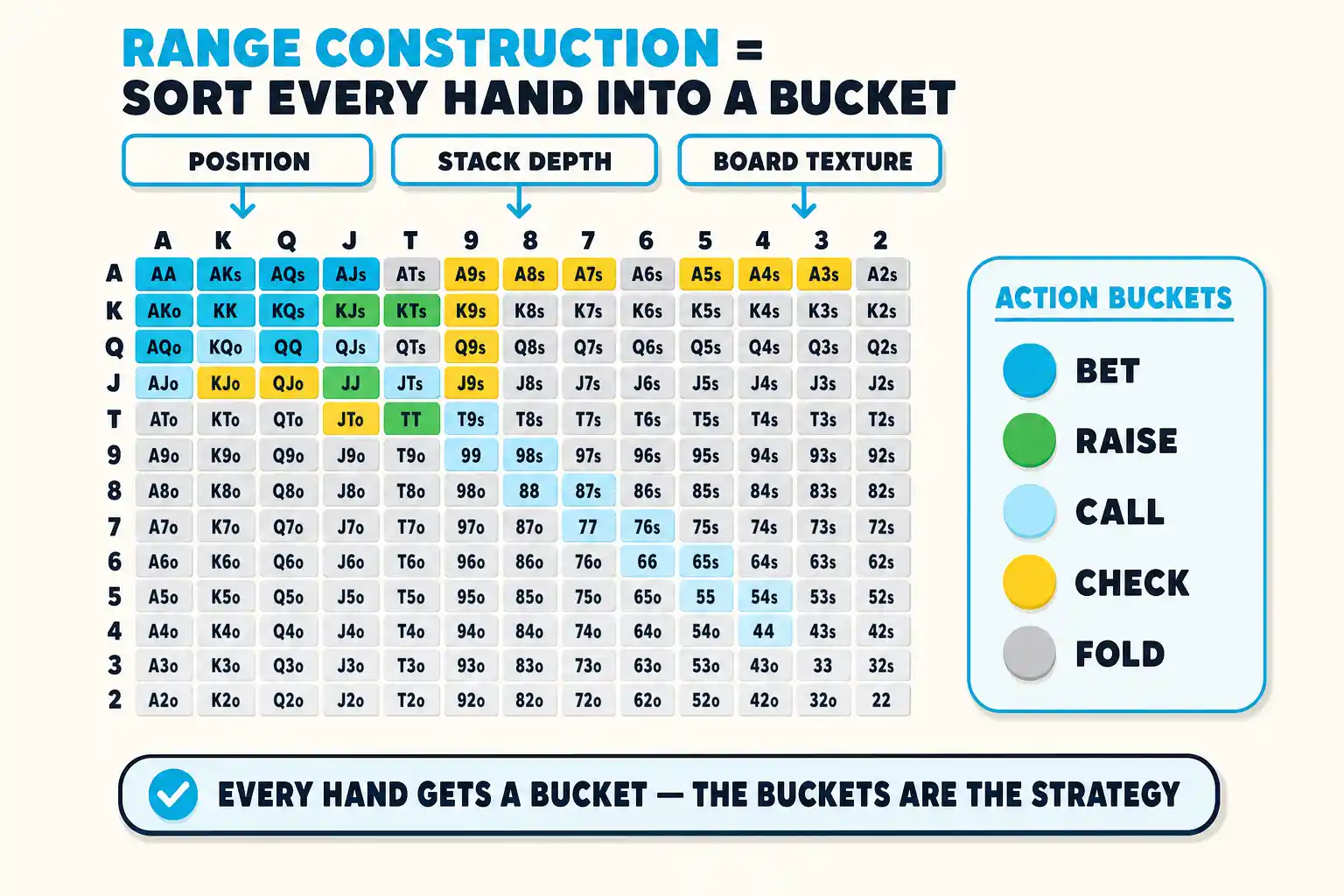
The shortcut: a range is a noun, range construction is a verb. When somebody says “the button has a 50% opening range,” they are naming the finished set. When they say “build the button’s c-bet range on K-7-2,” they are asking you to do the construction work: pick which combos bet, which check, and at what frequency.
Related terms
- Range
- Range vs range
- Baseline strategy
- GTO
- Frequency
- Mixed frequency
- Range advantage
- Board coverage
- Polarized range
- Linear range
- Merged range
Construction vs the terms it sits next to
The neighboring concepts are easy to swap by accident. The cleanest way to keep them straight is to ask which question each one answers.
| Concept | Question it answers |
|---|---|
| Range | What set of hands can a player have here? |
| Range construction | How do I decide which of those hands does what? |
| Range vs range | Whose distribution is doing better on this board? |
| Range advantage | Whose range has more equity on this specific flop? |
| Board coverage | How many different boards can my range credibly hit? |
| Baseline strategy | What is my default playbook before the table teaches me anything? |
| GTO | What set of frequencies is hardest for an opponent to exploit? |
| Frequency | How often does this action fire across the spot? |
| Mixed frequency | When one hand has more than one action, what is the percentage split? |
| Linear, polarized, merged range | What shape did the construction produce? |
The shortest path through the list: GTO is the target, frequencies are the math the construction has to hit, range advantage and board coverage are inputs, linear/polarized/merged are shapes the construction can produce, and the range is the output. Construction is the work in the middle.
Preflop construction: position, stacks, opener
Preflop construction is the cleanest version of the work because the inputs are stable. Three things drive every decision.
- Position. Earlier seats face more players left to act, so their ranges have to be tighter and more value-heavy. Late seats keep more speculative hands because they get the post-flop information advantage. The same hand, like 7♣ 6♣, lives in different buckets from UTG (fold) and from the button (open). That is construction speaking.
- Stack depth. At 100 big blinds you can keep small pairs and suited connectors because implied odds reward postflop flops. At 25 big blinds those same hands lose value and the construction trims them off the bottom. Below 15 big blinds the buckets collapse to shove or fold and the in-between actions disappear.
- Who has opened. A first-in opening range looks nothing like a 3-bet range, which looks nothing like a 4-bet range. Each layer of action narrows the inputs: facing a tight UTG raise, your construction tightens because their range is heavier; facing a wide button steal from the big blind, your construction widens because their range is lighter.
A useful preflop habit: when you build a range, name the four buckets out loud. Open / call / 3-bet / fold for the first-in spot. Call / 4-bet / fold for the spot facing a 3-bet. If a hand cannot land in a clean bucket, it usually belongs in the bucket adjacent to where you almost put it.
Postflop construction: texture, advantage, sizing, balance
Postflop construction has more moving parts because every street resets the inputs. Four checks, in order, do most of the work.
- Read the board texture. Dry, wet, paired, monotone, connected. Each texture changes which preflop hands made something and which still need help. The texture decides what counts as value and what counts as a bluff candidate before you do anything else.
- Locate the range advantage. Whose preflop range hits this flop better? On a king-high dry board after a button open, the button has range advantage; on a 6-5-4 connected flop after the same open, the big blind defender often does. Construction follows the advantage: the favored side bets more often and at smaller sizes; the unfavored side checks more, calls more, and saves big lines for the top of its range.
- Pick the sizing. Small bets keep medium-strength hands inside the bet bucket. Big bets push them out and force a more polarized construction: top-of-range value plus chosen bluffs, with the middle checked. Sizing and shape are paired decisions; you cannot pick one without committing to the other.
- Balance value and bluffs at that sizing. The bluff-to-value ratio is set by the pot odds your sizing offers, not by feel. A half-pot bet wants roughly one bluff per three value bets; a pot-sized bet wants closer to one per two. The construction job is to find enough credible bluff candidates, usually hands with backdoor equity, blockers to opponent value, or both, to fill the bluff side.
The construction is not finished at the flop. Each turn and river card resets which hands are still strong, which bluffs picked up equity, and which hands lost their reason to bet. A clean construction has a plan for the most common runouts before the flop bet ever goes in.
Example: building a button c-bet range on K♣ 7♦ 2♠
Setup: 100 big blinds, 6-max cash. The button opens to 2.5 big blinds with a wide range. The small blind folds, the big blind calls. The flop comes K♣ 7♦ 2♠ rainbow.
This is the textbook small-c-bet spot. The button has range advantage (more kings, more overpairs, more strong broadway), the board is dry (no draws to defend against), and a small c-bet at high frequency is the standard plan. Now the construction.
Step 1: value bucket. Hands that want a call from worse and can keep betting on most turns: AA, KK, AK, KQ, KJs, KTs. These bet small without question. AQ and AJ also belong in the bet bucket as thin value plus equity denial.
Step 2: bluff candidates. Hands that miss the flop but have a future. Suited aces below the king (A5s, A4s, A3s) carry an overcard, ace blocker, and a backdoor flush draw. Suited connectors that picked up a backdoor flush or backdoor straight draw (T9s of clubs, 98s of clubs) keep enough equity to barrel turns. These bet small at a meaningful frequency.
Step 3: give-up bucket. Pure air with no backdoor draw and no blocker, such as offsuit broadway misses with no backdoor flush (Q♥ J♣, J♥ T♣), usually checks. Continuing with these is overbluffing because the board does not give them a credible turn.
Step 4: pure check bucket. Medium-strength hands that prefer to control pot size: pocket pairs from JJ down through 88, sometimes 99, and second pair like A7s or 76s. They have showdown value, they don’t want to get raised off it, and the small c-bet sizing protects them by handling the value and bluff buckets without their help.
Step 5: mixed frequency. Some hands sit between buckets. A♣ T♣, AJo on a backdoor club texture, and KJo without a backdoor are real candidates for a mixed frequency split, betting some of the time and checking the rest. The exact percentages are a solver question, not a memorize question; what matters for construction is that you noticed the hand had two reasonable actions and assigned both of them a share.
The output is a c-bet range built around the dry-board, range-advantage shortcut: bet often, bet small, mostly value plus backdoor-equity bluffs, with the medium pairs checked back. Same range becomes a different range on a different flop, because the inputs reset.
This is one illustrative example, not a solver prescription. Real solver outputs depend on the exact preflop ranges, the exact bet sizing tree, and the rake; treat the buckets above as a teaching pattern, not a chart to memorize.
Common mistakes
1) Building the range without checking the inputs
Construction is downstream of position, stacks, opener, board texture, and range advantage. Skipping the input check and going straight to “I’ll bet AK and check 88” gives you a plan that works on a few flops and misses on the rest. Read the inputs first; the buckets fall out almost mechanically once you have them.
2) Confusing construction with the baseline
A baseline strategy is a default playbook of typical ranges across common spots. Range construction is the step you take when the spot in front of you is not exactly that default: a wider opener, a different board, a non-standard sizing. The baseline tells you where to start; construction is what you do when the inputs move.
3) Skipping the bluff side until later
If you build the value bucket, sketch the give-up bucket, and tell yourself you will figure out the bluffs at the table, you have built a value-only range. Without bluff candidates, your bets are obvious, and observant opponents fold every time you do not have it. Pick the bluff candidates during construction, not during execution.
4) Treating construction as a one-street decision
A flop construction that has no answer to the most common turn cards is half a plan. When you assign a hand to the bet bucket on the flop, ask which turn cards it keeps betting on, which turn cards turn it into a check, and which turn cards make it a fold. The hand should have a label for each branch before the flop bet is made.
5) Forcing every hand into pure actions
Some hands have two reasonable choices. Forcing a pure bet or pure check on every combo strips the construction of mixed frequency and makes your range easier to read. Allowing splits where the math supports them is part of the work, not a sign that the work is incomplete.
FAQ
Is range construction the same as building a range chart?
No. A range chart is a printed snapshot of one finished construction at one set of inputs (typically a position and a stack depth). Range construction is the underlying process: the same process that produced the chart, and the process you have to redo every time the inputs change. Charts are useful as defaults; construction is what lets you deviate when the table or the board pushes you off them.
How is range construction different from GTO?
GTO is the target of the construction: a set of frequencies that an opponent cannot exploit. Range construction is the act of approximating that target with concrete combos. You can build a range that aims at GTO frequencies, or you can build one that deliberately deviates to exploit a specific opponent. Either way the construction work is what produces the actual hands you bet, call, raise, or fold.
Can a constructed range be all pure actions, no mixes?
Yes, and at low stakes this is often a fine simplification. The mixes solvers prescribe are usually small EV differences between two close actions; a clean pure-action construction gives up a sliver of theoretical EV in exchange for being far easier to execute consistently at the table. The trade is reasonable as long as the pure choices match the inputs (texture, advantage, sizing).
How do you know your construction is good?
Three quick checks. First, every hand has a bucket, with no orphan combos that you cannot assign to bet, check, call, raise, or fold. Second, the value-and-bluff math at each sizing roughly matches the bluff-to-value ratio the bet size implies. Third, you can name what every bucket does on the most common turn cards. If any of the three fails, the construction is incomplete and the table will find the gap.