


Range Check
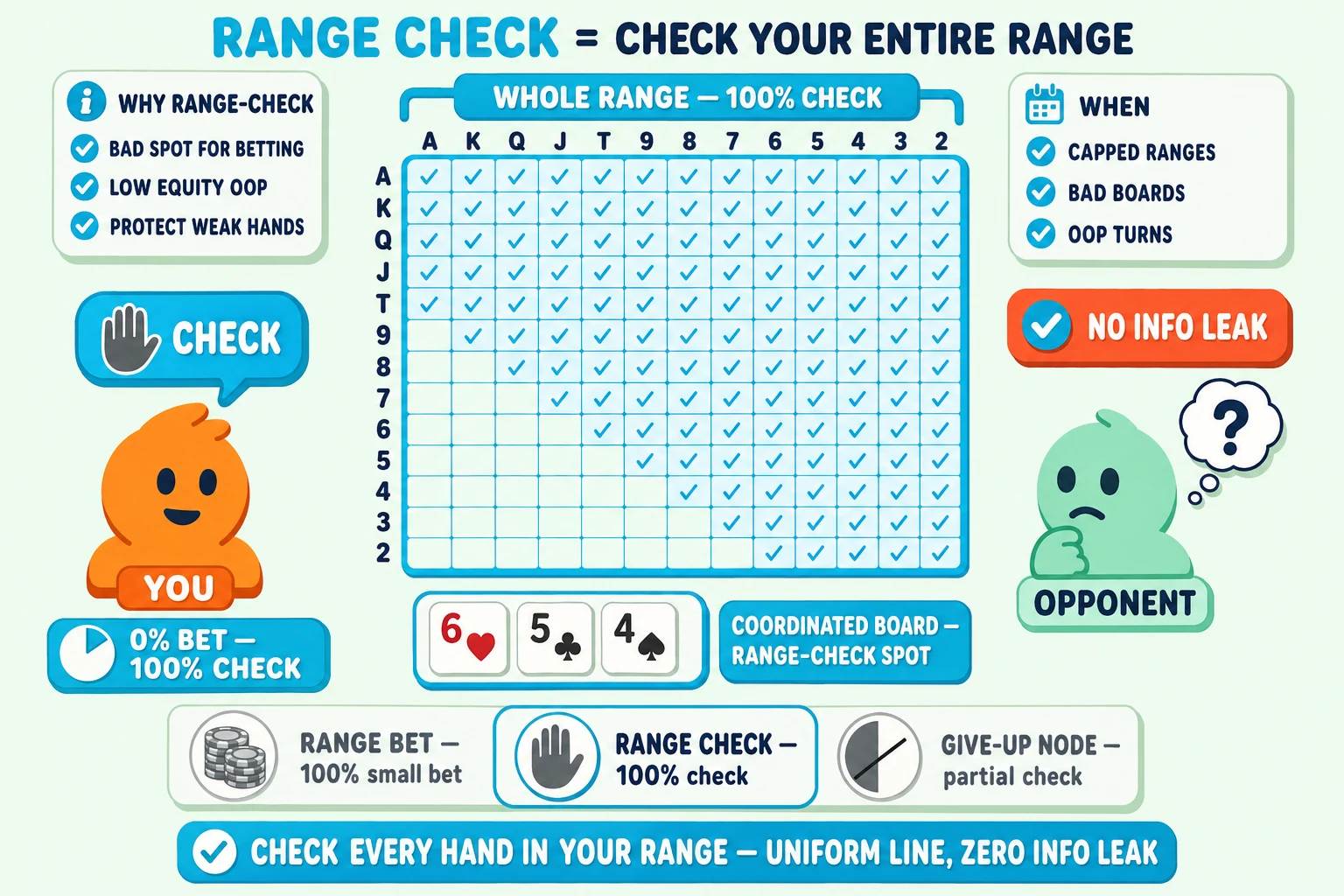
A "range check" is the set of hands you choose to check instead of betting. Your range is the set of possible hands you might hold. Good checking range construction mixes strong hands, weak hands, and draws in the same line. That prevents opponents from reading your check as strictly strong or weak.
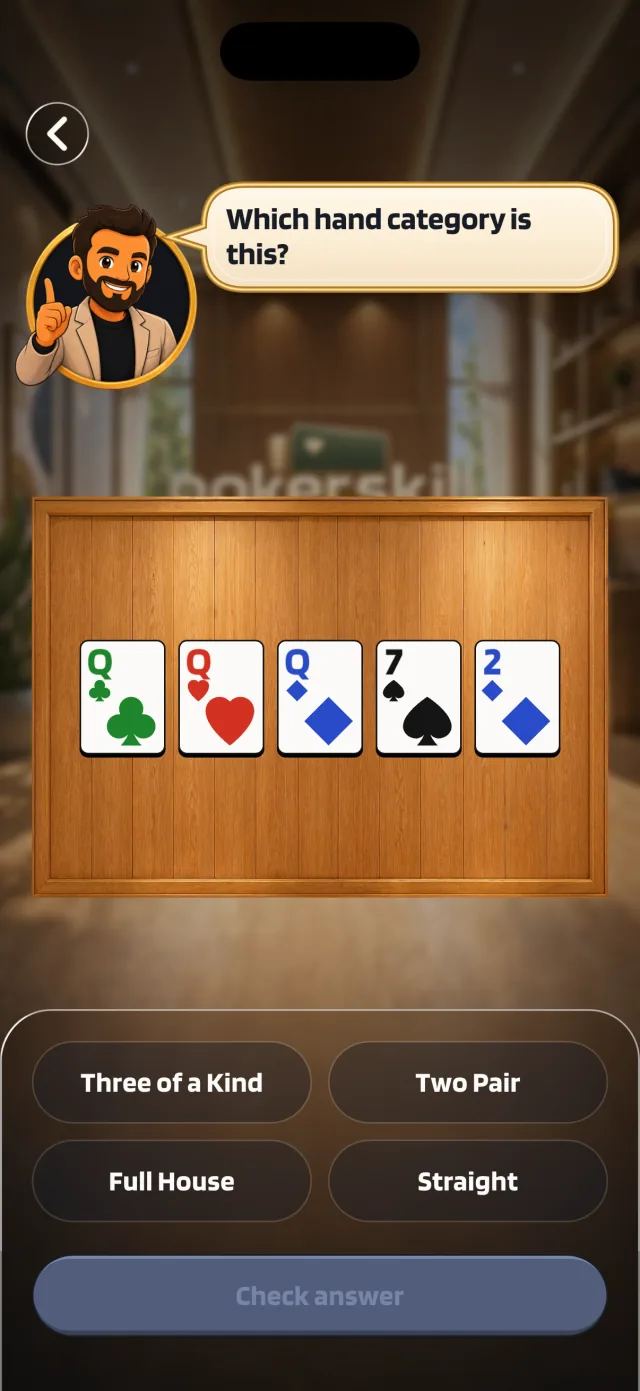
Practice this in Poker Skill. Out of position, the Defense Play Practice lesson checks a small pair, a combo draw and a flopped straight alike to the raiser, then lets the bet decide the branch.
Get the free appRange Check in No-Limit Texas Hold’em
Range Check: What it Means
A “range check” is the set of hands you choose to check instead of betting. Your range is the set of possible hands you might hold. Good checking range construction mixes strong hands, weak hands, and draws in the same line. That prevents opponents from reading your check as strictly strong or weak.
The goal is to create uncertainty and prevent predictable, exploitable lines. If your checking line contains only weak hands, opponents will bluff and exploit it. If it contains only strong hands, you’ll lose pot-control options and miss value-extraction chances. A balanced checking range mixes strength and weakness on the same line.
Why Balancing Your Checking Range Matters
Balancing your checking range prevents opponents from making easy, profitable decisions against you. If checking always signals weakness, opponents will bluff you frequently and profitably. If checking always signals strength, opponents will fold too often and you lose value.
A balanced checking range preserves flexibility. You can protect marginal hands by seeing another card for free, or induce aggression when you hold the nuts. By mixing draws, strong made hands, and bluff catchers in your checked hands, you force opponents into more mistakes and increase long-term expected value.
When to Check Strong Hands (and Why)
Sometimes you should check strong made hands like top pair with a big kicker, sets, or two-pair. Checking those hands occasionally avoids telegraphing strength and can induce bluffs or overcommitments.
Out-of-position (OOP) players-those who act before their opponent on later streets-should especially include strong hands in their checking range. Being OOP exposes you to more aggression, so include strong hands in checked lines to deter attacks. Checking strong hands can also extract more value later by inducing bets on later streets, letting you call with a wider range or raise for value.
How to Construct a Balanced Checking Range
Use simple, repeatable rules to build a checking range:
- Include a mix: strong made hands, flush and straight draws, and weak pairs or bluff catchers.
- Vary by flop texture: on coordinated, two-suited boards like 9♥8♥4♦, check back some strong and good hands.
- Adjust by position and range advantage: in position, check fewer strong hands and use betting to control pot size.
Concrete example: on 9♥8♥4♦, an OOP checking range can include top pairs, flush/straight draws, and weak pairs.
Adjusting Your Checking Range vs. Opponents and Stacks
Opponent tendencies and stack sizes should change your checking mix.
- Against aggressive opponents who attack checked ranges, include enough callable hands so their bluffs lose value.
- Against passive callers, check hands with showdown value and cut thin bluffs.
- Deeper stacks increase the value of preserving strong hands for later streets since you can extract more. With shallow stacks, prefer clearer betting or folding lines because commitment happens quickly.
Quick checklist
- Include strong hands, draws, and weak hands in your checking range.
- Ensure OOP checking ranges contain some strong hands to avoid being exploited.
- Adjust the mix by flop texture, for example checking some strong hands on 9♥8♥4♦.
- Increase callable/raisable hands versus opponents who attack checked ranges.
- Use checking to induce bluffs and to extract value on later streets.