


Opening Range
An opening range is the set of starting hands a player will raise with when they are first into the pot — when nobody before them has voluntarily called or raised. The set is tight from early seats and wider from late ones because the math of who is left to act changes seat by seat.
Practice this in Poker Skill. The raise-or-fold lessons practice it at 6-max and 100 big blinds, with one lesson each for under the gun, the cutoff, the button and the small blind.
Get the free appOpening range: the hands you raise when nobody has entered yet
What an opening range is
An opening range is the set of starting hands you choose to raise with when nobody before you has voluntarily put chips in the pot. The blinds are posted, every seat in front of you has folded, and now you face one question: do I raise this hand, or do I throw it away? The hands you say yes to from a given seat, at a given stack depth, are your opening range from that seat. It is a list, not a single hand, and it lives inside the broader idea of a range.
For the seat-by-seat ranges themselves, printable and ready to study, use the opening range charts.
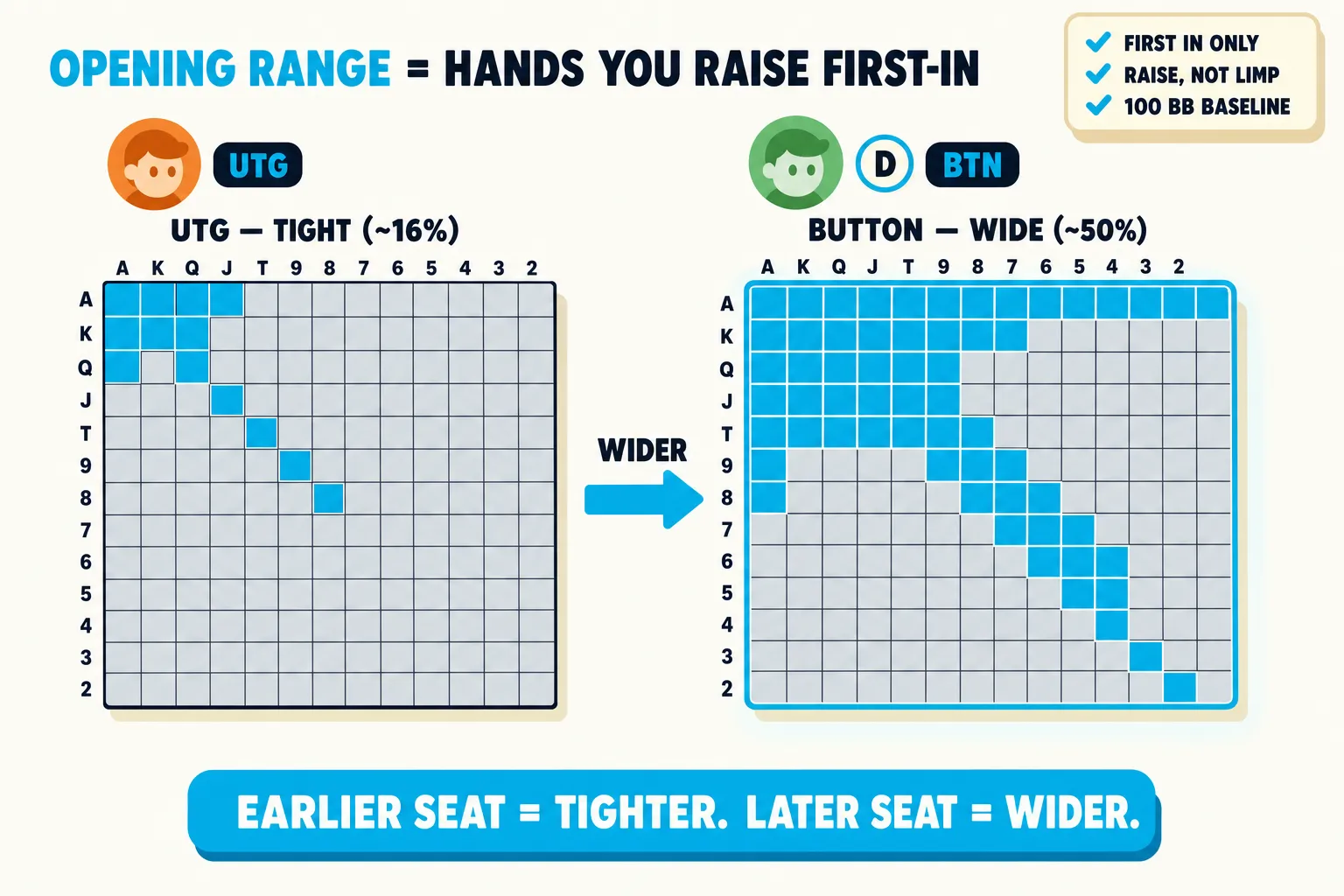
The shortest mental shortcut for what counts:
- You are first in. Every seat in front of you folded, or you are UTG with nobody before you. If somebody already called or raised, the spot is no longer an open.
- Your action is a raise, not a limp. Limp ranges are a separate idea you mostly avoid.
- The hand sits in the set you would raise from this seat at this stack depth. That set is your opening range.
If any of those three pieces is missing, the situation is something else — a 3-bet, a flat, a defend, or a fold.
Related terms
Opening range vs the terms that look like it
Opening range collects the hands; the other names collect different parts of the same picture.
| Term | What it names | How it relates to opening range |
|---|---|---|
| Range | Any set of hands a player can hold | The umbrella idea. Opening range is one specific kind. |
| RFI | The action of raising first in | The verb. Opening range is the set of hands that verb fires on. |
| Open-raise | The single raise itself | One play from inside an opening range. |
| First in | The condition of being first to act voluntarily | The pre-condition. No first-in spot, no opening range to apply. |
| Raise first in | A common rename for RFI | Same idea as RFI; different shorthand. |
| Preflop | The street | The street where opening ranges exist. |
| Position | Where you sit relative to the button | The single biggest input to which opening range applies. |
| Blind defense | What the big blind does versus an open | The mirror image. A defending range, not an opening range. |
The two pairs that get tangled most: opening range is the set, RFI is the action; and the button opening range is wide while the UTG opening range is tight, even though both are first-in raises with the same name.
Why opening ranges widen by position
Opening ranges are not arbitrary. They widen as you move from early to late seats for two reasons that compound each other.
- Players left to act. The earlier you open, the more seats remain who can wake up with a strong hand and 3-bet you. UTG faces five players behind at a full 6-max table; the button faces two. Each player behind is another chance to run into AA, KK, or QQ.
- Position after the flop. If you do get called, late seats act last on every street. Acting last lets you play more hands (small pairs, suited connectors, weak suited aces) because you can see your opponent’s action before deciding. Out of position, those same hands are harder to play, so you cut them.
Stack depth and table softness add wrinkles, but those two forces drive the basic curve: tightest UTG, wider through the middle seats, widest from the cutoff and the button.
Example: UTG vs button at 6-max, 100 BB
You are at $1/$2 6-max cash, 100 big blinds (BB) deep, and the action folds to you. Same dealt hand, different seat, different right answer.
Hand: 8♣ 7♣
- From UTG. This is a suited connector. It plays well multiway with deep stacks, but you have five seats behind who can 3-bet, and you will be out of position in any postflop pot the flop caller takes you to. A baseline tight UTG range at 6-max sits around 16-18% of hands and skips most suited connectors at the bottom edge. Fold.
- From the button. Three players have folded. Only the small blind and big blind remain, and both act before you on every postflop street. 8♣ 7♣ now sits comfortably inside the wider button opening range, somewhere near 45-50% of hands at 100 BB, because the in-position advantage and the stealing math both add value. Raise to about 2.5 BB.
Hand: A♠ Q♦
- From UTG. Strong, easy raise. AQ offsuit is on the upper edge of UTG ranges; you raise it to build the pot with a hand that flops top pair often.
- From the button. Even easier raise. AQ from the button sits near the top of an already wide range; you continue against most 3-bets and play postflop with position.
Hand: 4♠ 4♣
- From UTG. Pocket fours sit on the borderline. Common UTG ranges include them at 6-max because the implied odds of flopping a set still pay off when the hand cooperates. Marginal raise, but inside most baseline ranges.
- From the button. Easy raise. With small pairs, the button gets to set-mine, steal the blinds, or play a small postflop pot in position when called.
The pattern: the same hand changes status, fold to raise or marginal to easy, based purely on seat. The opening range is the way that pattern gets written down.
Common mistakes
1) Confusing the action with the set
RFI is a verb (raise first in); opening range is a noun (the hands you raise with). Players sometimes say “RFI” when they mean the range and “opening range” when they mean a single hand they are about to open. Same family, different layer. A clean way to keep them straight: the action goes on the felt, the range lives in your head.
2) Copying a chart without looking at the table
Charts are baselines, not orders. If the player to your left 3-bets every other open, you tighten the bottom of your button range. If the blinds fold to a steal three times in a row, you widen it. Charts assume well-balanced opponents who play near solver frequencies. Live small-stakes and home games rarely look like that. Opening with the same hands every orbit, regardless of who is in each seat, is one of the most common leaks at low stakes.
3) Ignoring stack depth
Opening ranges shift as stacks shrink. At 100 BB, a hand like 6♥ 5♥ from the cutoff plays well because of implied odds and postflop maneuvering. At 25 BB, the same hand wants you out of the pot. Short stacks turn small pairs and suited connectors into low-equity opens that rarely realize their value. Push-fold spots at 10-12 BB look nothing like the 100 BB chart you memorized.
4) Treating the opening range as fixed
Your opening range is a target, not an oath. Two consecutive 3-bets from the big blind, ICM pressure on a tournament bubble, a wild player on your left — each is a reason to move the edges of the range. The chart is a starting point. The judgment call is what you do with it after the table tells you something new.
FAQ
How is an opening range different from any other range?
A range is the full set of hands a player can have given their actions. An opening range is the specific subset that fires when nobody has voluntarily entered the pot in front of you, your action is a raise, and you are at a specific seat with a specific stack depth. Calling ranges, 3-bet ranges, and defending ranges all live next to opening ranges, but they answer different questions in different spots.
Why do my opening ranges change at different stakes?
Two reasons. First, opponent quality changes. Looser callers and rare 3-bets at small stakes reward wider opens with hands that play well postflop; tighter, more aggressive opponents at higher stakes punish loose opens. Second, rake and ante structure change the math. A bigger relative rake at micro stakes shaves the bottom off the open list. Two players at two different stakes can be doing everything right and still play different opening ranges from the same seat.
Should I memorize an opening chart for every position?
Memorize the shape, not every cell. The free preflop charts give you a baseline for each seat to work from. If you can describe a baseline range for UTG, the cutoff, the button, and the small blind in your own words — what kinds of hands belong, what is just outside the edge, what the table-read adjustments look like — you have what charts are for. Cell-by-cell memorization without that intuition is brittle and breaks the moment a 3-bettor sits down on your left.