


Orbit
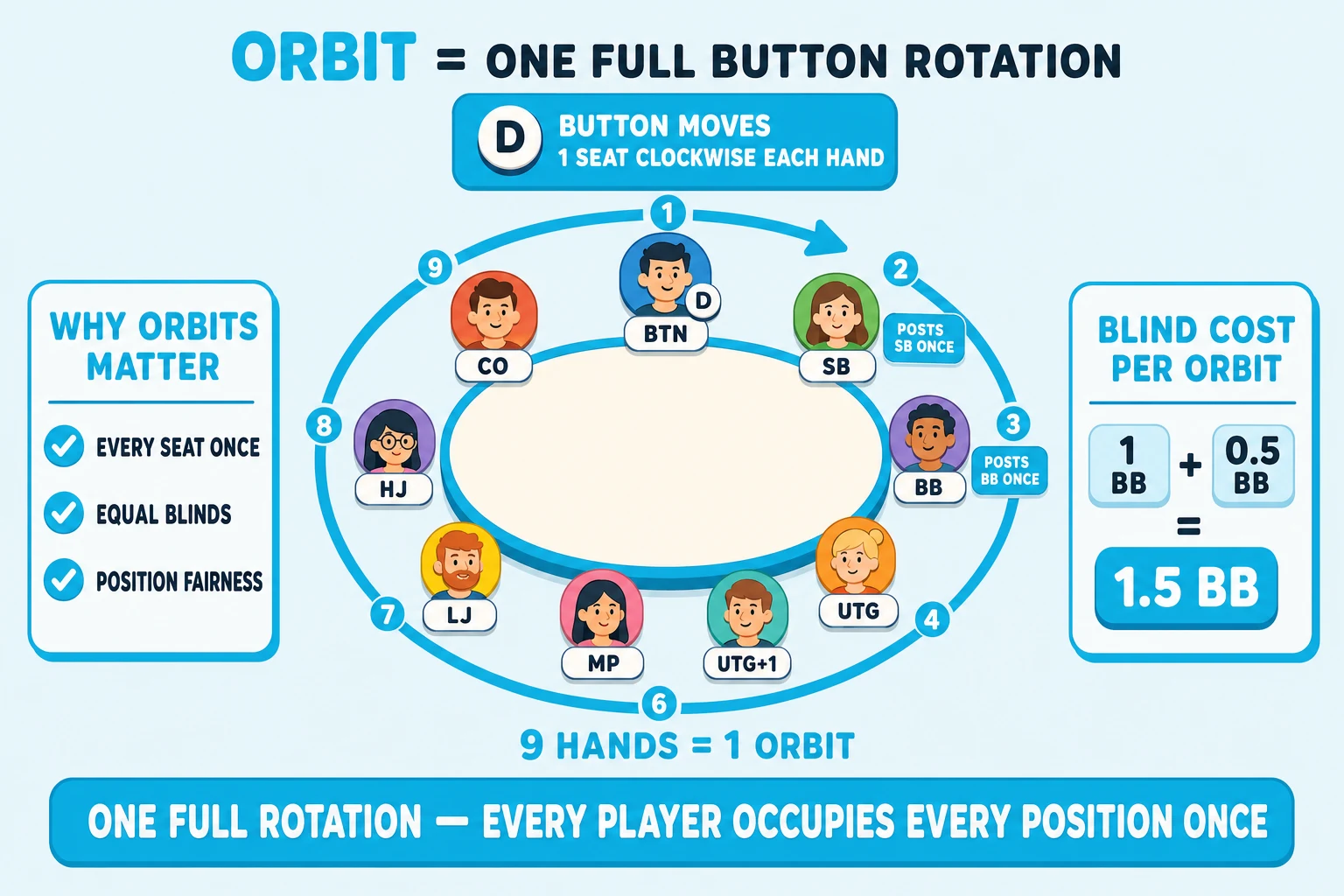
An orbit is one full rotation of the dealer button around the table. Every participating player occupies each table position once during an orbit. The orbit ends when the button returns to the same player after moving around all seats.
Practice this in Poker Skill. The First Orbit Mindset lesson works through the early and late seats of an orbit, folding J8 offsuit under the gun and opening wider on the button, where 9-3 offsuit still folds.
Get the free appOrbit (No-Limit Texas Hold’em)
What an orbit is
An orbit is one full rotation of the dealer button around the table. Every participating player occupies each table position once during an orbit. The orbit ends when the button returns to the same player after moving around all seats.
Why it matters: position is a central strategic factor in Hold’em. Over many hands an orbit shows how often you’ll be the button, the small blind, the big blind and each other position. Knowing those frequencies helps plan bankroll use, timing for aggression and when to expect blind duty.
Example: At a nine-handed table, starting the orbit on the button means the next hand you’ll be the cutoff, then each earlier seat in turn down to under the gun, then the big blind, then the small blind, until you return to the button.
How the dealer button moves each orbit
The dealer button moves one seat clockwise after each completed hand. The button marks the nominal dealer and sets the seat order for that hand.
Steps:
- The button sits in one seat for the current hand.
- After the hand finishes, the button slides one seat clockwise.
- The new button determines who posts the small blind, the big blind and who acts last post-flop.
Example sequence: If the button is at Seat 5, Seat 6 posts the small blind and Seat 7 posts the big blind. After the hand, the button moves to Seat 6, so Seat 7 becomes small blind and Seat 8 big blind for the next hand.
How blinds work during an orbit
Blinds are forced bets that start action before cards are dealt. The small blind is posted by the player immediately left of the button; the big blind is posted by the player two seats left.
During an orbit each player will post the small blind and the big blind once, assuming no seat changes or players sitting out. This rotation ensures fairness so no one permanently shoulders blind duty.
Example: Over nine hands at a full table, each player contributes the small blind once and the big blind once. Those forced bets seed the pot every hand and encourage action.
Why position matters across an orbit
Position is where you act in the betting order. The button acts last on all post-flop betting rounds, giving that player more information before deciding.
- Early positions act first and face more uncertainty; they generally need stronger hands.
- Late positions, especially the button, can play a wider range because they see opponents’ actions first.
Example: With K8 offsuit you’d usually fold from early position but could open or steal from the button. Acting last lets you control pot size and exploit weaker ranges.
Orbit consistency in cash games and tournaments
Button movement, blind posting and positional rotation work the same in cash games and tournaments. That consistency prevents systematic long-term seat advantage and distributes blind responsibilities evenly.
Format differences such as buy-ins, blind levels and payouts don’t change the orbit concept: the button still moves clockwise and blinds still rotate so everyone experiences each position.
Quick checklist
- Remember: an orbit = every player occupying every position once.
- Button moves one seat clockwise after each hand.
- Each player posts small blind and big blind once per orbit.
- Adjust hand requirements by position: tighter early, wider late.
- Orbit mechanics are the same in cash games and tournaments.