


All-in
All-in is the rules state of having every remaining chip in the pot for the current hand. Once you're all-in you can't bet, raise, or fold for the rest of the hand — your hand sees showdown for the chips you matched, and any chips deeper opponents wager beyond your stack form a side pot you can't win.
Practice this in Poker Skill. Short all-ins carry one more rule, taught in the lesson on raise mechanics: an all-in smaller than a full raise does not reopen the betting, so a player who already acted can only call or fold.
Get the free appAll-in: when every chip is in the pot for that hand
What “all-in” means
All-in is the rules state of having every remaining chip in the pot for the current hand. Once you’re all-in, the betting is over for you — you can’t bet, raise, fold, or do anything else with chips you no longer have. The remaining streets are dealt, and at showdown your hand competes for the portion of the pot you matched. Any chips deeper opponents wager beyond your stack get cordoned off into a side pot you can’t win.
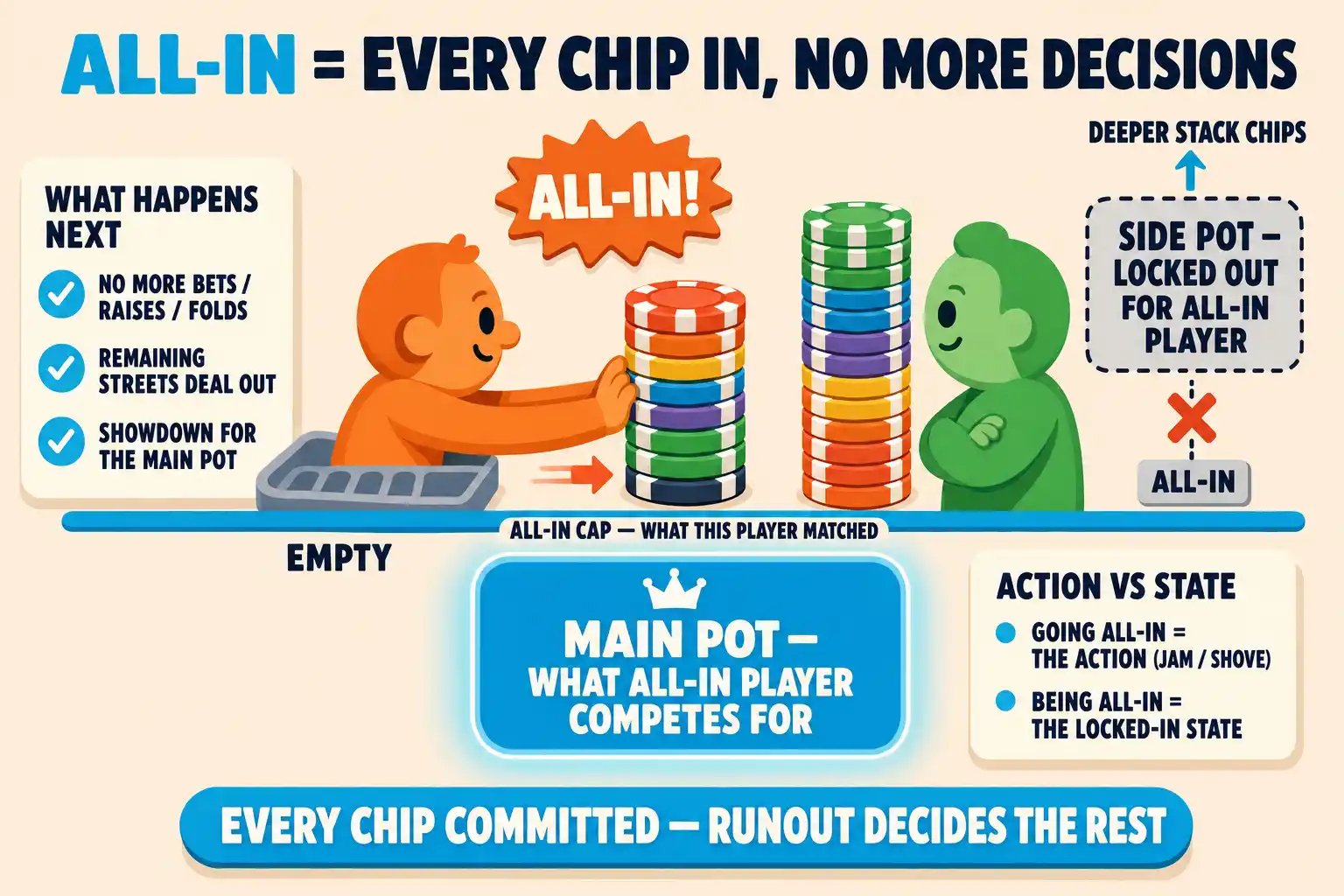
The slang for the action of pushing your stack in is jam or shove. The rules state, the locked-in condition you’re in once those chips are in, is what this entry is about.
Related terms
All-in vs jam, shove, call-off, and shove/fold
These five terms cluster around the same moment but answer different questions. Mixing them up makes table talk and study notes harder to follow than they need to be.
| Term | What it names | The verb angle |
|---|---|---|
| All-in | The rules state of having every chip in for this hand | ”I am all-in.” (condition) |
| Jam | The aggressive action of pushing your stack in as a bet or raise | ”I jammed for 18bb.” |
| Shove | The umbrella term for the all-in action — preflop, reshove, or postflop | ”I shoved the turn.” |
| Call-off | Calling an opponent’s all-in for your remaining stack | ”I called off with AQ.” |
| Shove/fold | The short-stack strategy of removing every option except shove or fold | ”10bb is shove/fold land.” |
A short way to keep the cluster straight: jam and shove are what you do; all-in is what you are; call-off is what happens when you finish the commitment by calling; shove/fold is the framework you use when stacks shrink enough that smaller bets stop making sense.
When “all-in” is the deciding word
The state matters most in spots where the betting is over and the math collapses to one calculation:
- The runout decides. Once you’re all-in and called, no future bet can change the outcome. Your hand’s expected share is exactly your all-in equity times the pot you’re matched into. There is no realization discount, no fold equity, nothing else to model.
- Side-pot eligibility freezes. Whatever the effective stack was at the moment your last chip went in, that’s the cap on what you can win. Deeper opponents who keep betting are competing for chips that are invisible to your equity.
- Short-stack shove/fold math. At ~10–20bb effective, smaller raises strand the bottom of your range and capture less fold equity than going all-in. The push/fold framework exists because the all-in option dominates the in-between sizes once stacks get short enough.
- Pot-commitment shows up early. You don’t have to be physically all-in to be effectively all-in. Once roughly a third of your stack is in the pot, and certainly once half is in, a follow-up bet that puts you in usually leaves the math demanding a call. The shove just confirms what the pot odds already decided.
When the state matters less: deep-stacked, multi-street pots with small bets relative to remaining stacks. There the interesting decisions are about future betting (sizing, range, board changes), and an all-in is rarely the natural next step.
Example: a turn all-in and a side pot
A three-handed hand that shows the state, the side pot, and the locked-in equity all at once.
Setup: 6-max NLHE cash, 100bb effective for two players, 35bb for the third. UTG opens to 2.5bb. The button (35bb effective) calls. The big blind (100bb) calls. Pot 7.5bb.
Flop: A♠ 9♠ 4♦. BB checks, UTG c-bets 4bb, button calls, BB folds. Pot 15.5bb. Stacks: UTG ~93bb, button ~28bb.
Turn: 2♠. UTG bets 12bb. Button shoves the remaining 28bb total — 16bb more on top. UTG calls.
Where the chips land:
- The button is all-in for 28bb on the turn. Their last chip is in; they have no more decisions in the hand.
- UTG covers the button. The first 28bb of UTG’s call matches the button into the main pot (the pot the button is eligible for). UTG and the button are matched 28-for-28 across the hand.
- Any chips UTG put in beyond the button’s 28bb cap form a side pot the button cannot win. In this hand UTG didn’t bet beyond the all-in cap on the turn, so the side pot is empty, but it would have existed if UTG had bet more. (See side pot for the full mechanic when a third player keeps the betting going.)
The river is dealt face-up. Neither player can bet. The button has no chips, and there’s no live opponent for UTG to bet at. River: K♣. Both players show. Whichever hand is best at showdown wins the main pot.
The button’s expected share at the moment of the call was simply their all-in equity on that A-9-4-2 board against UTG’s actual hand. Nothing about how the river ran out changed the decision they made.
Common mistakes
1) Treating “all-in” as a strategy instead of a state
“What’s your all-in strategy?” is a fuzzy question. The strategy is jamming, calling off, or shove/fold. The all-in is the condition that results from any of those actions. Lump them together and you end up debating whether to “be all-in more,” which doesn’t translate into any actual decision at the table.
2) Ignoring the side-pot cap
Short stack shoves, two deeper opponents call, and the short stack starts mentally counting all the chips on the felt as theirs to win. They’re not. Only the matched portion (the main pot) is in play for the all-in player. Treating the side pot as part of your equity is a quiet form of double-counting.
3) Calling off too light against the wrong range
The mistake reads “AK is a strong hand, I have to call.” The hand strength isn’t the question. The question is what the opponent’s shoving range looks like and what your equity is against that range. Hands that beat a wide opening range can be folds against a tight all-in range, and the books are explicit that calling decisions live and die on range work, not on the strength of the cards in your own hand.
4) Reading one all-in result as proof the decision was right or wrong
You shove AK against QQ for stacks. AK has roughly 43% equity. You lose. That outcome is not evidence the shove was wrong; it’s one of the 57 outcomes per hundred where QQ holds. All-in equity is a long-run probability validated across thousands of repetitions, and one hand is noise. The same goes the other way: winning a single coinflip doesn’t certify the call.
FAQ
What does it mean to be all-in in poker?
Being all-in means every chip you had at the start of the current hand is now in the pot. After that point you can’t bet, raise, or fold — the rest of the hand plays out for the chips you matched, and at showdown your hand competes for that portion of the pot only. Any extra chips deeper opponents wager beyond your stack form a side pot you can’t win.
Is going all-in the same as jamming or shoving?
Going all-in is the action; being all-in is the state. Jam and shove are slang for the action of pushing your stack in. You can also become all-in by calling: if you call a bet that uses your last chip, you’re all-in even though you didn’t make the original all-in bet yourself. The state is the same; the verb that put you there isn’t.
What happens after I’m all-in?
The dealer deals the remaining streets face-up if no live betting is left, or runs out the rest of the hand normally if other players still have chips and reasons to bet. You don’t act again. At showdown the best hand among players eligible for each pot wins that pot. You can win the main pot, but not any side pot created by chips wagered beyond your stack.
Why do short stacks go all-in so often instead of making smaller raises?
At ~10–20bb effective, smaller raises tend to fold out the weak end of your range to a reshove and offer poor pot odds when called. Going all-in captures fold equity immediately and only proceeds with hands whose all-in equity when called justifies the risk. That’s the math reason shove/fold charts dominate the in-between sizes once stacks get short.