


Freezeout
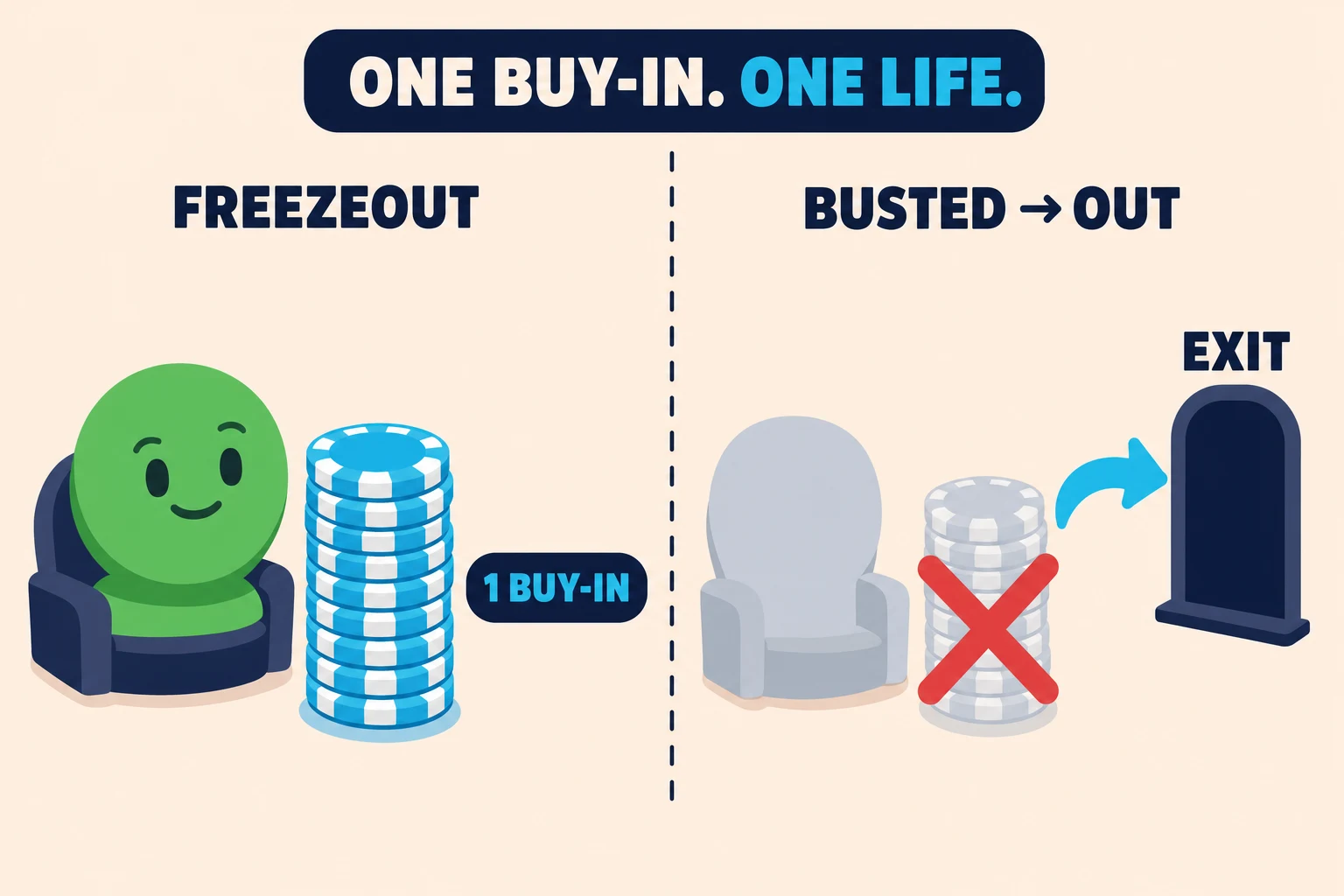
A freezeout is a poker tournament where one buy-in is your whole tournament. There are no rebuys and no re-entries: when your chips are gone, you are out. Most major tournaments (including the WSOP Main Event) are freezeouts, and the format shapes every strategic choice you make from level one.
Practice this in Poker Skill. The preflop lessons deal every player 100 big blinds, about the depth of a freezeout’s early levels, so the opening ranges they teach seat by seat carry into that stage.
Get the free appFreezeout: a tournament with one buy-in and no second chances
What a freezeout is
A freezeout is a poker tournament where every player buys in once and cannot buy more chips later. There are no rebuys and no re-entries inside a window. When your chips are gone, you are eliminated and the next time you sit down at this event will be next year. Most major tournaments are freezeouts by default, including the WSOP Main Event and most televised final tables. The format is the strategic baseline that other tournament formats (rebuys, re-entries, satellites) define themselves against.
Why the format shapes every decision you make
The single rule “one buy-in, one tournament life” changes how you value chips. Tournament chips are not money. The chips in front of you have value because they keep you in the event, and once they are gone you have no way to get more. That asymmetry, where a chip you lose hurts more than a chip you win helps, is the whole reason tournament strategy departs from cash-game thinking.
A freezeout makes that asymmetry sharper than a rebuy event does. In a rebuy, a busted stack costs you another buy-in but not your seat. In a freezeout, a busted stack costs you the entire tournament. So your floor on “is this risk worth it?” sits higher than it does in any format with a second-chance option.
Related terms
- ICM: the math that turns surviving chips into expected dollars near the money.
- Nash push-fold: the late-game shove/fold solver outputs you reach for once stacks compress.
- Short stack: the band most freezeout survivors play in for hours before the money.
- Stack depth: measured in big blinds, and the lever that decides which mode you are in.
- Ante: late levels add antes, which change steal math and accelerate stack erosion.
Freezeout vs. rebuy vs. re-entry
The three formats are easy to confuse because the words sound similar. The distinctions are worth knowing because each format is a different game.
| Format | Can you buy in again? | Total commitment per shot | Variance shape | Early-level posture |
|---|---|---|---|---|
| Freezeout | Never. One buy-in. | 1× the entry | Low (you cannot lose more than the entry) | Patient; chips are precious |
| Rebuy | Yes, at the same table during the rebuy window | 1× to 4×+ the entry | Higher (you may post the entry several times) | Looser; mistakes are recoverable |
| Re-entry | Yes, once or twice, as a fresh stack at a new table | 1× to 3× the entry | Medium (short-stack re-entries get a thin edge) | Looser early, normal once the window closes |
The rebuy column above describes the structure you see in many small-stakes online events; live rebuys vary. The point of the table is the rightmost column. In a freezeout, you cannot afford to gamble early the way a rebuy schedule encourages, because there is no Plan B for the chips you lose.
When freezeout discipline matters most
The format matters at every stage, but the spots where it matters most are where players slip.
- Early levels (~100 BB stacks). Patience pays. You have a long event ahead, post-flop room is wide, and your edge over weaker players is largest here. Marginal pre-flop flips for a full stack hurt your equity more than they help, even when the chip math is fine.
- Mid-stage (~30–50 BB). This is the long middle of most tournaments, and the place where bored players spew. Stay disciplined. You do not need to win the tournament here; you need to be alive when the money draws close.
- Near the money (the bubble). ICM tightens calling ranges sharply. Close chip-EV calls become folds because the seat you give up by busting on the bubble is worth real cash to you and to the players you leave behind.
- Final table. The biggest pay jumps live here. Medium and short stacks fold marginal hands they would call in a cash game without thinking. Big stacks press harder for the same reason.
- Heads-up. All payouts are decided on this match. Both stacks pivot from survival math to first-place equity, and play opens back up.
Example: the early-level marginal flip
You are 30 minutes into a $200 freezeout with 100 big blinds in front of you, blinds at 100/200 with no ante. A loose-aggressive opener in middle position raises to 500. The button shoves for his full 100 BB. You look down at A♠ K♠ in the small blind. The opener folds. Action is on you.
Against the button’s likely shove range (pocket pairs from JJ down through 77, plus AQ and a few suited bluffs), your hand sits at roughly 50/50 equity. By chip-EV, calling is fine. The pot odds even nudge it slightly positive.
In a re-entry event with a long re-entry window still open, this is a snap call. You either double up to a useful stack or you bust and rebuild from a fresh starting stack at the same blind level. Either outcome is recoverable.
In a freezeout, this same call is a leak for most players. You are 100 BB deep in the first hour against a field where post-flop edges decide most pots later. A coin-flip that puts your tournament life on the line trades a real future edge for a chip-EV breakeven. Folding is fine here. Save the flip for a spot where you have more equity, or where the stacks are shallow enough that the flip is forced.
This is not “play scared.” It is recognizing that tournament life has value the chip count does not show.
Common mistakes
1) Treating the early levels like a re-entry event
Re-entry math says “if you bust, ask whether the spot is still worth re-buying into.” Freezeout math has no such question, because there is no re-buy. Players who learn online in re-entry pools and step into a live freezeout often gamble too freely in the first three levels and then wonder why their tournament cashes are inconsistent.
2) Refusing to fold AK pre-flop
A♠ K♠ is the most-overplayed hand in tournament poker. It plays well, but it is not a hand you should commit 100 BB with against a tight three-bet shove from an early-position regular. In a freezeout, the cost of being wrong is the entire tournament. Fold and look for a better spot.
3) Ignoring ICM on the bubble
Once the money is in sight, calling ranges should tighten. Players who think “a chip is a chip” call off marginal hands, bust on the bubble, and turn a min-cash into a zero. The right reaction to ICM pressure is to fold tighter when called, then steal more when stealing.
4) Over-folding at the bubble of a flat-payout structure
ICM cuts both ways. In a tournament with very small pay jumps near the money, the survival premium is smaller than players assume, and ultra-tight bubble play wastes the chip-accumulation window. Read the payout structure before deciding how tight to play.
FAQ
Are all WSOP events freezeouts?
The WSOP Main Event is a true freezeout: one buy-in, no re-entries. Many other WSOP events are re-entry tournaments with a window of one or two re-entries during the first day, after which the field freezes. Read the event’s structure sheet before you sit down. If the structure does not say “freezeout” explicitly, look for a “re-entry” or “rebuy” line and the period during which it is allowed.
Can you re-enter a freezeout if you bust?
No. A freezeout by definition allows one buy-in per player; once you are eliminated, your participation in that event is over. If the event allows you to buy back in, it is not a freezeout, regardless of what the marketing copy calls it.
How does freezeout strategy differ from a sit-and-go?
A single-table sit-and-go is a small freezeout: one buy-in, no re-entries, top three or so paid. The strategic difference is mostly stack depth and pace. Sit-and-gos start shallow, reach the money fast, and spend most of the event in shove-fold territory. Multi-table freezeouts start deep, reward patience early, and only pivot to push-fold strategy at the end. Same format, different rhythm.