


Freeroll
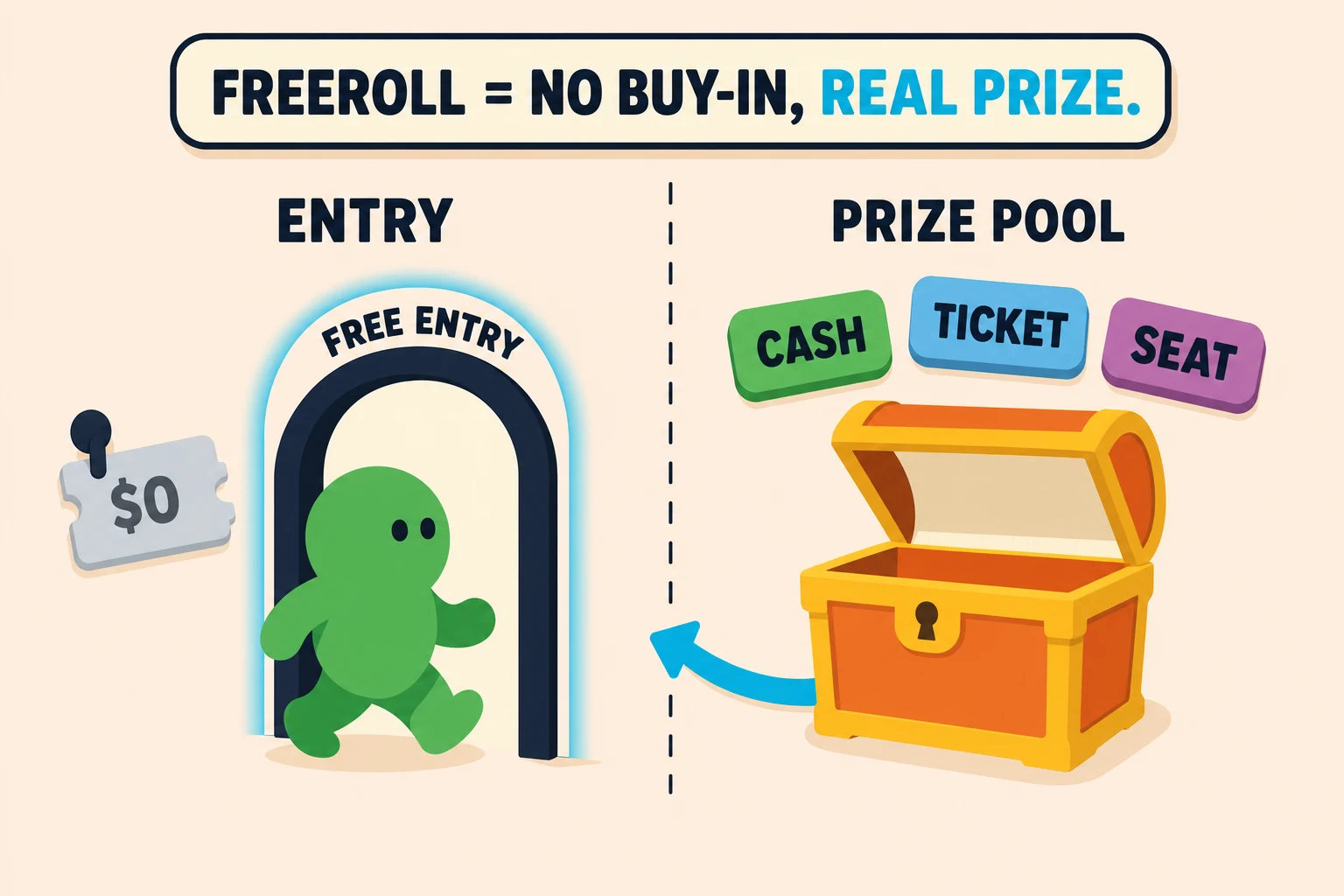
A freeroll is a poker tournament with no entry fee but a real prize pool. The operator or a sponsor pays for the prizes — cash, tickets, seats, or merchandise — instead of the players, which is why freerolls show up as new-player promotions, loyalty rewards, and league finales rather than as part of any room's regular schedule.
Freeroll: a tournament with no entry fee but real prizes
What a freeroll is
A freeroll is a poker tournament you enter without paying a buy-in, where the prize pool is real and is funded by someone other than the players. Cardrooms run freerolls as a loyalty perk for active members; online sites run them as a new-player promotion or a VIP reward; sponsors and leagues fund them as a tournament-shaped giveaway. The format is otherwise an ordinary tournament: a fixed starting stack, escalating blinds, and a payout structure that pays the top finishers. The defining feature is the asymmetry — your cost to enter is zero, but the seats, tickets, cash, or merchandise on offer are not.
The word can confuse on first contact because poker also uses “freerolling” for an unrelated equity-situation concept (when two players have the same made hand and only one has cards live to draw to a better one). Same word, different idea. Context separates them: tournament write-ups mean the format, hand analysis means the equity spot. This entry is about the format.
Why operators run them at all
Freeroll prize pools are paid out of marketing budgets, sponsor money, or VIP-program funding, not out of player buy-ins. A cardroom that wants to reward 200 of its most active members runs a $5,000 freeroll for them; an online site that wants new sign-ups posts a $500 freeroll on the promo page; a beer brand sponsoring a league runs a freeroll final with a trip as the top prize. The mechanic is always the same — players show up at no cost, the host posts the prize. Treat the freeroll as a tournament-shaped bonus rather than a part of the room’s regular game schedule.
Related terms
- Freezeout: the paid-entry baseline format with one buy-in and no rebuys; the closest structural cousin once a freeroll begins.
- Satellite: an adjacent format that also pays out non-cash prizes, but specifically tournament seats rather than mixed prizes.
- Rebuy: a paid format that lets you post additional buy-ins; the contrast for variance and discipline shape.
- Add-on: a paid mid-tournament chip purchase you will not see in a freeroll.
- Late registration: the registration window that often makes the early levels of a freeroll skippable.
- Bubble: the late-tournament zone where freeroll fields finally tighten up and play resembles a normal MTT.
Freeroll vs. freezeout vs. satellite vs. rebuy
The four formats answer different questions about cost and prize. The table is the fastest way to keep them straight.
| Format | Entry cost | Who pays the prize pool | Prize shape | Field tendency |
|---|---|---|---|---|
| Freeroll | $0 | Operator, sponsor, or league | Cash, tickets, seats, or merchandise | Largest and loosest |
| Freezeout | One buy-in | Players’ entries | Top-heavy cash payouts | Standard tournament field |
| Satellite | One small buy-in | Players’ entries (often with operator overlay) | Equal-value seats to a bigger event | Survival-focused |
| Rebuy | One buy-in plus optional re-entries | Players’ entries (multiple per player allowed) | Top-heavy cash payouts | Looser early, normal late |
A freeroll borrows the sit-down-and-play feel of a freezeout but inverts the cost-vs-prize math. A satellite is the closest cousin in spirit, since both formats commonly pay out non-cash prizes the operator finds cheaper to give away than equivalent cash. A rebuy lives at the opposite end — paid entry, paid second chances, and a field that has every reason to gamble early.
When freeroll context matters most
The format quietly shapes a few specific decisions in ways a paid event does not.
- The first hour. Fields play wildly because no one has any money in the pot. Players shove pre-flop with hands they would fold instantly in a paid event. The sane reaction is to tighten up, fold marginal spots, and let the most aggressive players knock each other out.
- Late registration. Many freerolls allow registration through the first few levels. Skipping the first hour and joining at the start of level three trades a smaller starting stack depth for less exposure to the wildest play. For most freerolls that swap is worth it.
- Mid-stage, after the first wave of busts. Once the field has thinned by half or more, play tends to look more like a normal tournament. The remaining players have invested time and want to cash. This is when survival math starts to count.
- Near the money. The bubble of a freeroll behaves much like a paid tournament’s bubble: even at small absolute prize values, calling ranges contract because cashing for $5 still feels better than cashing for $0. Standard ICM thinking applies, just at a smaller scale.
- Time as the real cost. Entry is free, time is not. A six-hour freeroll for a $50 first-place prize is paying you at most about $8 an hour, and only if you win. This is the variable freeroll players ignore most often.
Example: skipping the first hour of an online freeroll
A site posts a daily $200 freeroll. Registration opens at 7:00 PM, late registration runs through level six, and 4,000 players are expected. Top prize is $50; the prize pool pays the top 50 finishers. You are deciding whether to register on time or to late-reg at level four.
Players who register on time spend the first hour folding into a maelstrom. With no money on the line, opponents jam pre-flop with random aces, suited connectors, and small pairs. Against that mix, calling with A♠ K♠ wins chips on average, but every call puts your whole freeroll life on one runout. The hand is about a 75% favorite against a weaker ace like A♥ 6♦ and about 60% against a suited connector like 6♦ 5♦, but close to a coin flip against a small pair: about 49% against 3♦ 3♥.
Players who late-reg at level four enter with a starting stack that is shallower in big blinds than the on-time entrants — the same chips, higher blinds — but they skip the wildest hour of the event and join a thinner, more rational field. Their hourly rate, measured in expected dollar payout per hour played, almost always comes out higher.
This is not “freerolls are not worth playing.” It is “freerolls reward late entrants more than early entrants because the format’s wild phase is concentrated in the first hour.” If your goal is to learn tournament play, late-reg every freeroll you enter and treat the early hour as something other people do.
Common mistakes
1) Studying freeroll play to learn tournament strategy
The early levels of a freeroll do not represent how tournaments actually run. Players treat their stack as house money, jam light, and call lighter. Drawing strategic conclusions from those hands is studying the wrong game. Save the study time for entries with skin in the pot. Poker Skill’s Daily Puzzle, a new spot to solve each day, is study you can check: once you answer, it grades every option you could have picked.
2) Refusing to fold marginal hands “because it’s free”
Tournament life still has value in a freeroll. Once you bust, you are out, even if the entry was free. The first-hour shove with A-J because “what’s the worst that happens” is a leak in any tournament, and the right reflex is to fold the hand and wait.
3) Grinding low-prize freerolls as a bankroll plan
A $50 prize pool split across a top-fifty payout structure pays the winner a few dollars and the last paid finisher pennies. Hours spent for a few dollars is not a bankroll plan; it is unpaid practice. Freerolls are useful as warm-ups, study reps, and occasional sponsor-event windfalls. They are not a steady income.
4) Ignoring that the field eventually tightens up
Once the wild early entrants bust and the players who remain start to smell a cash, play mid-tournament forward looks much like a normal MTT. Players who keep splashing chips because “this is just a freeroll” hand off equity to the half of the field that has switched modes.
FAQ
Is the freeroll prize real money?
Yes. The prize pool is real cash, real tickets, real seats, or real merchandise — whatever the operator or sponsor put up. The prize is funded by someone other than the players, but it is not virtual or play-money. A $500 online freeroll pays the same $500 as a paid tournament with a $500 prize pool.
Is a freeroll the same as “freerolling” in a hand?
No. The format meaning (“a tournament with no entry fee”) and the equity meaning (“two players with the same made hand, one with live redraws”) are unrelated uses of the same word. Tournament-format writing means a freeroll event; hand-analysis writing means a freerolling situation. Context tells you which is which, and they almost never come up in the same sentence.
Are freerolls profitable to grind seriously?
For most players, no. Field sizes are large, top prizes are small relative to the time required, and the wild early-level play hurts the dollar-per-hour return for skilled entrants. A few specific freerolls justify the seat — sponsor-funded league finales, VIP-only events with overlay, large-prize-pool promos with manageable fields. Treat those as opportunistic plays rather than as a regular grind, and use any other freeroll for the practice reps it provides.