


Late Registration
Late registration is the window after a tournament has started where new players can still buy in. The window has two effects: you can skip the slow early levels and arrive closer to the money, and your starting stack is worth fewer big blinds than it was at the first hand. Both halves of that trade-off shape every late-reg decision.
Late registration: the window where you buy in after cards are dealt
What late registration is
Late registration is the period after a multi-table tournament has started during which new players can still buy in. The window opens when the first hand is dealt and closes at a fixed point named in the structure sheet — usually after the end of a specific level, sometimes a fixed number of minutes after the first card. When the window closes, the field freezes and no more players can enter. Inside the window, every new arrival sits down with the original starting stack but at the current blind level, which means you are immediately shorter in big blinds than the day-one players.
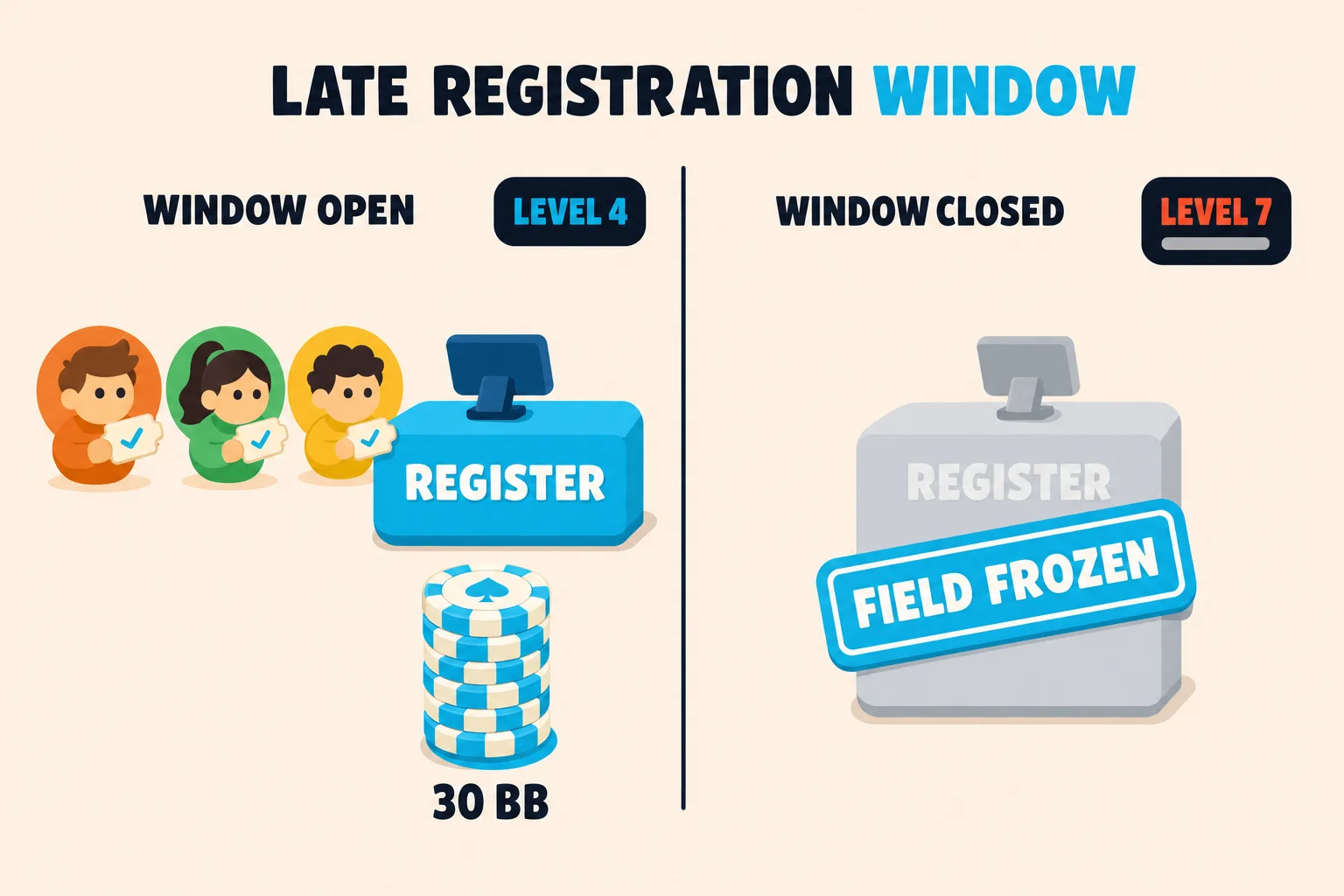
The key fact is the gap between buy-in mechanics and stack-depth mechanics. You pay the same buy-in as the day-one player, but the chips you receive are worth fewer big blinds because the blinds have been climbing without you. Late-registering at the very end of a long window can mean sitting down with 25 big blinds at a level the day-one player reached with 200.
Why the window exists at all
The window exists because tournaments need flexible field-building and players need a way to enter without abandoning the rest of their day. From the operator’s side, a longer window means more entries and a bigger prize pool. From the player’s side, a longer window means more flexibility about when to start playing.
The cost of the flexibility is shorter average stacks at the table during the late-reg window. The deeper into the window you arrive, the more the table around you has compressed.
Related terms
- Stack depth: how the buy-in translates into big blinds; the unit late-reg arrivals lose first.
- Big blinds: the unit your starting stack shrinks against as the window stays open.
- Short stack: what most late-reg arrivals are by the time the window closes.
- Freezeout: the format that decides whether late-reg is your only entry or one of several.
- Bubble: often closer than late-reg arrivals expect, especially in fast structures.
- ICM: the math that says short late-reg stacks are not as bad as they look near the money.
- Nash push-fold: the mode you go straight into when you sit down with 12 to 15 big blinds.
Late registration vs. re-entry vs. rebuy
Three nearby concepts that often get confused. The mechanic that distinguishes them is what happens when you bust, not when you sit down.
| Format | When you can buy in | What happens after you bust | Stack you receive |
|---|---|---|---|
| Late registration | Until the window closes, before busting | You are out (in a freezeout) or eligible for re-entry (in a re-entry event) | Original starting stack |
| Re-entry | After busting, until the re-entry window closes | You buy a fresh seat at a different table | Original starting stack at current blind level |
| Rebuy | After busting (or pre-emptively, depending on rules) until the rebuy window closes | You receive more chips at your existing seat | A new starting stack; add-ons vary by structure |
A single tournament can use late registration and re-entry — they are independent levers. Late registration controls the door for new players. Re-entry controls the door for players who already played and busted. A freezeout-with-late-reg lets you enter late but not re-enter after busting; a re-entry event with a generous late-reg window lets you do both.
When you read a structure sheet, find both lines: how long is the late-reg window, and how many re-entries (if any) are allowed and during what window. The two together describe how forgiving the format is.
When the late-reg decision matters most
The decision is not just “should I late-register?” but “where in the window should I arrive?” The right answer depends on stack-depth math, opponent quality, and how close the bubble is.
- Just after the start. The cleanest version of late-reg. You skip 20 to 60 minutes of slow early play and sit down with most of your starting stack depth intact. Best for players who want most of the day-one strategic options without the wait.
- Halfway through the window. Average outcome. You arrive with a usable but compressed stack of typically 30 to 50 big blinds, and you have to skip past hand-reading and image-building straight into pre-flop ranges that work for your stack size.
- Right before the window closes. The aggressive option. You arrive with 15 to 25 big blinds, often deep into the field, and you go straight into Nash push-fold territory. The argument is real (you get an instant ICM edge near the money), but it is also the version most players misuse.
- In a satellite or qualifier. Late-reg has the strongest theoretical argument here. The flat-payout shape rewards survival, and a short stack near the bubble has dollar-equity that exceeds its chip-share. This is where the “late-reg with a short stack” idea genuinely shines.
- In a fast-structure event. Be careful. If the blind levels are 15 minutes long, the window that looked reasonable on paper may close with the average stack at 12 BB, and late-reg arrivals are in shove-fold mode before they finish stacking their chips.
Example: late-registering an MTT with one hour left in the window
You late-register a $215 multi-table tournament with one hour left in the window. The blinds are 200/400 with a 50 ante; the starting stack is 25,000 chips. You sit down with the full 25,000, which is 62 big blinds at the current level. Five levels later, when blinds reach 1,000/2,000, that same 25,000-chip stack will be 12 BB. The structure has been doing the work without you in the seat.
So your late-reg arrival is simultaneously a 62 BB stack now and an unrecovered 12 BB stack five levels from now. The first hour is the window where you have decisions to make. After that you are short-stacked and your range is narrow.
The play during that first hour:
- Open standard 2.2× to 2.5× from late position with the upper half of your raising range; do not splash with marginal hands when the table has not seen you yet.
- Avoid 3-bet bluffs from out of position. With 60 BB and no read on the openers, you are paying full price for a play that depends on fold equity you have not earned yet.
- Take flips against covering big stacks only when the chip-EV is genuinely strong.
- Watch for the bubble. If late-reg closed with 350 players left and the money pays 100, the bubble is closer than you think. ICM kicks in earlier than your stack depth suggests it should.
The reason to late-register here at all is that you skip the first 90 minutes of the event with no chip exposure. The reason to play tightly for the first hour after sitting down is that you have a stack big enough to play poker but short enough that mistakes compound fast.
Common mistakes
1) Treating the late-reg arrival like a day-one stack
You sat down with the same chip count as the day-one player, so it is tempting to think you have the same options. You do not. Your stack is shorter in big blinds, the table around you has tighter ranges from playing real poker for two hours, and the field is closer to the money. The play that works at 100 BB on hand one is not the play that works at 50 BB on hand 800.
2) Calling too wide instead of shoving
The single biggest leak with a late-reg short stack is calling raises with hands that should be folds or shoves. A short stack’s main asset is fold equity, and fold equity belongs to the player putting the chips in first. Calling a 2.5× open with A♣ J♦ at 18 BB is a chip-EV breakeven at best; shoving the same hand from the cutoff or button when fold equity is real is much closer to the right play. The push-fold chart exists because the math says push or fold; the call is the trap. Near the money it gets stricter still, and Poker Skill’s push/fold charts spell out how: the range you can call an all-in with shrinks faster than the range you can shove.
3) Skipping reads because “you don’t have time”
Late-reg compresses the time you have to scout, but it does not eliminate the value of paying attention. Twenty hands in your seat is enough to flag the loose-aggressive opener, the calling station in the big blind, and the player who min-3-bets light. Players who sit down after late-reg and immediately start clicking buttons leave that information on the table. Use the orbit before you play any meaningful pots.
4) Late-registering on autopilot
Some players late-reg every event because the early levels feel slow. The structure does not always reward this. In a slow-structure event with a long late-reg window, arriving on time means hours of post-flop reps against weaker players at deeper stacks — the most profitable phase of the tournament for a strong player. In a fast-structure event, the same logic flips. Read the structure first, then decide.
FAQ
How long is the late-registration window in most events?
It varies. A typical online MTT runs late-reg for 60 to 120 minutes — about three to six blind levels — and a typical live MTT runs the window for the first three to five levels of day one. The structure sheet for the specific event names the cutoff. Major events can run longer windows for entry-friendly reasons; turbo and hyper-turbo events often close late-reg in 15 to 30 minutes.
Should I always late-register a tournament if I can?
No. The right answer depends on the structure, your skill edge, and the field. If the structure is slow and you have a real edge over weaker day-one players, registering on time is usually better — you give up nothing and gain hours of post-flop play against a softer field. If the structure is fast and the late-reg window closes near the bubble, late-reg has a stronger argument because you skip dead chip risk and arrive in a phase where edges are smaller. The blanket “late-reg every time” or “register on time every time” rule is usually wrong.
Does late registration cost the same as on-time registration?
Yes. The buy-in is the buy-in; you do not pay extra to late-register, and you do not get a discount. The only thing that changes is your effective stack depth at the moment you sit down. Some events charge a small registration fee that is the same regardless of when you enter; that fee is usually folded into the published buy-in number.