


Hand-for-Hand
Hand-for-hand is a tournament procedure where every selected table plays exactly one hand, then waits until every other selected table finishes that same hand before the next deal. It runs near the money bubble, the seat bubble in satellites, and any large pay-ladder threshold. The synchronized clock removes the incentive to stall, makes bustout order clean across many tables, and locks in the ICM pressure of the moment for everyone still alive.
Hand-for-hand: the synchronized-table procedure near the bubble
What hand-for-hand means
Hand-for-hand is a tournament procedure where every selected table plays exactly one hand, then sits and waits until every other selected table has finished that same hand before the next deal goes out. The tournament director announces the switch, the floor staff confirm each table’s status between hands, and the room moves forward in lockstep. Hand-for-hand most often runs at the bubble of a multi-table tournament, at the seat bubble of a satellite, and again at later thresholds where a single bustout would change the pay jump for several finishers at once.
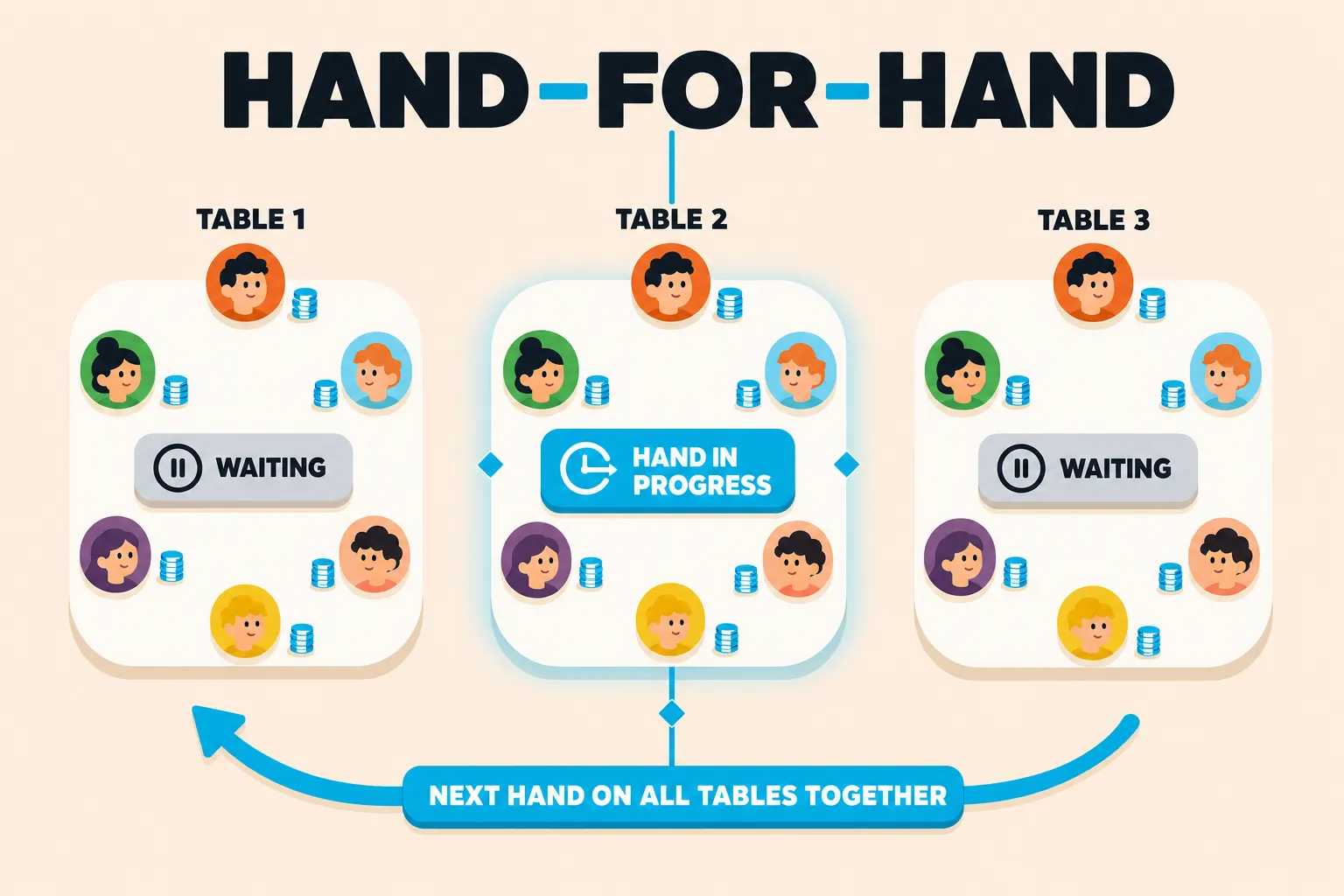
The same cards are not dealt at every table. Each table runs its own deck, its own button, and its own action. Only the clock is synchronized: one hand, full action, then everyone waits for the slowest table before the next deal.
Hand-for-hand vs. the bubble, pay jumps, and ICM pressure
Hand-for-hand is a procedure. The other four travel beside it but mean different things. Keeping them straight removes most of the confusion players have when the floor first calls it.
| Term | What it names | Where it lives |
|---|---|---|
| Hand-for-hand | A synchronized table-clock procedure | The room and the floor staff |
| Bubble | The tournament stage right before a payout threshold | The structure sheet |
| Pay jump | The dollar gap between two consecutive finish positions | The payout ladder |
| ICM pressure | The felt asymmetry between chip and dollar value | The decision in your seat |
Hand-for-hand is the timing mechanism the room uses to keep the bubble fair. The bubble is the moment that triggers it. The pay jump is the dollars at risk on the ladder. ICM pressure is the felt environment those dollars create at the table. A reader who wants the procedure is in the right entry; a reader who wants the math should follow the link to bubble, pay jump, or ICM pressure.
Why directors call it
Without hand-for-hand, two leaks open up across a multi-table room near a payout threshold.
- Stalling. A short-stack player at a slow table can tank every action to let other tables bust ahead of them. The slowest table effectively folds its way past the threshold. Hand-for-hand removes that incentive: stalling at your own table just makes every table wait, and your blinds still come around at the same orbit pace as everyone else’s.
- Ambiguous bustout order. If two players run out of chips on different tables during the same hand, the floor needs a clean rule for who finished higher on the ladder. Hand-for-hand makes that rule simple: both players busted on the same hand-for-hand round, so the official tie-break (most commonly chip count at the start of the hand) decides position. The ambiguity that would otherwise involve clock readings and floor judgment goes away.
A third effect falls out for free: every selected table is on the same ICM clock. The big stack at table 7 cannot accumulate three uncontested orbits while the bubble player at table 12 is folding into the money. Everyone gets the same number of hands across the threshold.
When hand-for-hand is on, and what changes
The procedure is invoked at three classic moments in tournament play.
- Money bubble in an MTT. Most large MTTs go hand-for-hand a few players before the cash. The room stays in lockstep until at least one player busts and the prize pool starts paying.
- Seat bubble in a satellite. Satellites award equal-value seats, so the only finish position that matters is “in the seats” or “out”. Directors usually go hand-for-hand from the seat bubble through the lock-up.
- Final-table bubble and other deep pay-ladder thresholds. Some events run hand-for-hand at the final-table bubble (10th to 9th in a nine-handed final) and again at the most consequential later jumps. Tournament series with very steep top-of-ladder rungs sometimes return to hand-for-hand approaching the final table itself or the last three rungs.
What changes for the players still in the room:
- Cadence slows. Every hand finishes at the speed of the slowest one anywhere in the field. A multiway all-in at table 4 with a long runout pauses every other table for the duration. Wait times of a minute or two between hands are normal; longer waits show up when several tables have action that goes deep.
- Stalling stops working. Tank-folding every action no longer lets you ladder past another table’s short stack. The clock stays parked on the same hand-count for everyone.
- Stack pressure feels heavier. Players have time to read the room between hands, watch other tables on a feature screen, and rethink their stack relative to the effective stack of the player they cover. The extra thinking time tends to push tight players tighter and amplifies the felt weight of every borderline decision.
- Antes and blinds keep their normal rhythm. Each player at each table still posts in the same order. The orbit pace is locked to your table’s button, not to the room. The synchronization is across tables on the same hand number, not across orbits.
- Floor staff become more visible. A floor person or a screen at each table signals “ready” between hands. In live events the dealer pauses with cards mucked until the room is confirmed ready; online clients freeze the next-hand timer.
In Poker Skill’s Seat Map & Blind Rotation lesson you follow the button one seat clockwise and work out who posts next, until the rotation makes you the big blind.
The procedure ends when the bubble has cleared (one or more eliminations have started the money or filled the seats) or when the director announces the room is back on its normal clock.
Example: the seat bubble of a 200-runner satellite
A satellite with 200 entries is awarding 25 equal-value seats. Twenty-six players remain across four tables. The floor calls hand-for-hand. You are at table 2, sitting on 18 big blinds with one short stack and three roughly equal medium stacks at your table; the chip leader is at table 4.
What you experience:
- The dealer at your table deals one hand. Action is folded around to the cutoff, who min-opens. You are in the big blind with K♣ J♦ and fold without much thought, because the cutoff is a medium stack who would not be opening light into a hand-for-hand bubble. The hand ends quickly.
- Your dealer caps the deck. You wait. A glance at the screen shows table 4 has a multiway all-in that needs a long runout. The wait is roughly two minutes.
- The next hand goes out. Action folds around. The button limps. Your small blind completes. You check the big blind with 7♠ 4♥ and check it down to a turn that gives a player two pair; the pot is small and nobody is at risk. The hand ends.
- The cycle continues for another half hour. Most hands end without anyone going broke. Then one short stack at table 1 busts on a flip; the floor announces the bubble has popped and the seats are locked. Hand-for-hand ends and the room returns to normal play to settle final positions for chip count, although the prize itself (the seat) is identical for everyone who made it.
What you would have done differently if hand-for-hand had not been on: probably more stall folds with weak holdings to let the slowest table bust someone first. The procedure removes that lever. Your right play during the procedure is the same play it would have been on a normal clock, weighted by the shape of the seat bubble: tighten calling ranges, keep shove ranges in shape from late position when fold equity is high, and avoid medium-vs-medium collisions you do not have to take.
Common mistakes and confusions
- Treating hand-for-hand as a different game. The math has not changed. ICM pressure is the same as it was the orbit before; the procedure simply locks in the same hand-count across tables. Players who try to invent a hand-for-hand-only strategy usually drift into either over-tightening or boredom-shoving.
- Trying to stall. Tanking every fold buys nothing. Your table waits, the room waits, and your stack still loses the same blinds and antes per orbit. Floor staff also notice repeated tanking and may apply a clock; the dealer and players around you absorb the friction without you gaining anything in the pay jump.
- Misreading the hand count as the orbit count. Hand-for-hand synchronizes which hand every table is on, not which seat is in the big blind. Your orbit position rotates at your table’s pace. Two short stacks at different tables can be in very different blind situations even though the room is on the same hand number.
- Forgetting that the chip leader can still attack. A big stack across the room is not affected by ICM pressure the way the medium and short stacks at your table are. Hand-for-hand does not protect medium stacks from late-position pressure; it only synchronizes when those pressure spots happen. The right adjustment as the medium stack is still tighter calls against covering big stacks, not a default that “hand-for-hand makes everyone fold”.
- Assuming everyone busts on the same hand. Two players who run out of chips during the same hand-for-hand round are scored by the tie-break rule, usually the chip count they started the hand with (the deeper one finishes higher). The procedure does not eliminate ties; it gives the floor a clean way to break them.
FAQ
Do all tables play the same cards during hand-for-hand?
No. Each table has its own deck, its own dealer, and its own action. The synchronization is across the clock (which hand of the bubble round every table is on), not across the cards. The point of the procedure is that the bubble round counts as one shared moment in time across the room, not that anyone is comparing hole cards from one table to another.
How long does hand-for-hand usually last?
The procedure ends as soon as enough players bust to clear the bubble. In an MTT money bubble that often takes a single elimination; in a satellite seat bubble that means the field shrinks to the number of seats available. Live events sometimes spend an hour or more on hand-for-hand if every table is short-stacked and avoiding confrontation; online events tend to clear faster because the cadence per hand is quicker even with synchronization.
Can I leave my seat during hand-for-hand?
Floor staff usually allow short breaks between hands during hand-for-hand, with the same rules as the rest of the event (you keep getting blinded and anted, your hand is folded if you are absent for the deal). Leaving for several hands at the bubble is rarely a winning idea — the orbit cost adds up fast and the procedure can clear before you get back. Most regulars stay at the table and use the wait time between hands to glance at the other tables and check their relative stack position on the clock display.
Does hand-for-hand exist in cash games or sit-and-gos?
It is almost exclusively an MTT procedure. Cash games have no payout ladder, so there is no bubble to defend. A single-table sit-and-go has only one table, so synchronization is meaningless. Multi-table sit-and-gos sometimes use a lighter form of hand-for-hand near the cash, but the room is small enough that the staff can usually handle the bubble informally.