


Hand vs Range Equity
Hand vs range equity is the average win share of one specific hand against the whole set of hands an opponent could be holding. It's the middle level between hand-vs-hand and range-vs-range, and it's the level most real-table decisions live at, because you almost never know the exact hand you're up against.
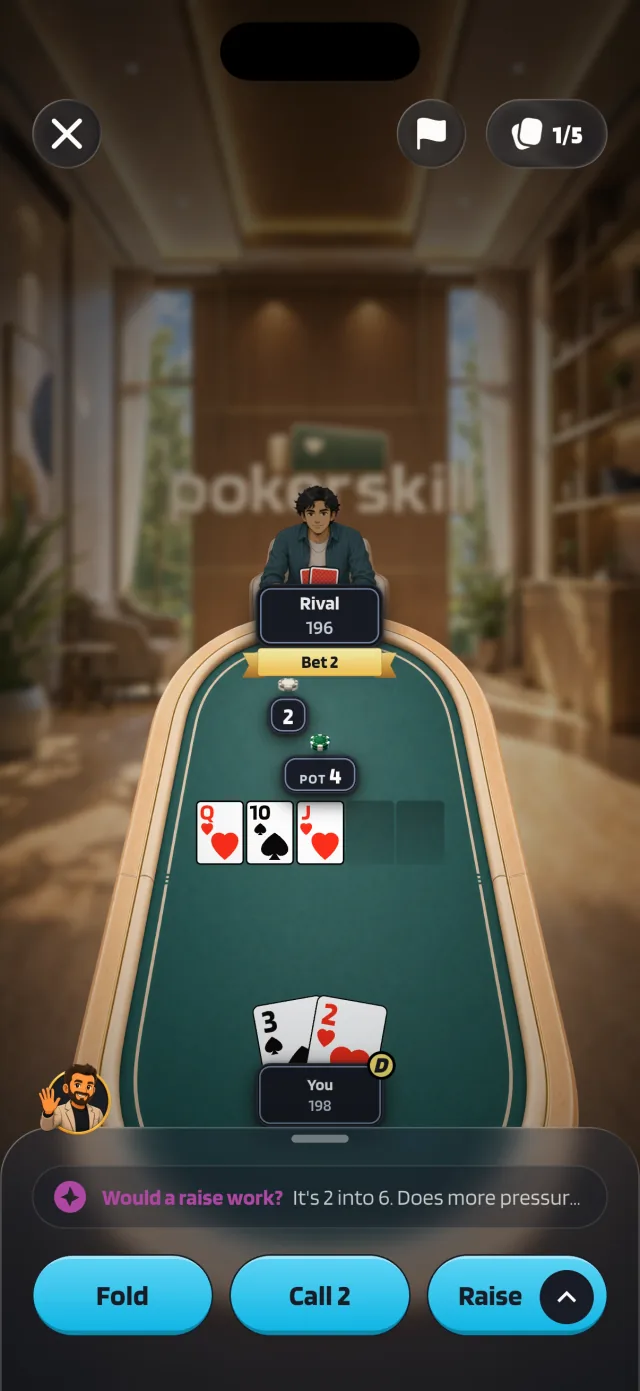
Practice this in Poker Skill. Practice vs AI, full hands against AI opponents, trains range-first thinking: before a close call, Coach Max, the coach at the table, can turn the question to everything the bettor could hold.
Get the free appHand vs Range Equity (one hand against a whole distribution)
What hand vs range equity means
Hand vs range equity is the average share of the pot one specific hand expects to win against the entire set of hands an opponent could be holding, weighted by how often each hand sits inside that set. It’s the middle level on the equity ladder: above hand-vs-hand (your two cards against one specific guess) and below range-vs-range (every hand you can have against every hand they can have). At the table, this is the level you actually solve, because you almost never know the exact two cards on the other side.
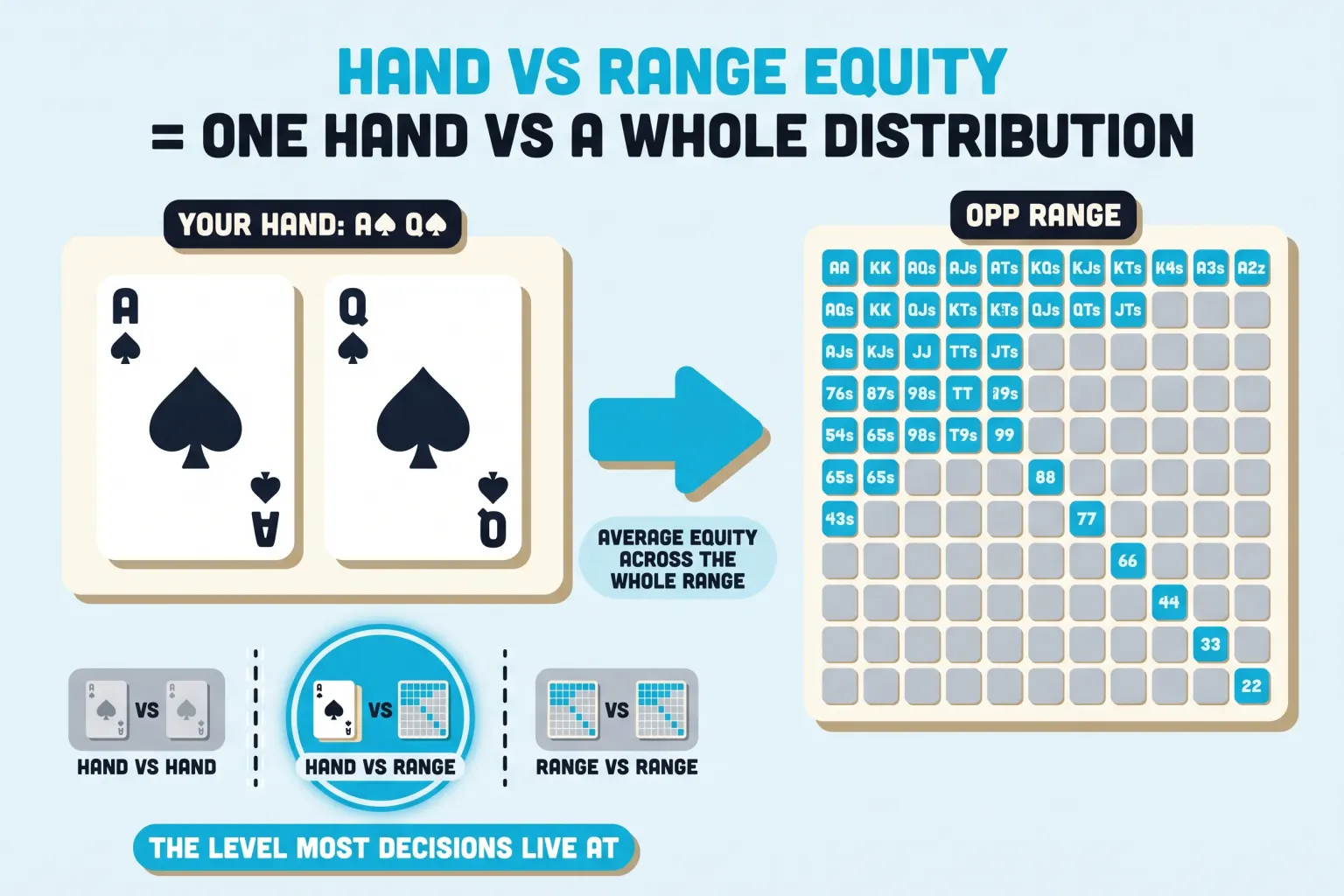
A useful way to keep the levels straight:
- Hand vs hand answers, “if my A♠Q♠ runs into K♥K♦, what’s my share?” One number, exact.
- Hand vs range answers, “if my A♠Q♠ runs into the set of hands they actually defend with, what’s my share on average?” One number, weighted across many matchups.
- Range vs range answers, “across every combo I can have on this board, who is favored?” That’s the level a solver works at.
You hold a specific hand. They hold a specific hand. But the only one you can see is yours. So the practical question is rarely your two cards versus their two cards; it’s your two cards versus the spread of hands their actions are consistent with.
Related terms
Hand vs hand, hand vs range, range vs range
The three frames stack. Each one keeps the layer below and adds new information.
| Frame | What gets compared | When you use it |
|---|---|---|
| Hand vs hand | Your two cards vs one specific holding | All-in vs a known hand, study, end-of-hand review |
| Hand vs range | Your two cards vs every hand they can have, weighted | The default at the table when their hand is unknown |
| Range vs range | Every hand you can have vs every hand they can have | Solver work, building strategy for a whole spot |
Hand vs hand is simple but rarely the real question; you almost never know the one hand. Range vs range is more accurate but expensive: a solver-style answer that’s hard to compute in your head while the action is on you. Hand vs range sits between the two and matches what your brain can actually do at the table: hold your two cards, picture the 6 to 12 hands their action says they have, and ask how you do across the whole picture. That’s the level most live decisions live at.
The shortcut: if you find yourself running one matchup over and over (my AQ vs their AK, my AQ vs their KK), you’ve drifted to hand vs hand and you’re underweighting everything else they could be holding. Reset to the range.
When hand vs range equity matters most
The frame is load-bearing in spots where their hand is genuinely unknown and the price you’re paying depends on the average, not the best or worst case.
- Calling a river bet. You hold a bluff-catcher. It beats every bluff in their line and loses to every value hand. Your equity against the value-only hands is near 0%; against the bluffs it’s near 100%. The number that matters is your average across the whole river-bet range, weighted by how many combos of each they actually have.
- Defending the big blind. You’re getting a price. The question is whether your specific hand has enough average equity against their open-and-bet range to make the call +EV over many runs. Hand vs range gives you that average; hand vs hand can’t.
- 3-bet jam decisions short-stacked. You shove A-Jo for 12bb. The question is your average equity against their call range, not just against AA. A call range of TT+/AQ+ has very different equity for you than a call range of 99+/AJ+.
- Continuation-bet bluffs. You’re choosing whether your specific bluffing combo has enough equity if called against their continue range. A gutshot with two overcards has very different equity against {top pair plus} vs {top pair plus + middle pair + flush draws}.
- River value-bet sizing. Your hand beats the medium part of their range and loses to the top. Average equity against their call range tells you how thin you can size; checking back is the right call when that average is too close to 50%.
When it matters less: spots where you actually do know the matchup (a turn shove into a flopped set, both players announcing tight ranges) — those are honest hand-vs-hand spots. Don’t pretend they’re hand-vs-range.
Example: A♠Q♠ on Q♥ 8♦ 4♣ vs a button calling range
Cash, 6-max, 100bb deep. You open A♠Q♠ from the cutoff to 2.5bb. The button calls; blinds fold. The flop is Q♥ 8♦ 4♣ rainbow.
Asking the hand-vs-range question:
- Build the range. A typical button calling range here is medium pairs (22–JJ), suited broadways (AJs, KQs, KJs, QJs, JTs), suited connectors (T9s, 98s, 87s, 76s), and a sprinkle of offsuit broadways (AJo, KQo). That’s a wide, mostly mid-strength range that smashes some flops and folds to others.
- Sort their range against your hand on this board. Your A♠Q♠ is top pair top kicker. Hands that have you beat: QQ (very few combos because the button often 3-bets queens), 88, 44, sets and two-pair combos that include your top card. Hands that crush you: almost none of their range. Hands that have decent equity but aren’t ahead: pocket pairs underneath the queen (a small slice of outs), suited connectors with backdoor draws.
- Estimate the average. Your specific A♠Q♠ has very high equity against this whole range — roughly the high 70s as a rough illustrative estimate. The exact number depends on which suited connectors and which pairs you actually credit to the range. The point is not the decimal; the point is you’re the heavy favorite across the whole spread, even though against the very bottom (sets) you have ~10% and against the very top (worse pairs) you have ~85%. The average is what drives the bet.
- What changes if their range narrows. Take the same A♠Q♠, but assume the button only continues with sets and over-pairs (AA, KK, QQ, 88, 44). Now your average equity collapses. Hand vs range changes when the range changes. The hand didn’t move; the picture you painted of them did.
That last point is the whole reason this is a frame and not a fixed number. Your equity is a function of the range you assigned, not a property of your two cards.
Example: AK vs a 5-bet jam range
Cash, 6-max, 100bb deep. You open A♣K♦ from the cutoff to 2.5bb. The big blind 3-bets to 11bb. You 4-bet to 25bb. They 5-bet jam for 100bb. The pot is roughly 125bb in front of you, asking 75bb to call.
You’re not facing one hand. You’re facing a 5-bet jam range. A typical solid-reg 5-bet shove range looks like {AA, KK, sometimes QQ at low frequency, sometimes AKs at low frequency}. Some pools include JJ and AKo too; some don’t. The composition matters.
- Against {AA, KK} only, A-K is a coin-flip-shaped underdog — roughly mid-30s equity. Pot odds ask for ~37.5% to break even; you’re below it, the call is -EV.
- Against {AA, KK, QQ, AKs} weighted to typical proportions, your average equity climbs into the low-to-mid 40s. Now the call is roughly break-even, and population reads matter.
- Against a wider, splashier range that includes JJ and offsuit AK, your average climbs further and the call becomes clearly +EV.
You’re not solving this against AA. You’re not solving it against KK. You’re solving it against the mix, and the average is what tells you whether to fold or call. These percentages are illustrative — the real numbers shift with which combos and frequencies you put in the range — but the structure holds: change the range, change the answer.
The same A♣K♦ is in your hand the whole time. Hand vs range did all the work.
Common mistakes
1) Picking one hand and treating it as the whole range
“He has it.” The cleanest leak in poker. You name the one hand that beats you, run the matchup, and act on that one number. Real ranges have many combos, most of which you beat or split with. Force yourself to name three or four hand classes their action makes sense with, and weight each by combo count, before you decide. The combo count is what does most of the work.
2) Forgetting that combos aren’t equal
Pocket pairs come in 6 combos pre-card-removal. Offsuit unpaired hands come in 12 combos. Suited come in 4. So a range of “QQ, JJ, TT, AKs” is not “four hands, average their equity.” It’s 6 + 6 + 6 + 4 = 22 combos, and the suited AK is 4 of them, not 25%. When you average equity across the range, weight by combo count or your number is wrong.
3) Using all-in equity numbers in non-all-in spots
Pulling a hand-vs-range number from a calculator gives you raw equity, the same thing as all-in equity — your share if no more betting happens. Multi-street spots have to also deal with realization: you fold turns, you face raises, you don’t get to see every river. Treating the raw number as final is how a “+EV” call shows up as a quiet leak. Hand vs range equity is a starting input for those spots, not the whole answer.
4) Building the range to fit the conclusion
If you decide you want to call, it’s tempting to pencil in extra bluffs. If you decide you want to fold, it’s tempting to scrub the bluffs out. The honest move is to build the range first — what their action actually looks like across the player pool, on this board, at this sizing — and then run your hand against the picture you built. Your conclusion should fall out of the range, not write it.
FAQ
What is the simplest definition of hand vs range equity?
It’s the average chance your one specific hand wins the pot against every hand your opponent could realistically be holding, weighted by how often each of those hands shows up in their range. One known hand on your side, a whole distribution on theirs. The number tells you how your hand performs on average across that whole spread, not against any one combo you’re picturing.
How is hand vs range equity different from regular equity?
Equity is the umbrella term: your hand’s percentage chance to win at any given moment. Hand vs range equity is a specific way of computing it: your hand against a distribution of opponent hands rather than against one known hand. Most equity numbers people throw around in study are hand-vs-hand (AK vs QQ ≈ 43%), but most decisions in real hands are hand vs range, and the two numbers can be very different.
How do I estimate hand vs range equity at the table?
Start with the range, not the math. Picture the 6 to 12 hands their action is consistent with on this board at this sizing. Sort those hands into “I crush”, “I’m crushed”, and “we’re close.” Roughly weight by combo count — pairs are 6, offsuit unpaired hands are 12, suited are 4. Your number is the weighted average. You won’t get decimals right; you don’t need to. You need to know if you’re a heavy favorite, a slight favorite, a coin flip, or behind, because that’s what tells you what to do.