


Final Table
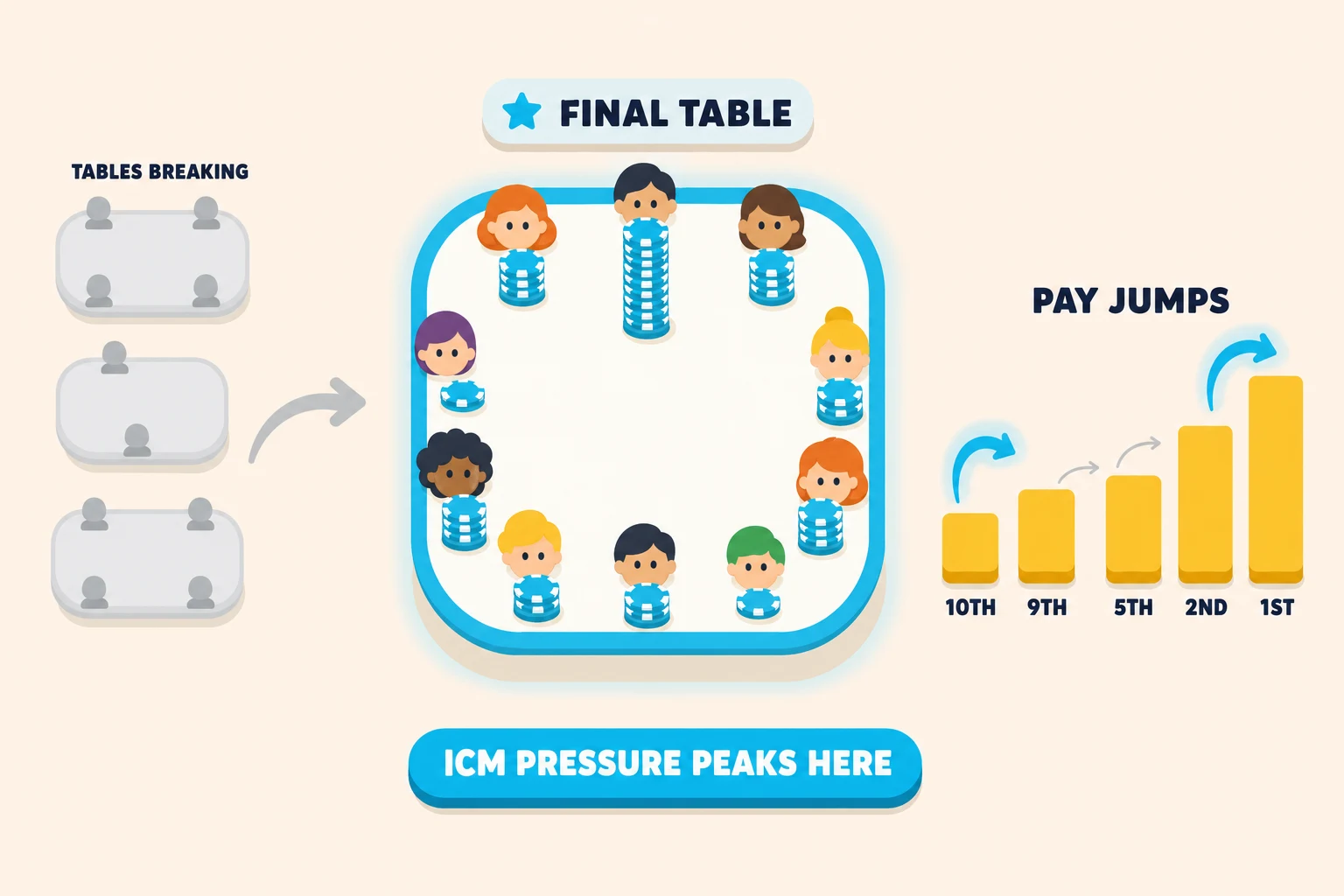
The final table is the last table of a multi-table tournament — the moment many tables collapse into one nine-handed (sometimes eight-handed) table where the steepest pay jumps live and ICM pressure peaks. The bubble into the final table (10th to 9th) is usually the second-largest single jump on the ladder, behind only the leap from second to first. Stack-band incentives diverge sharply once the field is one table: big stacks attack, medium stacks tighten, short stacks shove first and call narrow.
Practice this in Poker Skill. Practice vs AI deals full hands against AI opponents at three-player and heads-up tables, the seat counts a final table plays down to.
Get the free appFinal table: the last table of a multi-table tournament
What the final table is
The final table is the last table of a multi-table tournament, the moment the field consolidates from many tables down to a single eight- or nine-handed table that plays out the rest of the event. It forms by the same break-and-re-seat rule that runs the whole tournament: as players bust, the tournament director keeps the remaining tables balanced, and once enough seats empty out, the last broken table feeds its survivors into the final nine. Most online MTTs and most live events run a nine-handed final table; some live formats, most famously the World Poker Tour’s televised final, wait until six remain before the cameras roll. Either way, the same idea applies: one table, the steepest pay jumps on the ladder, and a decision environment that looks nothing like the deep-stack levels eight hours earlier.
Related terms
- MTT (multi-table tournament): the format whose endgame is the final table.
- Final three: the three-handed slice that lives inside the final table once six players bust.
- Bubble: the money bubble; the final-table bubble is the parallel concept here.
- Pay jump: the dollar deltas that get steepest at the final table.
- ICM pressure: the felt decision environment that peaks at the final table.
- ICM: the model behind the ladder math.
- Short stack: the band that shoves first and calls narrow.
- Medium stack: the band that tightens the most.
Final table vs. final three vs. bubble vs. pay jump
These four travel together but mean different things. Keeping them straight is how the rest of late-stage tournament play stops being confusing.
| Term | What it names | Scope | Where it lives |
|---|---|---|---|
| Final table | The last table of an MTT | A whole stage (8–9 seats down to heads-up) | The single-table endgame |
| Final three | The three-handed slice of the final table | A narrow window (3 seats) | The middle of the final-table stage |
| Bubble | An elimination threshold one bust from a payout step | A moment (one or two hands wide) | The money bubble and the final-table bubble |
| Pay jump | The dollar gap between two consecutive finish positions | A unit ($) | Every step on the payout sheet |
The final table is the stage: the seat count, the table itself, the entire window from the moment nine seats fill up to the moment one player has all the chips. The bubble is a threshold that happens once at the start of that window (the final-table bubble) and again at the very end of the tournament (heads-up). Pay jumps are the dollar units that make the stage bite: the deltas between 9th, 8th, 7th, and so on are what make ICM pressure stronger here than anywhere else. Final three is a slice that lives inside the stage, not a synonym for it.
When the final table reshapes correct play
Three things change the moment the field collapses into one table, and they change at the same time, which is why the final table is its own decision environment rather than just “late MTT.”
- Pay-jump shape gets steeper. Most top-heavy ladders place their two largest single jumps at the final-table bubble (10th to 9th) and at heads-up (2nd to 1st). The intra-table jumps in between are smaller but still meaningful. Reading the deltas on the payout sheet matters more here than at any other point in the tournament.
- ICM pressure peaks. Risk premium, the extra equity a hand needs above the chip-EV breakeven before a call or shove is profitable in dollars, climbs steeply at the final table for medium stacks against covering big stacks. The same call that needs ~50% equity in a cash game can need 55–65% here.
- Stack-band incentives diverge. Big stacks lose less per chip than anyone they cover, so steals and three-bets are paid for by their opponents’ bigger downside. Medium stacks have the most to protect and the worst price on a wrong call-off. Short stacks have to keep pushing first because fold equity is the only edge a 10–15bb stack has.
- Decisions narrow. Effective stacks at the final table are usually shallow enough (10–30bb in most online events, deeper in slow-structure live events) that most pots end pre-flop or with one strong post-flop bet. The deep-stack post-flop game from level one is gone.
- Coverage scrutiny rises. Live final tables get televised; online final tables get streamed and railed. Coverage does not change correct play, but it changes the population of opponents you face — recreational players sometimes tighten visibly when they are on camera, and a few exploit-aware regulars adjust to that tightening.
The final-table bubble (10th to 9th)
The single elimination from 10th to 9th is its own bubble. It works exactly like the money bubble, one bust away from a steep payout step, except the step is much taller. In a typical top-heavy MTT structure, the jump from 10th to 9th is often the second-largest single pay jump on the entire ladder, behind only heads-up. The next few jumps after the final-table bubble (9th to 8th, 8th to 7th, 7th to 6th) are usually smaller, and then the deltas widen again as the final three approach.
That uneven shape has two consequences. First, the medium stack at 10-handed who folds into the final table is making a much larger laddering decision than the medium stack who folds into the money. The dollars at stake per orbit are bigger. Second, once 9th place busts and the field is officially at the final table, the multiplier drops sharply for one orbit before the next steep jump (typically 5th-or-4th to 3rd) starts re-tightening play. The window right after the final-table bubble bursts is one of the cleanest places in the whole tournament to widen ranges, because everyone else has spent the last hour folding and is slow to re-calibrate.
Example: medium stack opens light at a 9-handed final table
Nine-handed online MTT final table. The chip leader has 60 big blinds and covers the table; you are at 22 BB on the button, a clean medium stack. A second medium stack (28 BB) sits in the cutoff. A short stack (8 BB) is two seats away in the small blind, on the verge of being blinded out next orbit. The next pay jump (9th to 8th) is roughly 2 buy-ins; the jump after that (5th to 4th) is steeper; the jump from 2nd to 1st is more than ten buy-ins. The cutoff opens to 2.2 BB. You look down at A♣ J♦.
Pure chip-EV reading is forgiving. A♣ J♦ has plenty of fold equity from the button against a 28 BB cutoff opening range, effective stack is exactly the size that makes a jam mechanically clean (no folds behind that read as extra-strong, no awkward flat-call), and when called you have decent equity against most continuing ranges. Earlier in the same tournament, say, at 200 players left in the money, this is a routine button shove.
ICM pressure changes the picture without changing the hand. The chip leader, whose action you have not yet seen, can call your jam much wider than a same-sized stack would. The cutoff is also a covering medium stack; if they call, you are flipping for your tournament life with one of the steepest pay jumps in the event right behind you. And the short stack in the small blind is one orbit from blinding out — folding past them is worth real dollars to you, and risking that ladder by jamming into a covered cutoff is worth less than it looks.
The honest read here is to tighten the button shoving range by one or two notches at the final table. Jam A♣ J♦ when the cutoff is the shorter medium stack and the chip leader is asleep; flat or fold when the chip leader is awake and the short stack is one round from busting. Same hand, same stack, same cards — different correct decision because the table is the final table.
Common final-table mistakes
1) Survival-only thinking that ignores the next big jump
Folding every marginal hand to “lock in” the next intra-table jump is one of the most common medium-stack leaks at the final table. Most ladders have a small jump or two between 9th and 6th and then a steep jump again toward the top three. Trading a thin laddering gain for the right to bust into the steepest jump on the sheet is exactly the trade ICM math says not to make. The right framing is the next two or three jumps, not the next one.
2) Treating the final table like deep-stack play
A 22 BB shove-or-fold environment is not a 100 BB cash table with bigger pay jumps. Hands that play well deep — small pairs, suited connectors, weak suited aces — lose a chunk of their value once the post-flop game collapses. ICM ranges concentrate strong-by-the-river hands (suited broadways, suited big aces, mid pairs) and shave the speculative bottom of the deep-stack range. Players who carry their early-MTT range into the final table run too many dominated combinations into stronger calling ranges.
3) Mis-reading the chip leader
The chip leader at the final table is not a normal opponent. They cannot bust in the hand, which means their calling threshold is anchored to chip-EV, not to ICM. Shoving into the chip leader is closer to shoving into a player who will call you with the worst of it because the price they pay to be wrong is small. The mistake is using the same shove range against a covering chip leader that you would use against a same-sized stack who fears the next pay jump as much as you do.
4) Fearing the wrong opponents
A short-stack jam is the threat the rail talks about, but the medium-stack open is usually the more profitable attack target. Medium stacks fold under final-table pressure; short stacks who shove first do not. A big stack with cover should be three-betting medium-stack opens wider than they would in a vacuum, exactly because the medium stack is the one who pays the biggest dollar penalty for getting it wrong.
FAQ
Is the final table always nine-handed?
The default in most online MTTs and most live events is a nine-handed final table. Some live formats run eight-handed final tables, and the World Poker Tour historically delayed the televised final until six players remained. Coverage that uses “final table” without a number almost always means nine seats; “TV final table” or “WPT final” can mean six. The decision environment — steep pay jumps, peak ICM pressure, diverging stack incentives — is the same either way.
Why are the pay jumps steepest at the final table?
Top-heavy payout structures are the norm: most of the prize pool is reserved for the top few finishes, with smaller increments for mid-ladder positions. That structure puts the two largest single pay jumps at the entry to the final table (10th to 9th) and at heads-up (2nd to 1st), with several moderate jumps in between. The math comes out of the structure, not the table itself, but the table is where the structure bites hardest because every all-in is one step from a steep ladder rung in either direction.
How is final-table strategy different from heads-up?
Heads-up is the last hand of the final table, but it is its own decision environment. Both stacks have already locked in second place, so the only payout left is the gap between second and first. ICM pressure collapses to “play for the win” once you are heads-up, ranges open up sharply, and the math is closer to a winner-takes-all framing than to the cautious nine-handed start of the final table. Strategy at nine-handed, six-handed, three-handed, and heads-up all live inside the final-table stage, but each is a noticeably different game.