


Exploitative Play
Exploitative play means deliberately leaving a balanced baseline to attack a specific opponent's leak. It is the highest-EV move when you have a real read; it is also the move that makes you exploitable in return when you don't.
Exploitative play: deliberately deviating to attack a leak
What exploitative play is
Exploitative play is choosing your action because you have a read on a specific opponent (or the player pool) and want to punish a leak in their game. It is the deliberate counterpart to a balanced baseline strategy and to GTO. Baseline says “play in a way that has no leak to attack.” Exploit says “I see their leak; I’m pulling a lever specifically to bleed it.”
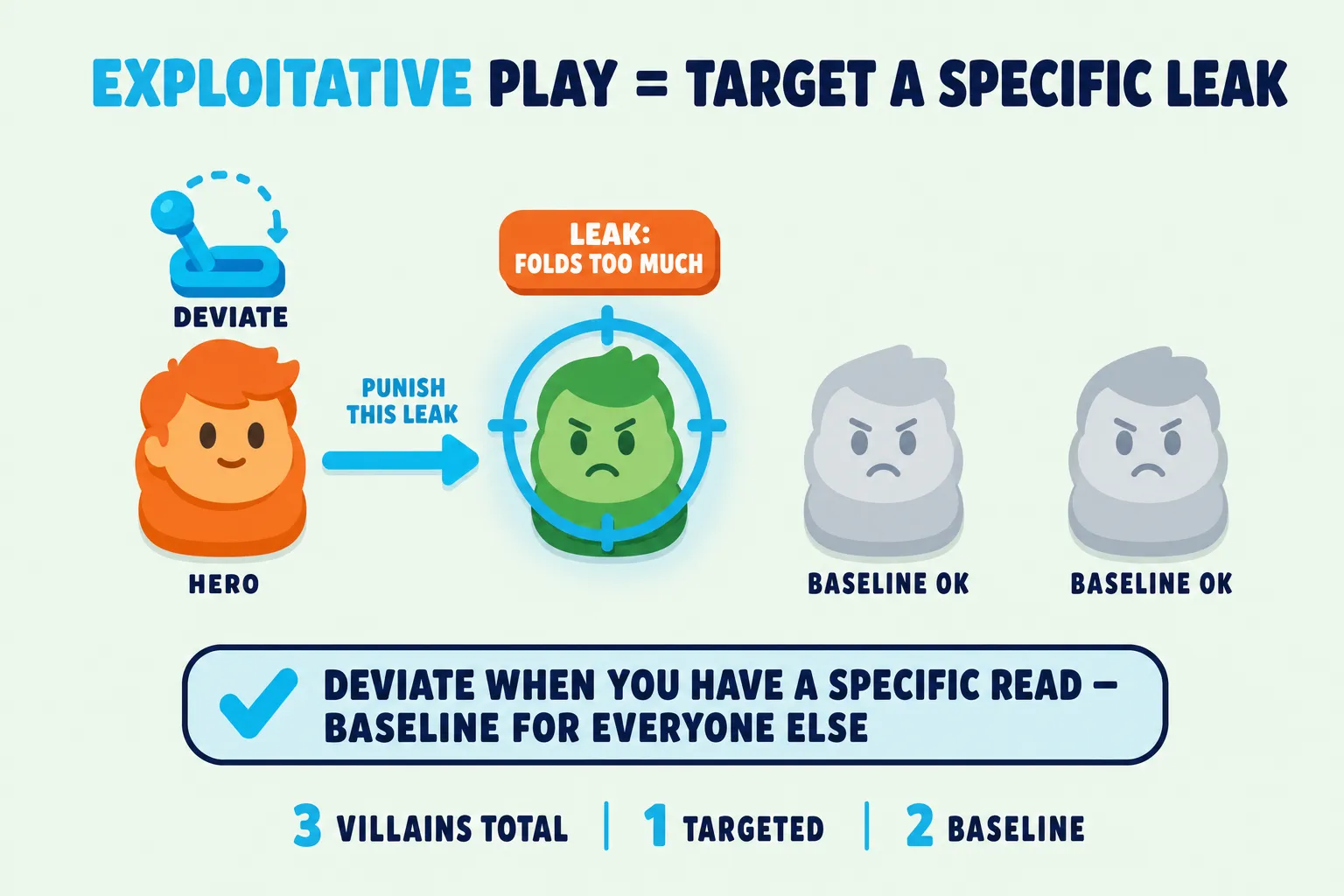
The defining word is deliberate. An exploit is not a hunch, not a hero call, not “I just felt like raising.” It is an answer to a concrete question, usually “is this opponent capable of folding here, calling here, raising here?”, followed by an adjustment in the direction the answer points.
Mental shortcut
- Baseline = “I have no read, so I play in a way that can’t be punished.”
- Exploit = “I have a read, so I deviate in a way that punishes them — accepting that I now have a leak myself.”
- Hero call ≠ exploit. A read-free guess against a vague feeling is not exploitative play. It is a coin flip dressed up as one.
Related terms
- Exploitative deviation
- Population exploit
- Population tendency
- Baseline strategy
- Player read
- Calling station
Exploitative play vs balanced play
Players often hear these two as opposites. They are a default and a deviation.
| Approach | What you assume about the opponent | What you optimize for | Where it loses ground |
|---|---|---|---|
| Balanced / GTO | Capable, paying attention, may counter-adjust | Being unexploitable | Soft tables where opponents have obvious, fixable leaks |
| Exploitative | Has a specific, observable leak | Maximum EV against this opponent | If the read is wrong, or a sharper player notices and counters back |
Most strong players use both. Baseline is the floor you stand on when you have no information. The exploit is the lever you pull when you do. The trap is treating either one as the answer to every spot.
Poker Skill measures play against a baseline too: in Practice vs AI, where you play full hands against AI opponents, Coach Max, the AI poker coach, grades your decisions against the strategy for the spot.
The deviation can also be small or large. A minimally exploitative move makes a small adjustment that still targets the leak; it bleeds less to a counter-exploit if your read is half-right. A maximally exploitative move pulls the lever all the way down. It earns the most when the read is dead-on, and the most when it is dead-wrong.
When exploitative play matters most
Exploit harder when these conditions stack:
- The opponent is clearly off-balance. A calling station, a nit, an over-folder, an over-aggressor. The bigger the gap between their tendency and a balanced range, the more EV you take by deviating.
- The pot is heads-up against the leaker. Side-pots and sharp third parties cut into your edge. Isolation works for the same reason value-bets do: more of the chips you win come from the player you have a read on.
- The stakes are softer. Lower games rarely punish wide opens, light 3-bets, or thin value. The pool’s collective patience to counter you is short.
- You have time to keep updating. Live cash, a long online session, a deep tournament stack — anywhere your read can keep accumulating evidence rather than relying on one hand.
Exploit less when:
- You are playing tough regulars who notice and counter-adjust.
- You are multi-tabling and cannot maintain reads per opponent — the HUD helps, but mental bandwidth is finite.
- The pot is multi-way and your line will be read by a sharper third player.
- The read came from a tiny sample (one showdown, one weird river) and the cost of being wrong is high.
Example: thin-value spots against a calling station
You hold T♠T♦ on a button steal that the big blind defended. Flop comes A♣ 9♣ 3♦. Pot is roughly 8bb, stacks are 92bb behind. The big blind is a calling station you have watched call two rivers light in this orbit.
Baseline line. Most c-bet trees treat ten-ten on an ace-high board as a check-back range hand: middle pair, no value to extract from worse, and the ace blocks much of villain’s calling range.
Exploitative line. Against a station, the read changes the math. Your hand still beats most of villain’s float range: pocket pairs below tens, weak nines, gutshots that called preflop. A calling station won’t fold those even when you bet, and they will rarely raise without a real hand. The deviation:
- Bet a smaller size (about a third of pot, ~3bb) on the flop. Tiny enough that they call with the same wide range, big enough that you are getting paid by hands that fold to a half-pot bet against a thinking opponent.
- Plan a second bet on most turns where the board does not pair the ace or smash a connecting card. Cut your bluff hands from this line, since pure air loses against someone who calls down, and keep the medium-strength hands that picked up showdown equity preflop.
- Skip the river overbet. Stations call medium sizes more often than large ones; pick the bet size their floor is comfortable with, not the size your range would normally use against an attentive defender.
Each step is a deviation. None of it is random. The whole plan answers one question: what does this specific opponent fold, call, and raise? The baseline answer is “balanced sizes with a balanced range.” The exploitative answer is “small sizes, mostly value, no big bluffs.”
Common mistakes
1) Calling a hunch an exploit
A read is a specific claim about a specific tendency: “this player has folded the river to a half-pot bet three times tonight.” A hunch is “this feels weak.” If you cannot finish the sentence “I am deviating because they tend to ___,” you are not playing exploitatively. You are guessing. Guesses lose to baseline over a session, every time.
2) Stretching a population read into an opponent read
A population tendency like “low-stakes online overfolds turns” is a real thing, and it justifies a population exploit. It does not justify treating this specific villain as if you had personally seen them overfold. Specific player reads are stronger than population reads. Treat them as different evidence and size your deviation to whichever you actually have.
3) Pulling the lever all the way on a thin read
One showdown is not five showdowns. Reads accumulate; deviations should scale with them. A faint signal earns a small deviation (slightly thinner value, slightly wider blind defense). A loud signal earns a larger one (size up against the station, cut bluffs entirely, isolate them preflop). Beginners tend to flip the lever fully the first time they spot anything; that is where most exploit losses come from.
4) Forgetting to drift back to baseline
The opponent who folded too much in level one starts defending wider in level four. The pool that overfolded turns last month adapts as the season runs. If the read decays and the deviation does not, you are no longer exploiting — you are off-baseline for no reason and inviting the counter. Build the return to baseline into the plan: re-check your read every orbit, every session, every month.
FAQ
Is exploitative play the opposite of GTO?
Functionally yes, but it is more accurate to call them a default and a deviation. GTO gives you a strategy your opponent cannot beat even if they read your soul. Exploitative play gives you a strategy that beats this opponent more than GTO would, in exchange for being beatable yourself if a sharp player notices. Strong players carry both. Baseline is the floor; the exploit is what you choose to do once the floor is no longer the question.
How big does my read have to be before I deviate?
Bigger than “they look weak.” A useful threshold is three things: a specific tendency you can name, more than one observation backing it, and a deviation whose downside you understand if the read is wrong. A station who has called you down three times tonight clears that bar easily. A player you have watched for one orbit usually does not. The deeper the read, the harder you can pull the lever.
Does exploitative play also apply against the whole player pool?
Yes. That is the population exploit version of the same idea. Pool tendencies (everyone in this game folds turns too much, everyone three-bets too tight from the small blind) work the same way as individual reads, just at lower precision. The deviation is smaller because the evidence applies to a class of opponents rather than one villain, and the counter-exploit risk is higher because any sharp player at the table may notice. The mechanic stays the same: read, deviate, return to baseline if the read decays.