


Population Exploit
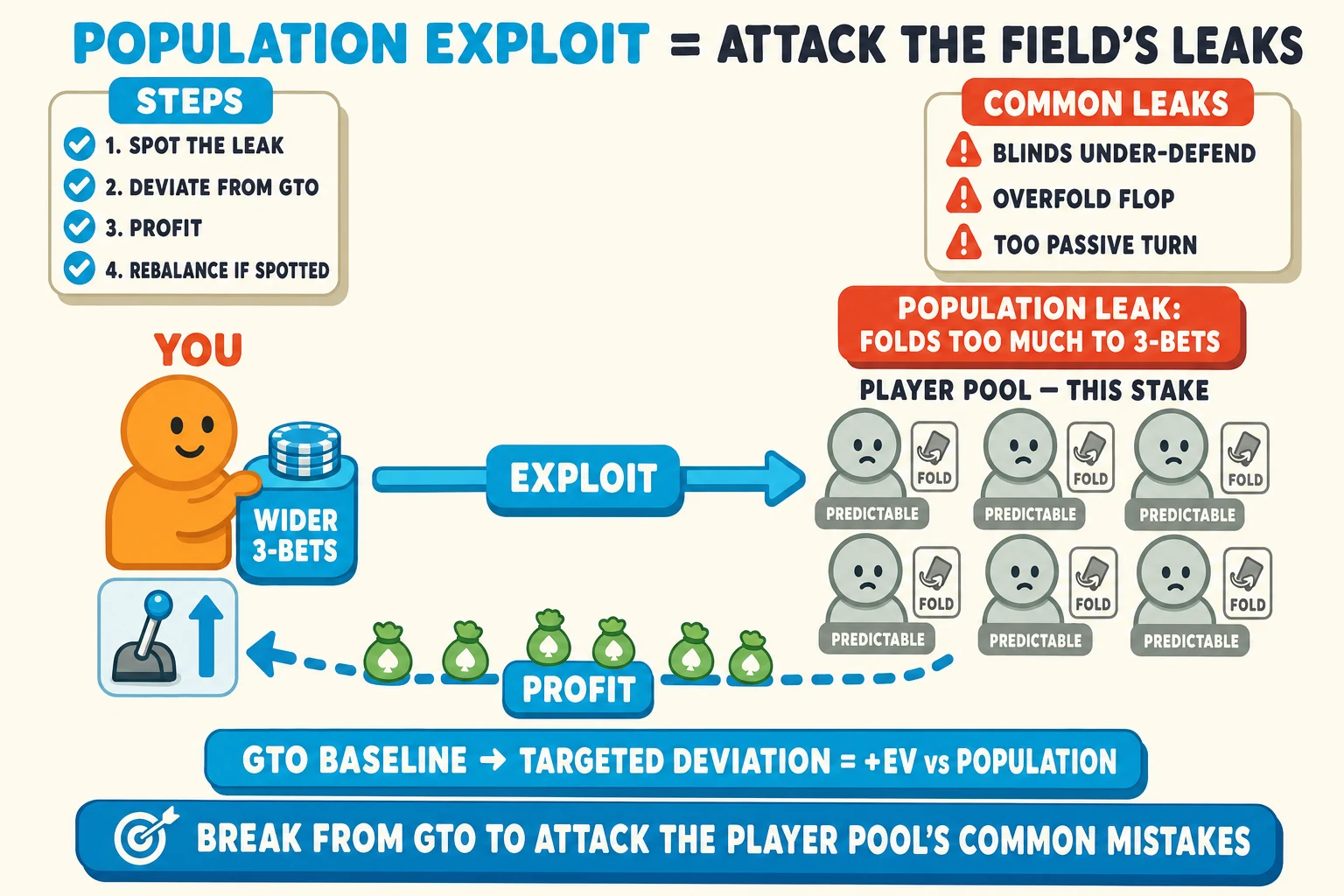
A population exploit intentionally departs from Game Theory Optimal (GTO) strategy to profit from common mistakes across the player pool. GTO aims to be unexploitable. When most opponents make predictable errors-folding too often, calling too much, or under-defending blinds-strict GTO leaves money on the table. For example, if most players fold too often to 3-bets-a 3-bet is a preflop reraise-open and 3-bet more. That adjustment increases expected value but risks counter-exploitation by observant opponents.
Population Exploit: How to Profit from Common Player Tendencies
What a population exploit is (basic definition and why it matters)
A population exploit intentionally departs from Game Theory Optimal (GTO) strategy to profit from common mistakes across the player pool. GTO aims to be unexploitable. When most opponents make predictable errors-folding too often, calling too much, or under-defending blinds-strict GTO leaves money on the table. For example, if most players fold too often to 3-bets-a 3-bet is a preflop reraise-open and 3-bet more. That adjustment increases expected value but risks counter-exploitation by observant opponents.
When to favor exploitative adjustments over GTO
Use exploitative adjustments when you observe repeated, table-wide leaks.
- Favor exploitation when several players share the same leak, such as folding excessively to raises.
- Prefer exploitative play at low and mid stakes where opponents rarely notice or punish deviations.
- Revert toward GTO if the table changes: a capable opponent arrives or begins exploiting your lines.
Example: On the button, when both blinds fold often to 3x opens, widen your range and add preflop pressure. If a competent defender sits in the big blind and 3-bets light, tighten back toward GTO.
Poker Skill’s Button: Raise or Fold lesson teaches the unadjusted version of this spot, a wide open whenever the action folds to you, which is the range that under-defending blinds let you widen further.
How to spot common population tendencies at the table
Use quick practical checks in your first sample of hands-about 30-100 hands.
- Track fold-to-raise, 3-bet, and blind-defense frequencies. High fold-to-raise or rare blind-defense suggests you can open wider and steal more pots.
- Observe postflop habits. Note if opponents call down weak hands, fold predictably to turn aggression, or keep medium pairs too often.
- Use seat-to-seat patterns rather than single hands. A pattern from one seat over 30-100 hands is more reliable than a single sample.
Example: If the small blind calls preflop but gives up on the turn after three bets, add more turn aggression.
Concrete preflop and sizing adjustments to exploit the field
Use solver ranges as your baseline, then make targeted deviations:
- Open wider from late position when blinds under-defend. Add suited connectors and weaker aces to your button range.
- Increase open sizes modestly in live games or versus opponents who play postflop poorly. Larger sizes win more uncontested pots when opponents fold too often.
- Use larger opens and apply more pressure versus opponents who fold frequently. Conversely, tighten value-betting ranges and reduce bluff frequency against heavy callers who call too much.
Against passive defenders who rarely 3-bet, raise more hands for value and continuation-bet more often. Against sticky callers, prioritize strong value hands and cut marginal bluffs.
Managing the risk of counter-exploitation and staying flexible
Monitor how the table reacts. If one opponent begins to 3-bet you light or attack your wider opens, scale back and rebalance.
- Mix balanced lines periodically so you don’t become a predictable exploiter. Include solver-style hands occasionally to obscure your adjustments.
- Continually reassess table composition and be ready to switch between exploitative and GTO-informed play as the group changes.
Checklist: Quick actions to apply at the table
- Check fold-to-raise, 3-bet, and blind-defense rates within your first sample of hands.
- Widen late-position opens and increase sizing only when blinds show under-defense or excessive folding.
- Tighten value ranges or reduce bluff frequency against heavy-callers.
- Mix balanced lines occasionally to avoid being identified as exploitative.
- If skilled counterplay appears, revert toward solver-based defaults and re-evaluate the table.