


Population Line
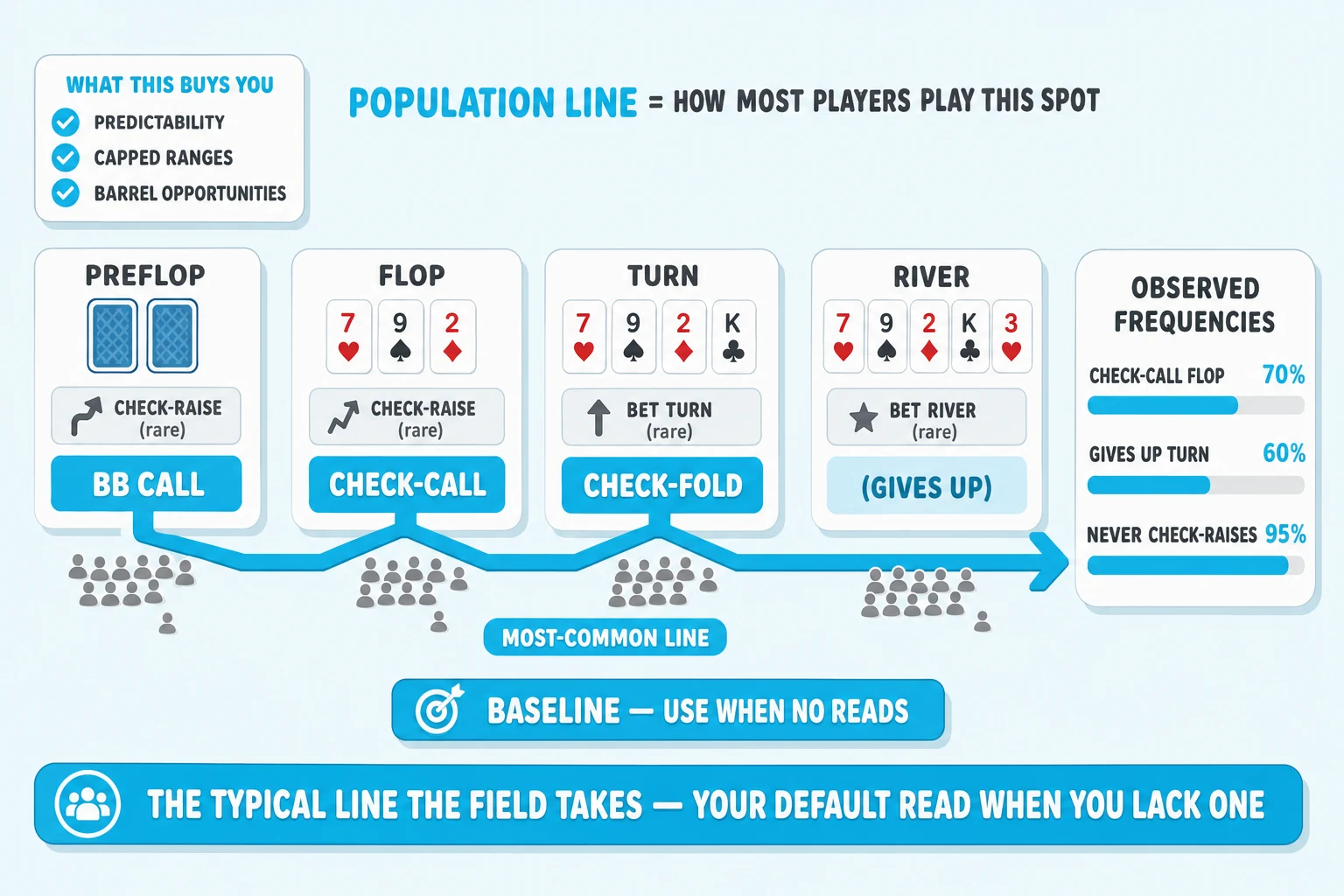
The population line summarizes the aggregate tendencies of the average player pool, not reads on a single opponent. It describes how a typical player at a given stake acts - for example, how often the field three-bets (re-raises preflop), defends the blinds (calls or raises from the small or big blind), or raises on the river. Use population tendencies as a baseline plan when you lack solid reads on any one player. Exploit what most opponents are likely to do, then adjust as you collect individual information.
Population Line in No-Limit Texas Hold’em
What the population line is
The population line summarizes the aggregate tendencies of the average player pool, not reads on a single opponent. It describes how a typical player at a given stake acts - for example, how often the field three-bets (re-raises preflop), defends the blinds (calls or raises from the small or big blind), or raises on the river. Use population tendencies as a baseline plan when you lack solid reads on any one player. Exploit what most opponents are likely to do, then adjust as you collect individual information.
Common population tendencies (leaks) to watch for
Most fields make predictable mistakes you can exploit.
- Playing too many starting hands. Players limp or call raises with marginal holdings and enter large pots without a plan. Example: cutoff opens to 3x and a player calls with 9♣7♣, then calls flop and turn bets - punish with position and aggression.
- Passive play, especially out of position. Opponents often check-call instead of betting or raising; check-call means calling when checked to. Example: you raise from the button, a blind calls, and then check-calls the turn with one pair - extract value by betting thinner.
- Predictable three-betting and blind-defense patterns. Many three-bet only with premiums and either defend blinds too weakly or too widely. If a stake rarely three-bets light, treat three-bets as strong and fold marginal hands.
- Board-texture predictability. Players tend to over-fold to heavy turn pressure on dry boards and over-call on paired or draw-heavy boards.
How to observe and record population tendencies
- Track frequencies. Record how often opponents three-bet, defend blinds, check-raise, or bet the river. Keep simple counts: hands observed, occurrences, and percentage.
- Keep concise session notes. Short notes work best: table, stake, sample size, and key frequencies. Example: “$1/$2 live, 3 tables, 120 hands - 3-bet seen 6x, mostly vs opens; blind defend loose vs button steals.”
- Look for recurring patterns across sessions. Single-table behavior can be noise; trends across sessions reveal real tendencies. Compare observed numbers to your stake expectations to find exploitable deviations.
Translating population trends into in-game adjustments
- Tighten versus three-bets when the field rarely three-bets light. Example: you open A-Js to 3bb and face a 9bb three-bet - folding A-Js is often correct against a tight three-bet range.
- Attack capped preflop caller ranges with pressure. Callers who just call preflop often lack strong hands; put them to tough decisions postflop. Example: you open from the cutoff, big blind calls, flop K-8-2 rainbow - bet for value and fold out weaker hands.
- Exploit passive tendencies by betting more thinly. If opponents rarely raise as a bluff or punish thin value bets, increase value-bet frequency and use position to isolate weaker players.
Poker Skill’s Basic Betting Strategy lesson practices the default version of the second adjustment, where the preflop raiser bets a dry K-9-3 flop that misses both players and keeps the lead.
Balancing population line with individual reads and limitations
Use the population line as your default plan when you lack player-specific information. Shift toward individual reads as you gather notes and hand samples; the population line should complement, not replace, direct observations. Remember averages can be wrong for a particular opponent or small samples. If one player consistently deviates from the field, prioritize that live read over the average.
Quick checklist
- Note 3-bet, blind-defense, check-raise, and river-bet frequencies for your stake.
- Fold marginal hands to 3-bets if the population shows tight three-betting tendencies.
- Attack capped preflop caller ranges with targeted postflop aggression.
- Keep short, consistent session notes and update adjustments as samples grow.