


Dominated Draw
A dominated draw is a draw that can improve and still finish second-best to a higher version of the same made hand or a stronger draw path. Out count alone hides the problem; draw quality is what actually matters.

Practice this in Poker Skill. The Nut Flushes & Monotone Boards lesson drills the dominated flush draw: K♥ 9♥ on Q♥ 7♥ 2♣ counts as a non-nut draw because an ace-high flush beats it when a heart comes.
Get the free appDominated Draw in No-Limit Hold’em
What a dominated draw is
A dominated draw is a draw that can complete and still finish behind. The card you wanted comes, you make the hand you were chasing, and someone already has, or now also has, the better version of it.
The classic shape is a non-nut flush draw against a range that contains a higher flush draw or a stronger flush already. You hit a card that looks like a winner. You bet it like a winner. Then the bigger flush calls or raises and wins the pot.
Out count is not the whole story. Two players can both have “9 outs to a flush” and have very different hands. The one drawing to the nut flush is in good shape. The one drawing to the second-best flush is in a dominated draw and is going to pay off the better hand whenever both connect.
Dominated draw vs clean draw vs dirty out
These three terms get tangled together. Keeping them separate makes spotting trouble much easier.
- Clean draw: when you hit, you almost always have the best hand. A nut flush draw on a non-paired board is the textbook case.
- Dominated draw: the whole draw is structurally weaker than draws inside the opponent’s range. Example: a king-high flush draw against a range that contains the ace-high version, or a sucker-end straight draw against one with the high-end straight draw.
- Dirty out: an individual card inside an otherwise reasonable draw that is risky on its own, like a flush card on a paired board, or a straight card that also completes a higher flush.
A dominated draw is upstream of dirty outs. The whole path is the problem, not just one card.
If your draw is dominated, expect to fold more, semi-bluff less without backup, and chase only when the price and stack depth give you room to fold when villain’s strength is obvious.
Why dominated draws cost more than they look
Counting nine outs and multiplying by 4 looks like ~36% equity by the river. That feels like enough to call almost any reasonable price. The trap is what happens when you hit.
The math you see at the table is raw equity. The math that decides your stack is equity realization: how much of that equity you actually keep once both players play the rest of the streets. Dominated draws under-realize for three reasons:
- Some hits are walking into a bigger hand. When the opponent’s range contains the dominator, you complete a flush and immediately face the bigger flush. The pot you win when villain has nothing is small. The pot you lose when villain has the nuts is enormous. That asymmetry shows up as reverse implied odds.
- You can’t credibly bluff the rivers you wanted. When the third heart comes in, the very card you were drawing to is also the card the opponent’s nut-flush hands love most. The natural bluffing river is now the one where villain is least likely to fold.
- Cold runouts still cost. When you miss, you fold whatever you put in. When you hit, you lose more. The “good” outcome is no longer reliably good.
That is the real cost of a dominated draw: not the missed turn, but the hit you pay off.
Why multiway, deep stacks, and tight ranges make it worse
A dominated draw at six-max heads-up versus a wide button raise is one situation. The same dominated draw multiway against an early-position raiser is a different one. The variables matter.
Multiway pots
Every extra player adds another range that can contain the dominator. Two opponents covering the suit means roughly twice as many ways for someone to already hold A♥x or K♥x on a hearts board. The non-nut flush draw was always vulnerable. With three or four players to a flop, it is structurally too weak to continue in many lines.
Deeper stacks
Deep stacks turn small mistakes into stack-off mistakes. With 100bb behind, a hit that goes to showdown gets there cheaply. With 250bb behind, the same hand has multi-street commit potential. Reverse implied odds scale with stack depth: the deeper the stacks, the more the dominator collects on the streets after you hit.
Tight, value-heavy ranges
A loose-passive opener has plenty of weak hearts in their range. A tight UTG raiser does not. Their 4-bets and big-bet lines are full of A♥x suited combos and high broadway hearts. The same draw that plays fine against a wide range plays terribly against a narrow value-heavy one, because the dominators are the exact hands that are still in.
When all three stack together (multiway, deep, and tight ranges), even strong-looking draws are often dominated draws in disguise.
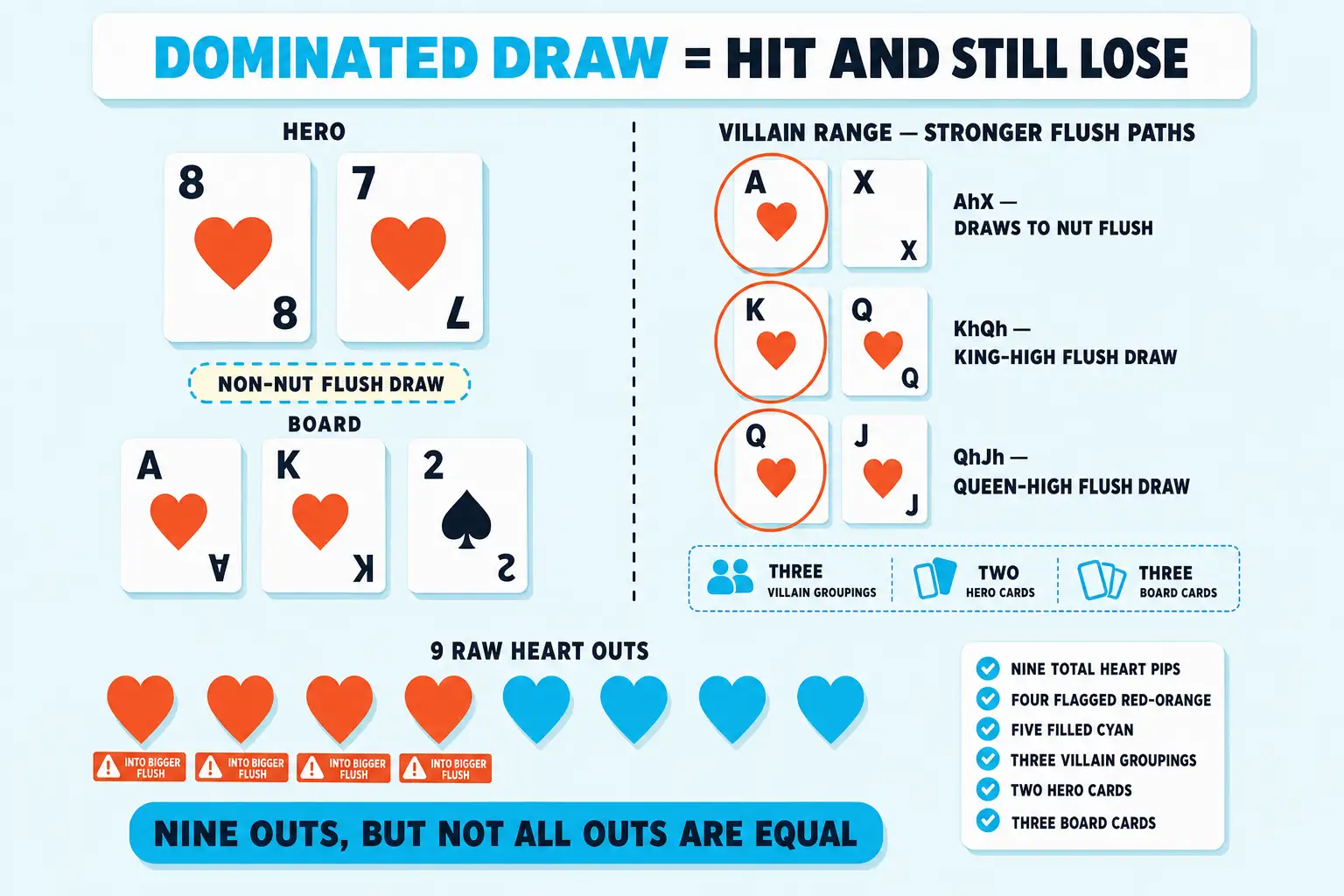
Example: 8♥7♥ on A♥K♥2♠
This is the cleanest beginner example for the concept.
Hero: 8♥ 7♥ Flop: A♥ K♥ 2♠ Action: Tight player opens UTG, multiway flop, hero faces a sized continuation bet.
At first read this is a flush draw with two backdoor straight outs. Nine flush outs sounds healthy.
Now look at the opponent’s range:
- A♥x suited combos like A♥Q♥, A♥J♥, A♥T♥ already have the made nut flush draw, and any heart on the turn or river makes them the nut flush.
- K♥Q♥, K♥J♥ are drawing to a king-high flush, which still beats hero’s eight-high flush.
- Q♥J♥, Q♥T♥ are drawing to a queen-high flush, also still ahead of hero.
That covers the entire top of the suit. Hero’s draw is dominated by every meaningful heart hand the tight UTG opener can show up with.
What this means in practice:
- Raw outs: 9 flush outs.
- Effective draw quality: lower, since many of those hits land into a higher flush.
- River play if a heart hits: mostly check-fold; the third heart that completes hero is also the card that turns A♥x into the nuts.
- River play if hearts miss: eight-high. Folding to any pressure.
- Deep-stack overlay: worse. The deeper the stacks, the more the dominator collects when both players hit.
This is not a “fold all the time” lesson. It is a “stop pricing this draw the same way you’d price A♥Q♥ on the same board” lesson. The price has to be much better, the stacks shallower, or the field tighter and smaller, before the math works.
For a guided walk through the same hand, see the flush-draw and reverse implied odds entries; they share this exact example for the same reason.
These numbers and ranges are illustrative. They show how the spot looks at the table, not a solver claim.
Common mistakes with dominated draws
1. Counting outs and stopping there
Nine outs only matters if those nine cards usually win when they hit. With a dominated draw, several of them connect into a higher version of the same hand.
2. Treating “I have a draw” as license to call any price
A nut flush draw can call a wide range of sizes correctly. A dominated flush draw cannot. The shape of the draw decides the price you can pay, not the existence of the draw.
3. Semi-bluffing the dominated card
Betting big on the third-flush river while holding the eight-high flush turns hero into a bluff catcher for the opponent’s nut flush. The river that finally completes the draw is often the worst river to barrel.
4. Pricing dominated draws the same multiway as heads-up
Multiway adds dominators. Multiway also adds the player who only continues with hands strong enough to pay off when hero hits. Both effects push the same direction.
5. Confusing dominated draw with dirty outs
Dirty outs are some of the cards in your draw. A dominated draw is the whole draw. A draw can be both, but they are not the same diagnosis.
FAQ
What is a dominated draw in poker?
A dominated draw is a draw that can improve and still lose. The cards you are chasing complete a hand that is structurally weaker than hands inside your opponent’s range, most often a non-nut flush draw against a range with the higher flush draw or the made nut flush draw.
Is a king-high flush draw dominated?
It depends on the range you are facing. Against a wide late-position opener it is usually fine. Against an early-position raiser whose range is loaded with A♥x suited and big-broadway hearts on a hearts board, a king-high flush draw is often dominated.
Why do non-nut flush draws lose more in multiway pots?
Each extra player adds another range that can contain the dominator. Multiway pots also tend to go to showdown more, so the times the dominated draw connects into a second-best flush get realized as actual stack losses instead of folds on earlier streets.
How is a dominated draw different from dirty outs?
Dirty outs describe individual risky cards inside a draw. A dominated draw describes the whole draw, where the path itself is structurally behind. A draw can have dirty outs without being dominated, and a dominated draw can have outs that are still individually clean against weaker villains.
Should you ever chase a dominated draw?
Sometimes. When the price is good, the stacks are shallow enough to cap how much you lose on the hits, the field is small, and the opponent’s range is wide enough that the dominators are not over-represented, a chase can be fine. The default posture is caution, not auto-fold.