


Disconnected Board
A disconnected board is a flop whose ranks sit far enough apart that no straight is live and no straight draw has more than a couple of outs. The classic shape is a high card with two scattered low cards like K-8-3 or A-7-2 rainbow. Disconnected textures favour the preflop raiser, support high c-bet frequencies, and keep equity static all the way to the river.
Practice this in Poker Skill. After you raise and one player calls, A♠ Q♦ on K♦ 7♣ 2♠ takes a small c-bet in the beginner flop lessons, because a flop that dry barely connects with the calling hands.
Get the free appDisconnected Board
What is a disconnected board?
A disconnected board is a flop whose ranks sit far enough apart that no straight is live on the flop and no straight draw has more than a few outs. The textbook shape is a high card with two scattered low cards: K-8-3, A-7-2, Q-6-2. The single useful test is to count the flopped straights the texture allows. K♣ 8♦ 3♥ has zero. A♠ 7♦ 2♣ has zero. Compare that to 9-8-7, which has two. The fewer straights and gutshots a board supports, the more disconnected it is, and the more the preflop raiser’s range advantage stays intact through the runout.
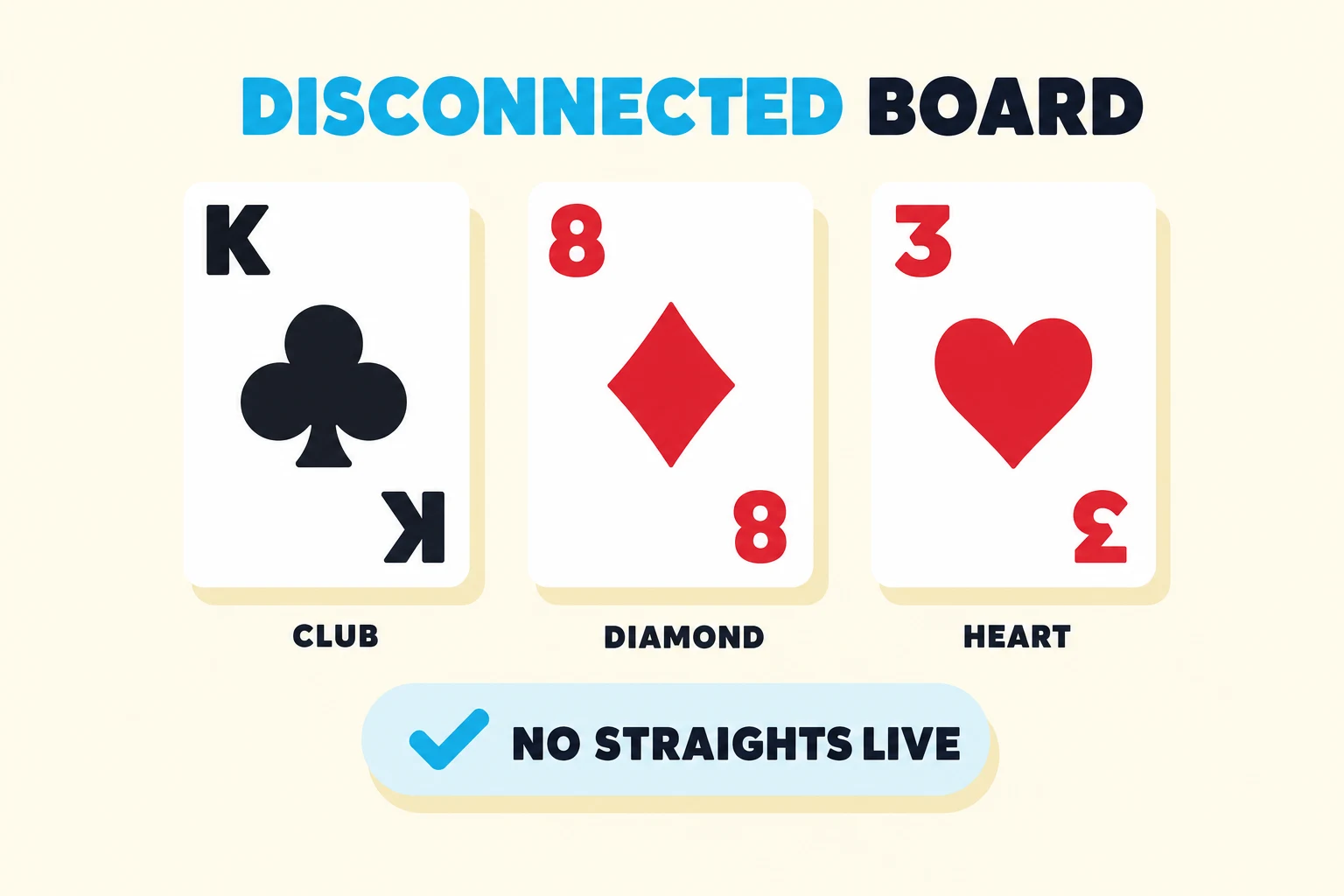
Disconnected vs near-connected: where the line sits
Three sub-shapes show up in practice. High-card disconnected flops pair a Broadway card with two low scattered cards (K-8-3, A-7-2, Q-6-2). The raiser keeps a heavy share of strong hands and the caller’s range mostly misses. Low-card disconnected flops are sometimes called parched: three low ranks with no draws live (7-4-2, 9-3-5, 8-3-2 rainbow). These play similarly but the raiser’s high-card hands miss too, so the c-bet works on range advantage rather than absolute hand strength. Borderline disconnected flops have one stretched gap (K-9-3, A-9-4): a single gutshot exists for a tiny slice of the caller’s range, but the texture still behaves like a dry board for sizing and frequency decisions. Anything tighter than that, like K-T-7 or J-9-5, has crossed into near-connected territory.
Related terms
- Connected board — the direct contrast: ranks stack close, straight draws live everywhere.
- Dry board — the working synonym most players reach for first; in practice “dry” and “disconnected” name the same family.
- Wet board — the umbrella for high-equity-shift textures that disconnected flops sit outside of.
- Rainbow board — three different suits; a near-default modifier that makes a disconnected flop even drier.
- Board texture — the parent concept this entry sits under.
- C-bet — the action disconnected flops support more than any other texture.
- Range advantage — the strategic mechanism that pays the c-bet.
Disconnected vs other “dry-leaning” textures
Disconnected boards are not all the same. The table below reads left to right from the most extreme range advantage for the raiser to the textures where the gap starts closing.
| Board type | Example | Flopped straights | Defining feature | C-bet posture |
|---|---|---|---|---|
| High-card disconnected, rainbow | K♣ 8♦ 3♥ | 0 | One Broadway, two scattered low cards, no flush draw | Very high frequency, ~½ pot |
| Ace-high disconnected, rainbow | A♠ 7♦ 2♣ | 0 | Ace anchors raiser’s range, caller mostly misses | Very high frequency, ~½ pot |
| Parched (low-card) disconnected | 7♥ 4♣ 2♦ | 0 | Three low cards, no draws | High frequency, smaller size |
| Two-tone disconnected | K♠ 8♠ 3♥ | 0 | One backdoor flush draw, no straights | High but trimmed, mixed sizes |
| One-gap connected | T♥ 8♣ 7♦ | 1 | OESD plus gutshot live | Lower frequency, larger size |
| Sequential connected | 9♥ 8♥ 7♣ | 2 | Two straights, flush draw, equity flips fast | Mostly check, polarize when betting |
The big jump on this scale is between two-tone disconnected and one-gap connected. Adding a single straight to the flop roughly doubles the raiser’s incentive to check, because the caller’s range starts catching up fast on equity even when nothing made yet.
When disconnected boards matter most
The texture pays best in a few specific spots:
- Late-position open, single caller. BTN or CO opens, BB calls. The raiser’s range is loaded with high cards and pocket pairs. K-8-3 hits more of that range than the BB’s. A small-to-medium c-bet collects pots that the BB never planned to fight for.
- Heads-up. The raiser’s range advantage is a function of two ranges only; it shrinks fast in multiway pots.
- Rainbow flops. Rainbow is a near-default modifier on disconnected boards because the absence of a flush draw makes equity even more static, which lets the bigger range advantage do more work.
- High-card flops with one Broadway. The Ace or King anchors the raiser’s range; the caller has only a sliver of strong hands and a wider field of two-overcards-no-pair combos that fold to a small bet.
The texture matters less when the caller’s range is unusually weighted toward small pocket pairs (a tight EP open vs BB call), and on monotone or paired boards, where the rank disconnection still holds but the equity behaviour shifts because suit coordination or the pair itself starts driving the action.
Worked example
You open the button to 2.5bb with A♠ J♥. The BB calls. The flop comes K♣ 8♦ 3♥ in a single-raised pot, ~100bb effective.
Hand-read first. The BB’s calling range is full of small and medium pocket pairs (22 through QQ), suited Broadways (KQ, KJ, QJ, JT), suited connectors that mostly missed (98s, 87s, 76s), and a long tail of suited gappers and Ax-suited that landed nothing. Strong hands on this flop are limited: KK (3 combos), 88 (3 combos), 33 (3 combos), KQ-suited and KJ-suited that flopped top pair, and a couple of K-x suited combos that the BB might or might not be calling preflop. The bulk of the BB’s range either flopped a single small pair (88-22 below the king) or completely missed.
A♠ J♥ has two overcards and no draw. Equity against the BB’s continue range hovers around 35–45%, which is not the point. The point is that the BB’s range is mostly trash on this flop, and a small c-bet folds out everything from JT to 65s in one motion. A half-pot bet (around 2.6bb into a 5.5bb pot) is the textbook size: it gives the BB a bad price to chase backdoor draws, gets folds from the long tail of unimproved hands, and leaves a workable stack for a turn barrel on most cards if the BB calls. Bigger sizes lose folds without earning more from the strong hands the BB will defend regardless. Smaller sizes leave money on the table by giving live overcards a cheap continue.
Common mistakes
1) Sizing as if every board were the same
The biggest single leak. Many players settle on one c-bet size, ¾ pot or pot, and use it everywhere. On a disconnected board the BB’s range cannot fight back, so a half-pot bet does the work of a pot-size bet at half the cost. Carrying a wet-board sizing here pays the BB’s strong hands extra and saves nothing.
2) Auto-giving up after a single call
A flop call from the BB on K-8-3 rainbow is not a strong hand most of the time. It is a small pair, a backdoor draw, or a stubborn ace-high. Plenty of turns improve the raiser’s perceived range (any Broadway overcard, any card that completes a gutshot for the bluffing combos in your range). Firing again is often the right call; folding to your own preflop range every time the BB calls once is how value gets left behind.
3) Overplaying one pair as if it were two
A♠ K♥ on K-8-3 is one pair, not a monster. On a disconnected board the equity does not shift much, so the value of getting three streets of value is real but not infinite. Pot-control on the turn against passive opponents, especially out of position, beats blind aggression. Three-street value comes from finding the spots where the BB cannot fold a worse king, not from assuming every BB calldown is one.
4) Ignoring multiway
Two callers on K-8-3 changes the math. With two opponents the chance somebody has a king or a pocket pair is high enough that the high-frequency c-bet collapses. Tighten the c-bet range to genuine value and the strongest semi-bluffs, and check more of the marginal stuff back. The single-raised heads-up math does not transfer.
FAQ
Is a disconnected board the same as a dry board?
For practical purposes, yes. Most poker books use the two terms interchangeably; “dry” is the working vocabulary that shows up at the table, “disconnected” is the more precise label that emphasises the rank-distance feature. Every disconnected board is dry. A handful of dry boards (paired flops like K-K-3) are dry without being disconnected in the rank-distance sense, but for sizing and frequency decisions the strategic implication is the same.
Does the texture stay disconnected through the runout?
Often yes, and that is exactly what makes the texture so friendly to a high c-bet frequency. Blank turn cards (offsuit small or middling cards that do not pair the board) keep equities almost flat, which means the value hands stay good and the bluffs do not get punished on the river. The runouts that change the picture are scare overcards (Ace on K-8-3, King on Q-7-2) that fold out marginal pairs, board-pairing cards (turning the 8 on K-8-3) that introduce trip combos, and runouts that put a flush draw on the board for the first time.
Why do disconnected boards favour smaller c-bets, not larger?
The raiser’s range advantage on a disconnected high-card board is wide and shallow: lots of medium-strong hands, very few monsters. A smaller bet keeps the marginal hands in the c-betting range without overcommitting them, holds a workable SPR for the turn, and still folds out the long tail of unimproved hands in the caller’s range. Larger sizes only earn extra from the strong hands the caller defends anyway, while losing folds from the marginal junk that is happy to fold to almost anything.