


Open-Limp
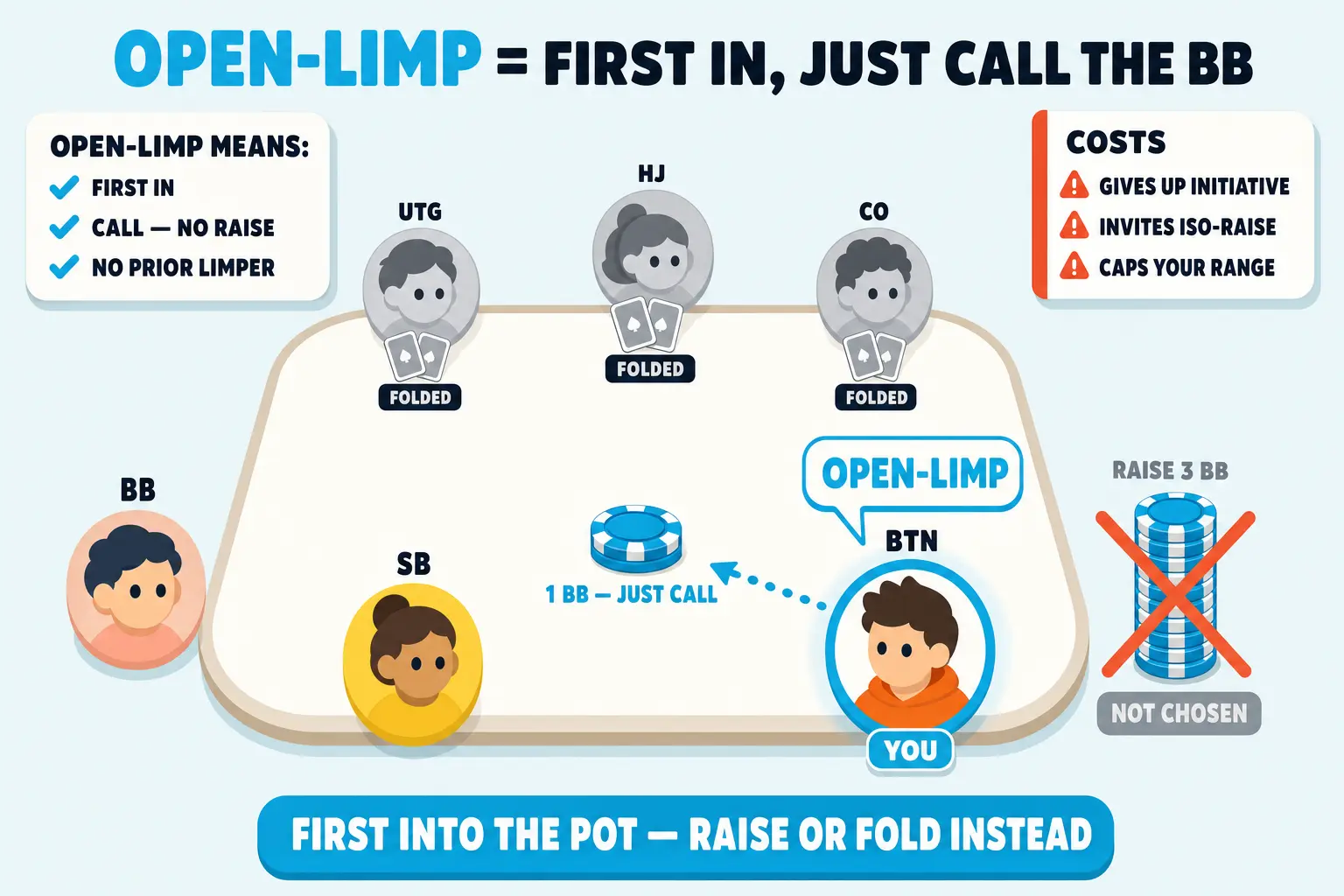
An open-limp is a limp made when you are first into the pot preflop, calling the big blind instead of raising or folding. The limp action itself just means matching the big blind, but "open" tags this as the opening voluntary chips, not a follow-on call behind another limper. Open-limping concedes initiative, invites isolation raises, and caps your range, which is why a raise-or-fold default usually beats it.
Practice this in Poker Skill. In the Raise or Fold (No Limping) lesson, T♦ 9♦ on the button is a raise, since raising first keeps the pot simpler and avoids a limped multiway flop.
Get the free appOpen-Limp in No-Limit Texas Hold’em
What an open-limp is
An open-limp is a limp made when you are first into the pot preflop, calling the big blind instead of raising or folding. The limp action itself just means matching the big blind, but “open” tags this as the opening voluntary chips, not a follow-on call behind another limper. Open-limping concedes initiative, invites isolation raises and caps your range, which is why a raise-or-fold default usually beats it.
Example: in a $1/$2 cash game, UTG folds to MP, and MP slides $2 forward instead of raising. That $2 is an open-limp because no one had voluntarily entered the pot before MP acted.
Open-limp vs. limp, limp-call and open-raise
The four terms sit close together but mean different things.
- A limp is the broad action of calling the big blind preflop instead of raising. It does not say whether you were first in or behind another limper.
- An open-limp is specifically a limp made first in, when no one before you has voluntarily put chips into the pot.
- A limp-call is what happens after an open-limp when a later player raises and the original limper calls instead of folding or 3-betting.
- An open-raise is the alternative play in the same seat: first in, but raising instead of just calling.
Example: UTG folds, MP open-limps for $2, the cutoff raises to isolate, MP calls. MP’s first action was an open-limp; the second action that completes the chain is a limp-call.
Why open-limping is a common beginner leak
Open-limping is one of the cleanest tells of a passive preflop strategy. It costs you in three concrete ways.
- You give up initiative. The preflop raiser is the player opponents have to react to postflop. As an open-limper you are rarely that player on the flop, so you are usually checking and calling rather than betting.
- You invite isolation raises. Aggressive players in late position routinely iso-raise open-limpers because they get to play a bloated pot in position against a known-passive range. From the limper’s chair you are then choosing between folding, calling out of position or 3-betting a hand you already declined to open-raise.
- You cap your range. A consistent open-limp range tends to omit your strongest hands, so opponents read the limp as medium speculative holdings and pressure you, the classic capped range problem.
A simple raise-or-fold default avoids all three: you either commit with a raise that puts opponents on the defensive, or you fold and save the chips for a better seat.
Example: UTG open-limps, cutoff isolates
Effective stacks 100 BB, 6-max cash. UTG, first to act, looks down at K♦ J♣ and slides one big blind in instead of opening. The hijack folds, and the cutoff raises A♠ T♠ to isolate. The button and the blinds fold, and UTG calls.
Three things happened to UTG in two actions. First, UTG signed up to play the entire hand out of position against a player who has acted later on every street that follows. Second, UTG forfeited initiative; cutoff is now the preflop raiser and gets the natural c-bet on most flops. Third, UTG’s range is capped: the same player would usually open-raise AA, KK, AKs, so cutoff can play the whole flop assuming UTG does not have those hands.
Repeat the same example with 7♠ 6♠ instead of K♦ J♣ and the bottom line does not improve much. The suited connector flops well in position in a multiway pot, but here UTG is heads-up out of position against a first-to-act disadvantage and a clear range cap. Folding pre or open-raising and seeing what happens both tend to do better than the open-limp line.
When an open-limp is defensible (narrow exceptions)
There are spots where a small dose of open-limping survives study. The honest framing is “rare and intentional,” not “fine if I feel like it.”
- Some short-stack tournament strategies. Around 25 BB in the small blind, a structured limp range sits beside raises and a few push-fold shoves, so hands with good equity can see a flop without raising and then folding to a jam. This is a deliberate plan with predefined responses to opponents’ shoves and iso-raises.
- Highly passive live tables where multiple players limp behind every open. Even there, an open-raise is usually still the larger edge; the limp is exploitative rather than baseline.
These are illustrative spots, not universal rules. Outside them, default to raise-or-fold when you are first in.
Common mistakes
- Open-limping the same hands you would open-raise. If a hand is good enough to play, it is usually good enough to raise; mixing them inside one open-limp pile blurs your range and gives away nothing in return.
- Open-limping early position with the plan to “see a flop cheap.” UTG and HJ in 6-max have the most players left to act. Cheap flops there are rare; isolation raises are common.
- Open-limping and then folding to small iso-raises. If your plan against the iso-raise is to fold, the big blind you limped was already wasted.
- Treating a small-blind limp range from a short-stack chart as license to open-limp middle position with 100 BB cash stacks.
Quick checklist
- “Open-limp” means first in plus calling the big blind, not just any limp.
- Default to raise-or-fold when first in; the limp branch is a deliberate exception, not a habit.
- Expect iso-raises and plan the response before you open-limp.
- If your open-limp range omits your strongest hands, opponents will play you as capped, and they will be right.