


First to Act
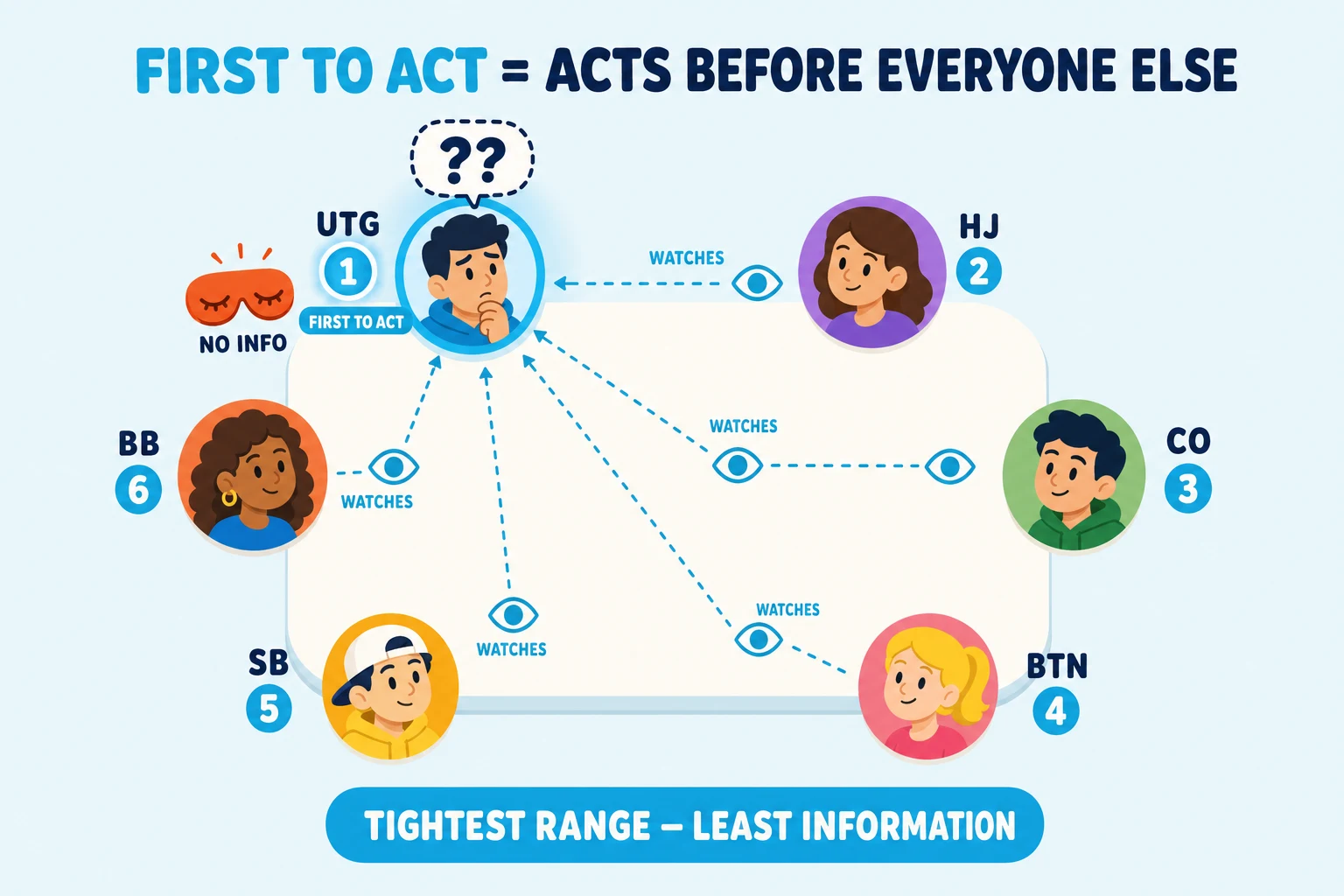
"First to act" names the player who makes the opening decision in a betting round. Preflop in No-Limit Texas Hold'em, this player sits immediately to the left of the big blind and is called Under the Gun (UTG). In No-Limit, unrestricted bet sizes raise the consequences of acting first compared with fixed-limit games.
Practice this in Poker Skill. Finding that player is the first question in the lesson on postflop action order: after the flop, action starts at the first live seat to the left of the button, so a small blind still in the hand acts first.
Get the free appFirst to act
What “first to act” means
“First to act” names the player who makes the opening decision in a betting round. Preflop in No-Limit Texas Hold’em, this player sits immediately to the left of the big blind and is called Under the Gun (UTG). In No-Limit, unrestricted bet sizes raise the consequences of acting first compared with fixed-limit games.
Why acting first is a disadvantage
Acting first forces decisions without seeing opponents’ intentions. You must fold, call, or raise before others act, so you lack information they will use to exploit you. Your actions also reveal information: raise size and whether you continue signal something about hand strength. Being first to act on every postflop street means you are out of position - opponents see your action and respond. That makes multi-street decisions harder, especially versus check-raises, bets into you, or opponents who control pot size.
Preflop tactics when first to act
From UTG, use simple, disciplined rules over fancy gambits.
- Never limp. Limping means just calling the big blind instead of raising. From UTG this invites steals, multi-way pots, and gives later players cheap chances to see flops with position on you. Raise or fold.
- Tighten your opening range. Acting first makes you more likely to face callers or raises, so open with hands that perform well against multiple opponents and don’t rely on position to realize equity.
- Keep plays straightforward. Open-raise with hands you can continue with on later streets while out of position - premium pairs and strong broadways fit this bill.
Concrete example: Holding AQ offsuit UTG in a nine-handed cash game, open-raising is standard. Limping lets several players limp behind and reduces the hand’s value; folding AQ is too conservative. A raise defines the pot and narrows the field.
Typical UTG raising range
A conservative full-ring UTG opening range centers on clear premium hands:
- Core premium hands: pocket pairs AA-TT and big broadways like AK.
- Secondary strong hands: AQ and, depending on table dynamics, AJs or KQs.
- Avoid speculative hands such as small suited connectors and weak aces from UTG because they lose value out of position and are more likely to be dominated or face re-raises.
Example: In a standard full-ring game you might open with AA, KK, QQ, JJ, TT, AK, AQ, and add AJs/KQs only if the table is particularly passive.
Postflop implications and simple adjustments
The out-of-position disadvantage continues after the flop because you act before opponents on every street. That reduces your ability to extract value or control pot size.
Adjustments to compensate:
- Play more conservatively: avoid elaborate bluffs that require precise reads or multi-street deception.
- Favor hands that hold up heads-up (heads-up = against a single opponent), like top pairs and strong pocket pairs.
- Fold marginal hands more readily when facing aggression, for example versus raises or check-raises.
Example: You open UTG with KQs, the cutoff calls, and the flop comes J-7-2 rainbow. If the opponent leads, a straightforward fold or a small continuation bet to define action beats complicated check-raise bluff lines.
Quick checklist
- If you’re first to act (UTG), tighten your opening range.
- Do not limp from first to act - raise or fold.
- Open with premium hands (AA-TT, AK, AQ; AJs/KQs situational).
- Play straightforwardly postflop when out of position.