


Side-Pot Eligibility
Side-pot eligibility is the rule that each player can win only the pots they put chips into. After someone goes all-in, the chips split into a main pot every contributor matched and one or more side pots only the deeper stacks could keep building. The same hand can be best at the table and still be locked out of part of the chips, because eligibility decides which pot a hand even contests.

Practice this in Poker Skill. Practice vs AI has a three-player table with two AI opponents, and when a shorter stack is all-in there, this rule decides which pot each of you can win.
Get the free appSide-Pot Eligibility
What side-pot eligibility means
Side-pot eligibility is the rule that each player can win only the pots they put chips into. After someone goes all-in, chips no longer pile up in one stack. They split into a main pot every active player matched, plus one or more side pots only the deeper stacks kept building. Eligibility freezes the moment a player’s last chip is in: the all-in player competes for the main pot only, and any deeper opponents fight for the side pots among themselves.
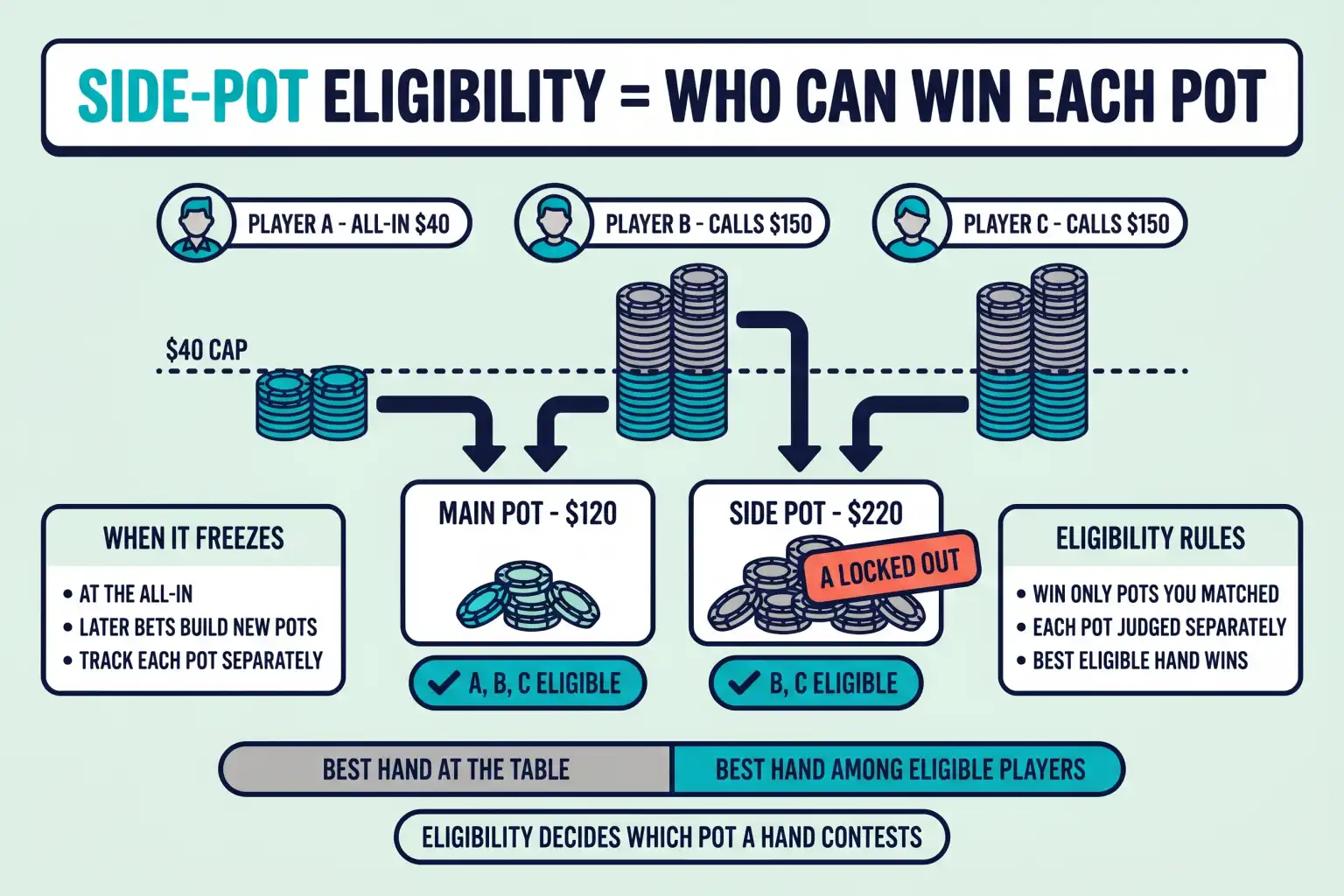
The eligibility rule is what makes side pots fair. It’s also the answer to a question that confuses new players at showdown: “I had the best hand, why didn’t I win all the chips?”
Eligibility vs the side pot, the main pot, and all-in
The terms cluster around the same situation but each names a different piece.
| Term | What it names |
|---|---|
| Side pot | The chip pool itself, the chips beyond the all-in cap |
| Main pot | The chip pool every contributor matched, capped at the shortest all-in |
| All-in | The state of having every chip in for the hand |
| Side-pot eligibility | The rule that each player can win only the pots they contributed to |
| Showdown | The moment hands are compared, separately for each pot |
A short way to keep the cluster straight: side pot is the thing, all-in is the state, eligibility is the rule, and showdown is the moment the rule gets applied.
When eligibility decides the hand
Eligibility matters whenever the stacks aren’t equal entering the all-in.
- Multi-way pot with one short stack. A short stack jams, two deeper opponents call. The short stack is eligible for the main pot only. If the deeper opponents keep betting on later streets, the side pot can grow larger than the main pot, and the short stack winning showdown only collects the smaller pool.
- Two all-ins of different sizes. A 30bb stack jams, a 60bb stack calls, and the deepest stack covers both. The chips split into a main pot all three contributed to (capped at 30bb each) and a side pot the 60bb and the deepest stack built (capped at 60bb each). Each pot has its own eligible-player list.
- Cash games and tournaments equally. The rule is identical in every No-Limit format. The chip math just translates differently. In tournaments, a short stack winning the main pot only might survive the level even though the deeper opponents won the bigger side pot.
Example: three players, three contributions
A clean example in a 6-max cash game with $1/$2 blinds.
Setup: Three players see a flop. Player A has $40 behind. Player B has $200 behind. Player C has $300 behind.
Action: A shoves $40. B raises to $150. C calls $150. A is now all-in for $40. B and C still have chips, but no more betting happens this hand. The chips on the felt total $40 + $150 + $150 = $340.
How the chips split:
- Main pot: $40 from each of A, B, C, equals $120. All three are eligible.
- Side pot: $110 from B plus $110 from C, equals $220. A is not eligible because A had no chips above $40 to put in.
At showdown: Each pot is awarded to the best hand among that pot’s eligible players.
- If A has the best hand of the three, A wins the $120 main pot. B and C compare hands for the $220 side pot, and whichever of them is better takes it.
- If B has the best hand of the three, B wins both the main pot and the side pot, $340 total.
- If C has the best hand and A is second, A wins nothing (A was beaten in the only pot A was eligible for), and C wins both pots.
The same hand strength produces three different outcomes depending on who else was in. That’s the eligibility rule at work. The cards decide who has the best hand, and eligibility decides which pot that hand even contests.
Common mistakes
1) Counting all the chips on the felt as your pot
A short stack jams, two deeper players call, and the short stack mentally pictures winning everything on the felt. They can’t. The rule caps their winnings at the matched portion. Treating the side pot as part of your equity quietly overstates your hand’s value before the cards run out.
2) Forgetting eligibility freezes at the moment of the all-in
Once a player’s last chip is in, no later betting can change which pots that player is eligible for. If two deeper opponents keep betting on the turn and river, those chips go into a side pot that was decided the moment the short stack got there. Players sometimes feel they should share in the bigger pot because they’re still in the hand. They aren’t. The live cards keep coming, but the eligibility doesn’t.
3) Reading “I had the best hand” as “I should have won all the chips”
A common confusion at showdown: the all-in player flips the best hand and is surprised they only get the main pot. They had the best hand for the main pot, where they were eligible. The side pot is a separate contest among the deeper stacks. Hand strength and eligibility are independent. You only contest the pots you’re eligible for, regardless of how strong your cards are.
4) Missing eligibility when there are two all-ins
With two players all-in for different amounts, the chips can split into more than one side pot. Each pot has its own eligible-player list and its own best-hand contest. Lumping them together at showdown produces wrong winners. Track them as separate pots, decided separately.
FAQ
What does side-pot eligibility mean in poker?
It’s the rule that each player can win only the pots they contributed to. Once someone is all-in, the chips split into a main pot every active player matched and one or more side pots only the deeper stacks built. The all-in player is eligible for the main pot only, and the deeper opponents are eligible for the side pots among themselves.
Why can’t an all-in player win the side pot if they have the best hand?
Because they never put chips into it. The side pot is the chips beyond the all-in cap, chips the all-in player physically couldn’t match. The eligibility rule says a player wins only the pots they contributed to, so the side pot is contested only by the deeper opponents who built it.
How are pots awarded if there are multiple side pots?
At showdown the dealer awards each pot separately, usually starting with the outermost (deepest) side pot and working back to the main pot. Each pot is given to the best hand among its eligible players. The same player can win more than one pot if they’re eligible and best in each.
Is side-pot eligibility the same in cash games and tournaments?
Yes. The rule is identical in every No-Limit format. The chip values and stake structure differ, but the eligibility logic, you can win only the pots you contributed to, is the same.
Checklist
- After every all-in, ask which pot each remaining player is eligible for.
- Eligibility freezes when a player’s last chip is in. Later betting builds new pots, not the same one.
- Each pot is awarded separately at showdown to the best hand among its eligible players.
- An all-in player with the best hand wins the main pot only. The side pot is for the deeper stacks.
- Multiple all-ins can produce multiple side pots, each with its own eligible-player list.