


Single-Raised Pot (SRP)
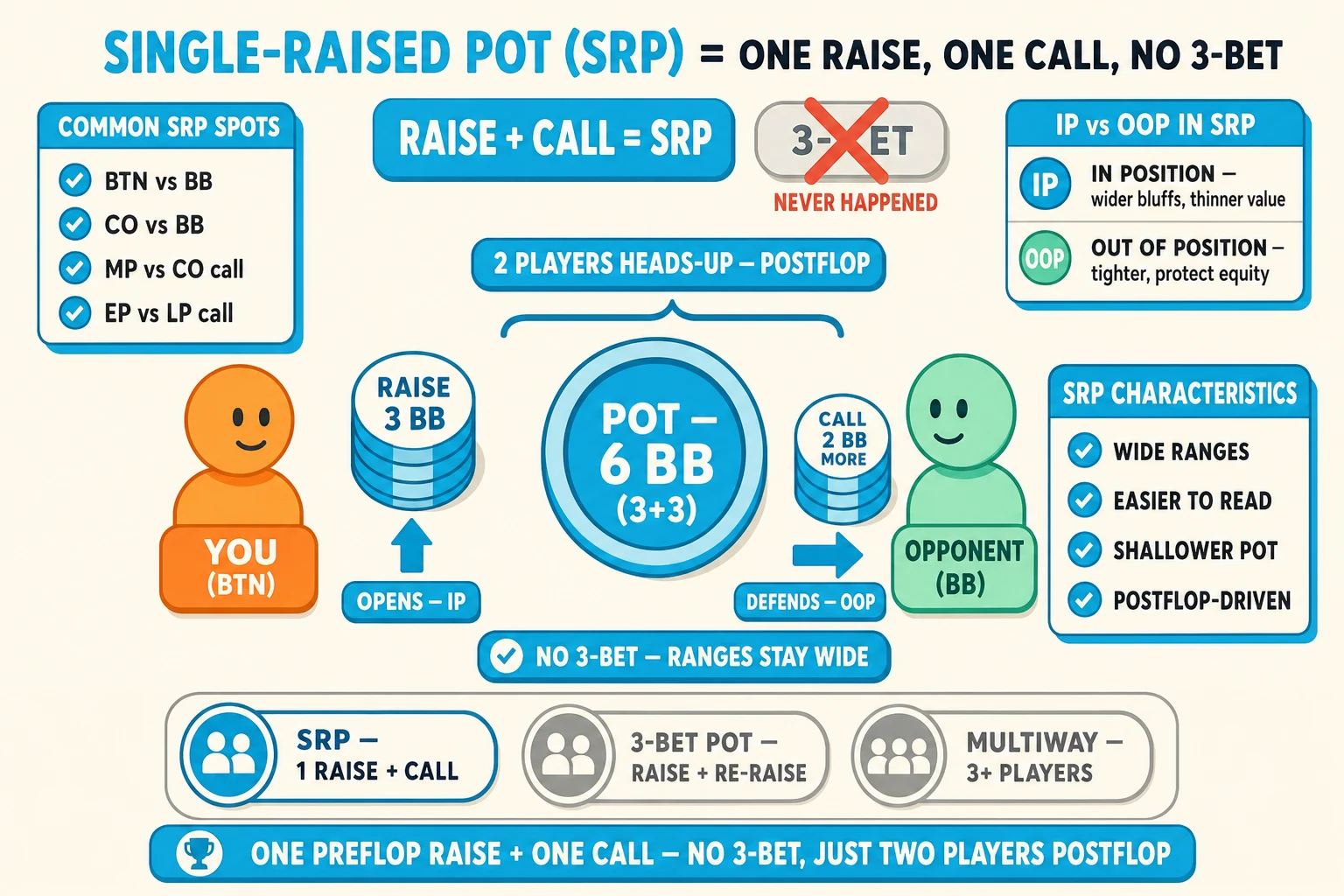
One preflop raise, one call, no 3-bet. The most common postflop heads-up spot in cash games. Ranges stay wide, postflop math is bigger than preflop math, and position is doing most of the work.

Practice this in Poker Skill. The Basic Betting Strategy lesson works in raise-and-call pots like these, where you name each bet’s job before any chips go in and check when a bet has no job.
Get the free appSingle-raised pot (SRP)
What a single-raised pot is
A single-raised pot (SRP) is the postflop spot you reach when one player opens preflop and another calls without a 3-bet. The button opens to 3 BB, the big blind calls, and the two of you see a flop. SRPs are the bread-and-butter heads-up postflop scenario in cash games and most tournament spots. Ranges stay wide because no preflop reraise has filtered them, but they are still narrow enough to read clearly. That is what makes the SRP the foundation other postflop spots build off.
Position in SRPs
In position (IP) means you act after your opponent on each postflop street. Out of position (OOP) means you act first. The two seats want different things.
- In position: you see the action before you decide, so you can control pot size, extract thin value, and bluff with better data. On a K-7-2 rainbow flop, the button can fire a small probe bet to fold out weak air or get called by worse.
- Out of position: you act first and have fewer comfortable lines. Protect vulnerable hands and be selective. From the big blind facing a button c-bet, betting or check-calling to protect equity is often the right answer.
- Practical adjustments: IP, widen your bluff frequency and lean on thinner value bets. OOP, tighten continuation ranges, favor stronger holdings, and pick pot control over big lines with marginal hands.
A check-raise is a check followed by a raise of an opponent’s bet on the same street. Bluff-catching is calling with a marginal hand that mainly beats bluffs.
Preflop range construction for SRPs
Your preflop choices set up everything that comes after.
- Open and call with hands that play well postflop: suited connectors (9♠8♠), broadways (KQ, AQ), and pocket pairs (66+). They have showdown value and the equity to bluff or improve.
- Keep your range balanced. Strong value hands plus speculative holdings. If you only raise top pairs, opponents fold to your aggression on the bad boards and call you on the good ones.
- Adjust by position: tighten out of position with fewer speculative calls, widen in position. Open 76s on the button, but fold 76s more often facing a raise from the cutoff.
Postflop decision framework
A simple step-by-step that works on every street.
- Range intersection: who connects with this flop more often? On 8♠7♣2♦ both ranges include connectors and middle pairs; on K♦6♣2♥ the preflop raiser’s range has more kings.
- Pick an objective: control the pot, extract value, or apply pressure. Small bets keep ranges wide; larger bets compress them.
- Size to that objective: roughly one-third pot to probe and extract, one-half to full pot when you want folds or to charge equity.
- Plan one street ahead. If you bluff the flop, know which turns let you barrel. If you check-call, know which turns you lead and which you give up.
For example, in position with A♣Q♣ on J♦9♣3♠, a small bet folds out worse Jx hands and gets called by draws. Out of position facing a bet with the same hand, check-call keeps villain’s bluffs in their range.
Advanced turn and river strategies
The lines that pay best later are the ones that fit specific opponents and runouts.
- OOP can take the lead on favorable turns. If a turn completes draws that fit your range and you have a disguised strong hand, betting takes initiative back.
- Use turn overbets, traps, and line variation selectively. Overbets punish frequent folders; traps work better against passive call-down players.
- Adjust to the population. Bluff more into frequent folders. Value-bet thinner against calling stations. The default lines are the starting point, not the answer.
Quick checklist
- Confirm the pot is an SRP before applying SRP defaults.
- Use position to widen bluffs and extract value; tighten and protect OOP.
- Build preflop ranges for postflop playability and board coverage.
- Size bets to your objective: control, value, or pressure.
- Watch opponent tendencies and deviate from defaults when it pays.