


Standard Deck
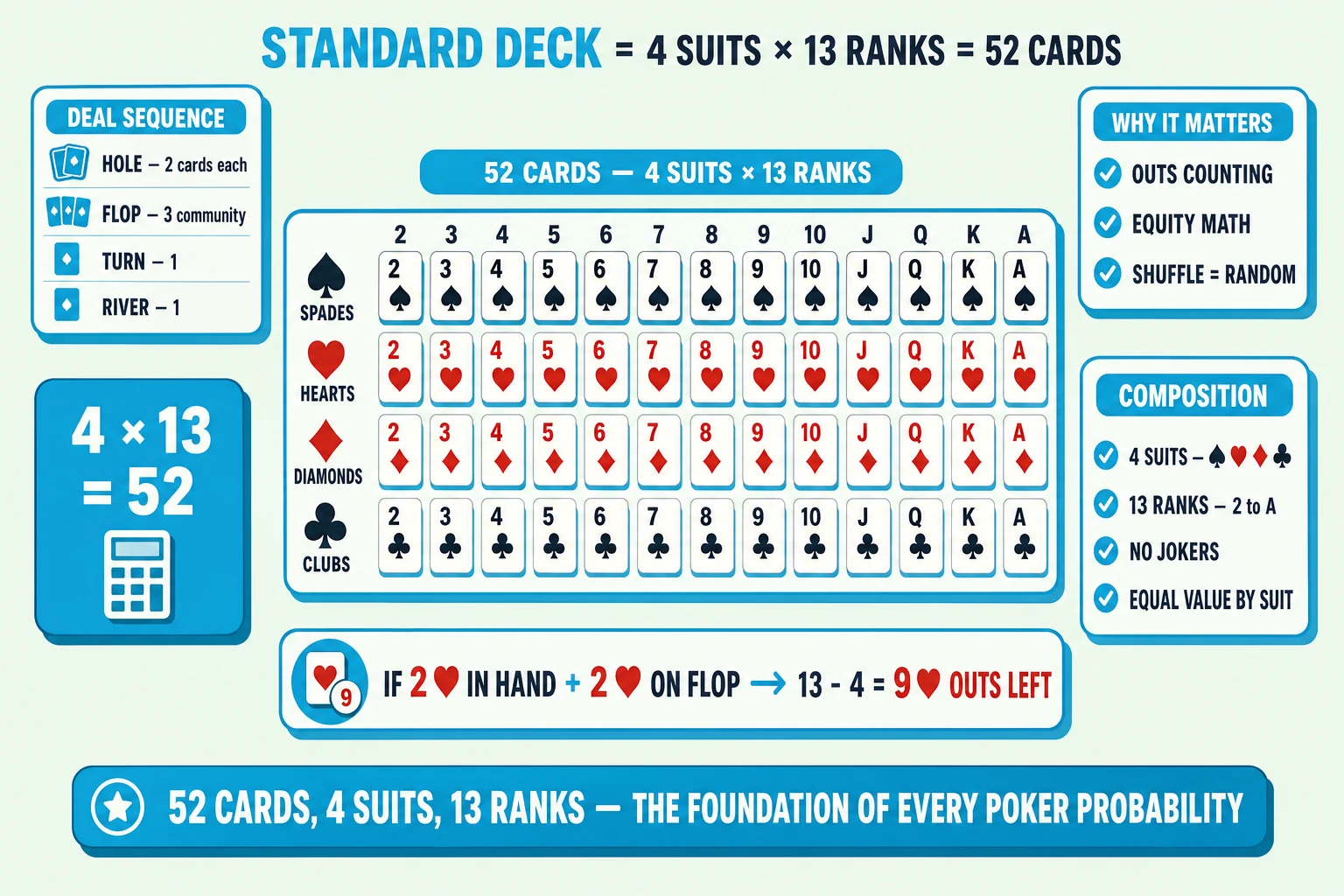
52 cards across 4 suits and 13 ranks, no jokers. Suits are equal in value; outs and equity math both rest on knowing what is dealt and what remains unseen.
Practice this in Poker Skill. One of its first hand-ranking questions puts Q♣ 8♣ 4♣ 2♣ on the board and asks which card makes a flush; any of the nine clubs still in the deck does.
Get the free appStandard Deck
What’s in a standard 52-card deck
A poker deck holds 52 cards: four suits of thirteen ranks each.
- Four suits: hearts, diamonds, clubs, spades. Suits are equal; no suit inherently beats another.
- Thirteen ranks per suit: Ace, 2, 3 … up to King.
- Total cards = 4 suits × 13 ranks = 52 cards.
The four suits are hearts and diamonds in red, clubs and spades in black. A poker deck is not a different product from a regular deck of playing cards. It is the same 52 cards, dealt with the jokers set aside. A few poker variants deal a joker back in, but No-Limit Texas Hold’em never does.
Example: each suit contains 13 cards. If you hold two hearts and two hearts appear on the flop, 13 - 4 = 9 hearts remain unseen in the deck.
How the deck is used in No-Limit Texas Hold’em
- Each player receives two private (hole) cards dealt from the 52-card deck. Hole cards are the two cards only you can see.
- Five community cards are dealt face-up in stages: the flop (3 cards), the turn (1 card), the river (1 card).
- Players use any combination of their two hole cards and the five community cards to make the best five-card hand.
Example: You hold A♠ K♠. The flop comes 7♠ 2♥ K♦. You already have a pair of kings using K♦ and K♠. On the flop your best five uses both hole cards with the three community cards; by the river you can use both hole cards, one or neither, whichever makes the best five-card hand.
Why shuffling and randomness are essential
- Dealers shuffle before each hand to ensure randomness and fairness.
- A properly randomized deck prevents predictable patterns and bias in outcomes.
- Consistent shuffling preserves the mathematical probabilities underlying strategy, keeping your calculations valid.
Practical point: dealers shuffle so previous hands don’t leak information into future deals. Fair shuffling means unrelated earlier deals shouldn’t affect your current decisions.
How the 52-card structure determines hand probabilities
- All possible hand combinations and relative frequencies come from the fixed 52-card set.
- The number of suits and ranks directly controls how many of each hand type can exist.
- For example, a flush requires five cards of the same suit; each suit has 13 cards, so unseen suited cards matter when estimating flush chances.
- Strategic calculations-like estimating outs and equity-rely on which cards are visible and which remain. Outs are unseen cards that will improve your hand. Equity is your hand’s expected share of the pot across remaining outcomes.
Example: If you have two hearts in your hand and two more hearts appear on the flop, count the hearts you can still hit: 13 total hearts - 4 seen = 9 hearts remaining (9 outs) that could complete a five-card heart flush by the river.
Practical takeaways for serious players
- Memorize the basic structure: 4 suits × 13 ranks = 52 cards. This lets you count outs quickly.
- Always track dealt community cards and visible hole cards to know which ranks and suits remain.
- Treat deck composition as the fundamental constraint behind odds and strategic choices: bet, fold, and call based on how many cards can plausibly improve your hand.
Quick checklist
- Know: 4 suits × 13 ranks = 52 cards.
- Remember dealing sequence: 2 hole cards -> flop (3) -> turn (1) -> river (1).
- Expect a shuffle before each hand to ensure randomness.
- Use deck composition when calculating outs, probabilities, and strategic plays.