


5-bet
A 5-bet is the fourth raise in a preflop sequence: open, 3-bet, 4-bet, then 5-bet. At 100bb cash it's almost always all-in, but at deeper stacks it can be a sized re-raise. The range is narrow: top value (AA, KK), AK, and a few blocker bluffs.

Practice this in Poker Skill. The Raise Mechanics & Reopening lesson has you find the minimum legal raise, and a 5-bet follows the same rule.
Get the free appThe blocker bluffs in a 5-bet range are hands like A5s, whose ace cuts down the other player’s AA and AK, and Poker Skill’s 3-bet chart already uses the suited wheel aces, A5s through A2s, as its bluffs two raises earlier in the chain.
5-Bet (preflop): the fourth raise in the chain
The escalation chain and why a 5-bet is rare
A 5-bet is the next raise after a 4-bet in the preflop betting round. The chain reads open → 3-bet → 4-bet → 5-bet. By the time chips reach the fourth raise, both players have already declared a strong-looking hand, so the 5-bet sits at the top of preflop pressure and almost always represents a premium pair, AK, or a tight blocker bluff. At 100 big blinds in a cash game it usually goes all-in. At deeper stacks it doesn’t have to.
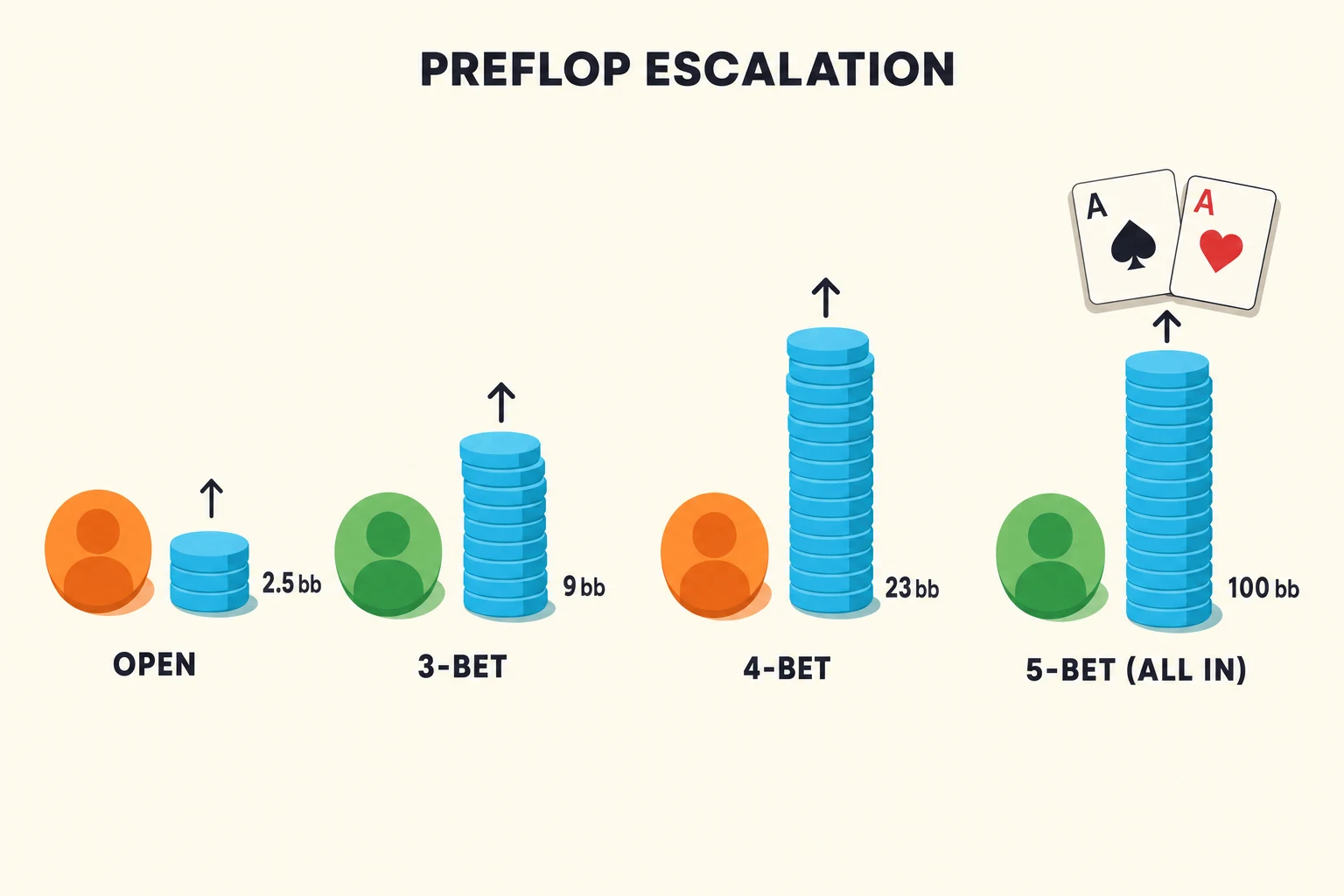
A 5-bet is uncommon because each step of the escalation strips weaker hands out of both ranges. By raise four, calling stations have folded and bluffers have given up; the player who 5-bets is telling you they’re happy to play for stacks. That’s why the term is often used as shorthand for “the all-in re-raise over a 4-bet” even though the bet number describes a position in the sequence, not a sizing.
Related terms
- 4-bet: the raise that comes immediately before a 5-bet.
- 3-bet: the first re-raise; where the chain starts heating up.
- Value 4-bet: the 4-bet type most likely to be 5-bet jammed over.
- Bluff 4-bet: the 4-bet type most likely to fold to a 5-bet.
- Jam: the action a 5-bet usually takes at 100bb.
- All-in equity: the math that decides whether to call a 5-bet jam.
- Stack depth: the variable that shifts the 5-bet from automatic jam to sized re-raise.
4-bet vs 5-bet vs 6-bet: what changes at each step
Each escalation step trims the range and changes the implied commitment. The naming is just “next bet number”; what matters is what each step does to ranges and stacks.
| Step | Typical role | Common range | All-in at 100bb? |
|---|---|---|---|
| Open raise | Start the pot | Position-dependent, wide | No |
| 3-bet | Pressure the open | Polarized or linear | No |
| 4-bet | Punish wide 3-betters; set up value | Narrow value + blockers | Sometimes |
| 5-bet | Commit for stacks | Premium pairs, AK, occasional blocker bluff | Usually |
| 6-bet | Almost always a value-only over-jam | AA, KK, sometimes AK | Always |
Each one also has a minimum size, the rule Poker Skill teaches in its lesson on raise mechanics: call the last bet, then add at least the last raise, so after a 3-bet to 10bb and a 4-bet to 23bb the smallest 5-bet is to 36bb. The shape is consistent: every extra raise shrinks the range and pushes both players closer to a stack-off decision. By the 5-bet, fold equity is shrinking fast. See “When this matters most” below.
When this matters most
The 5-bet decision is load-bearing in a few specific spots:
- Cash 6-max at 100bb. This is the canonical setting where 5-bet language assumes “jam.” If the original opener 4-bets to 23bb out of 100bb, the 5-bet shove is the only continuing line that doesn’t leave an awkward stack-to-pot ratio for the flop.
- Blind-versus-blind. Ranges are wider, the 4-bet appears more often, and the 5-bet jam is built into solver baselines (BvB SB 5-bet at 100bb is all-in in modern solver outputs).
- Against a known frequent 4-better. If a player 4-bets with too many bluffs, AK and even some suited Broadway hands become 5-bet jams that fold out the bluffs and call dominated by KK+.
When the 5-bet matters less:
- Deep stacks (200bb+). With more chips behind, the all-in 4-bet starts disappearing in favor of a sized 4-bet, and the 5-bet can be a sized re-raise too. SPR (stack-to-pot ratio) climbs back into postflop territory.
- Tournament short stacks (under ~25bb). The whole bet-number language collapses because the open raise often has the player committed already; what books call a “5-bet” in cash terms is just a stack-off decision.
- Pots with multiple opponents already committed. If the action goes raise → 3-bet → 4-bet → call → and now you’re facing the call, you’re choosing between 5-betting and folding without a clean spot to size down.
Example: 100bb 6-max, BTN vs BB
Cash game, $1/$2, $200 effective. Standard 6-max preflop sizes.
- You are on the BTN with K♥ K♣.
- Open: you raise to $5 (2.5bb).
- 3-bet: the BB makes it $20 (10bb). The pot is now $26.
- 4-bet: you raise to $46 (23bb). The pot is $67.
- 5-bet: the BB jams all-in for $200 (100bb). You owe $154 more to call.
The pot is $247 after the jam. To call $154, you need 154 / (247 + 154) = 38.4% equity to break even. Against a tight 5-bet range of {AA, KK, AK}, KK has about 47% equity (mostly because it is well ahead of AK and chops with itself). That clears the 38.4% bar, so KK calls.
Now switch your hand to A♠ K♦. Same line. Against the same {AA, KK, AK} range, AK has about 37% equity, just short of the 38.4% bar. Add the three suited A5 combos as bluffs and AK climbs to about 42%, enough to call.
Now switch your hand to Q♣ Q♠. QQ vs {AA, KK, AK} runs about 40%. Also a call. Against this tight range the price carries KK and QQ, and AK needs the jammer to hold at least a few bluffs. Folding KK or QQ after 4-betting at 100bb is a leak here; folding AK is right only against a jammer who never bluffs.
That’s why the 5-bet jam at 100bb works as a shove rather than a sized re-raise: any sized 5-bet would still leave 38%-equity calls priced in, so the jammer simply puts in the rest and locks in the all-in equity.
Common mistakes
1) Folding the 4-bet to the 5-bet jam
Once you 4-bet to 23bb at 100bb, you’ve committed yourself to most premium ranges. With AK or QQ+ in front of you, the math usually says call. Folding here is the most expensive single mistake in 5-bet spots.
2) 5-bet bluffing without blockers
A 5-bet bluff that doesn’t hold an A or a K runs into AA, KK, and AK at full frequency. The hands that work as 5-bet bluffs (rarely, and only against opponents with thin 4-bet ranges) are A5s-style holdings: they block AA and AK while keeping the nut-flush-draw safety net if called.
3) Treating “5-bet” as automatically all-in
Stack depth changes the size. At 200bb the 5-bet can be 60bb to 80bb without commitment, and the term still applies. Lock in “fourth raise” as the definition; let the situation tell you the size.
4) Misreading the 4-better’s range
A balanced 4-better’s range against a tight 3-better has more value than a thin 4-better’s range against a wide 3-better. The same hand is a 5-bet jam in one population read and a fold in the other. The mistake is using a default reaction without thinking about who actually 4-bets and how often.
FAQ
Is a 5-bet always all-in?
No. At 100bb it usually is, because the 4-bet has already put about a quarter of the stack in and the remaining shove keeps the math clean. At 200bb or deeper, a 5-bet can be a sized re-raise that still leaves chips behind for postflop play. The bet number describes position in the sequence, not commitment.
What hands belong in a 5-bet jamming range?
The core is AA, KK, and AK at 100bb. QQ goes in too against most 4-betters, especially in blind-versus-blind. The only hands that work as 5-bet bluffs at all are blocker hands like A5s: they reduce the 4-better’s value combinations of AA and AK while giving the bluff a backup if called.
How do I respond to a 5-bet when I have already 4-bet?
Compute the pot odds. After a 4-bet to 20bb to 25bb at 100bb cash, you usually need around 37% to 40% equity to call the jam. Against a tight {AA, KK, AK} range, KK clears that bar easily, QQ narrowly and AK only once the range holds a few bluffs. The fold should be reserved for hands that don’t beat the jamming range often enough, most often a 4-bet bluff that didn’t pick up enough fold equity from the 4-bet itself.