


Bluff 4-Bet
A bluff 4-bet is the third raise in a sequence: open-raise, opponent 3-bets, and you 4-bet with a non-premium hand. You use psychological pressure and fold equity - the chance an opponent will fold - to win the pot without seeing a flop. Cold four-bet bluffs - 4-bets made without first investing in the pot (for example, you were not the original opener but 4-bet directly) - are rare and earn extra respect. That rarity contributes to their power.
Practice this in Poker Skill. The 3-bets a bluff 4-bet answers are what the Response to Opens lessons teach, such as Q♥ Q♦ from the big blind against a wide button open and A♥ Q♥ from the small blind against a cutoff open.
Get the free appBluff 4-Bet (No-Limit Texas Hold’em)
What a bluff 4-bet is
A bluff 4-bet is the third raise in a sequence: open-raise, opponent 3-bets, and you 4-bet with a non-premium hand. You use psychological pressure and fold equity - the chance an opponent will fold - to win the pot without seeing a flop. Cold four-bet bluffs - 4-bets made without first investing in the pot (for example, you were not the original opener but 4-bet directly) - are rare and earn extra respect. That rarity contributes to their power.
When to attempt a bluff 4-bet
Target opponents who 3-bet very frequently, roughly over 20%. Frequent 3-bettors have wide ranges and cannot defend all hands correctly, increasing your fold equity. Prefer deeper effective stacks, generally at least around 55 big blinds, so the 4-bet meaningfully pressures opponents. Shallow stacks, under about 20 big blinds, remove leverage and make the move ineffective. Always check whether fold equity is high enough; if opponents fold about 64% of the time, a 4-bet bluff can be profitable even with any two cards. If a 3-bettor’s continuing range tightens to roughly 9% or lower, the bluff loses much of its profitability.
Sizing and execution
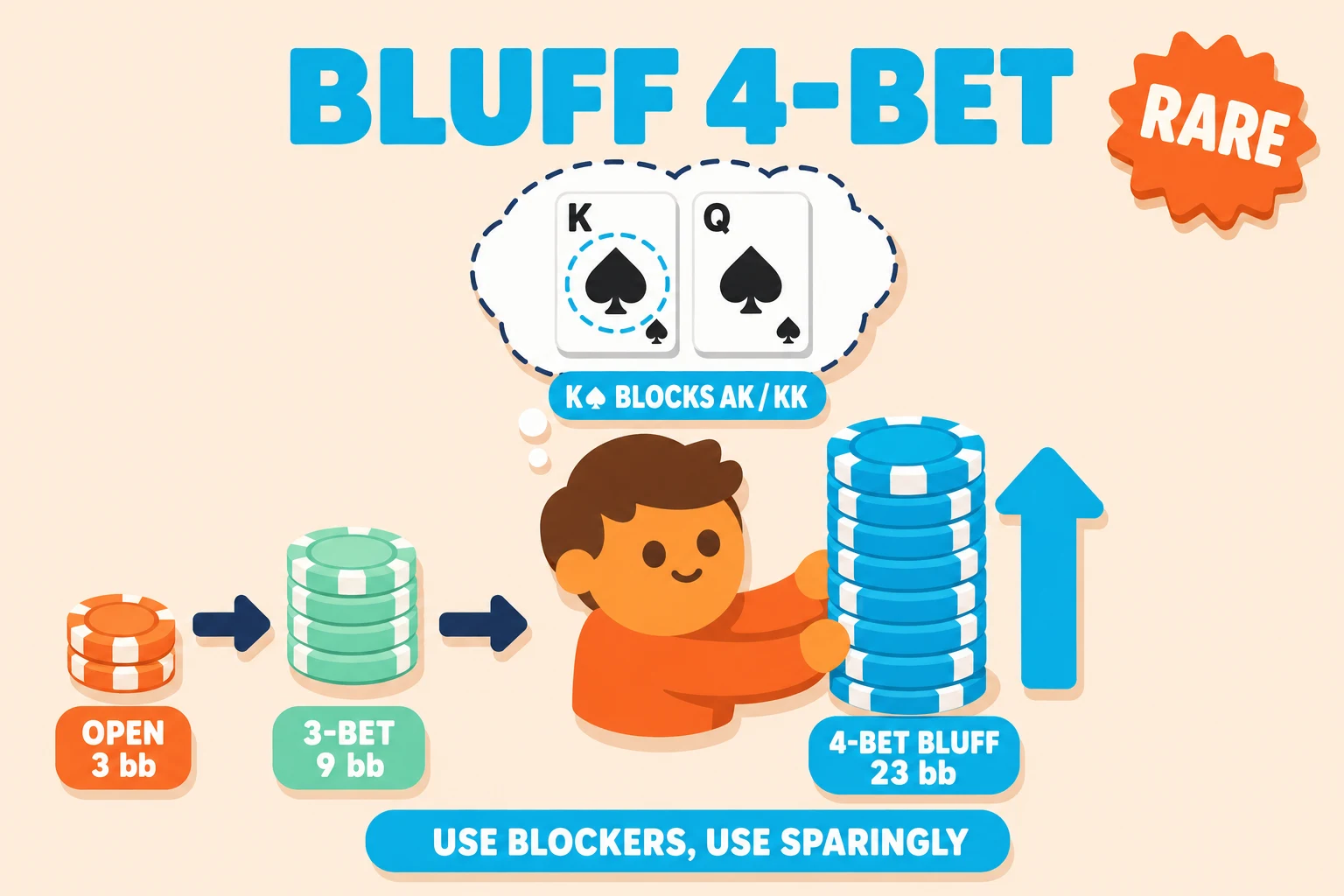
Size your 4-bet to about 2.3-2.7 times the opponent’s 3-bet. This range pressures the 3-bettor without turning the decision into an overbet that merely increases variance.
Execution steps:
- Confirm opponent profile: frequent 3-bettor and loose-aggressive tendencies.
- Confirm stacks: prefer effective stacks of at least 55 big blinds.
- Pick a coherent 4-bet size, roughly 2.3-2.7× the 3-bet.
- Plan for calls and shoves: be prepared to fold or to include some value 4-bets in your mix.
A cold 4-bet usually gets more respect, but it must remain consistent with your perceived range. If opponents start calling or 5-betting exploitatively, reduce frequency or adjust your hand mix.
Hand selection and blocker use
Choose hands that include strong blockers - cards that reduce the combinations of your opponent’s top hands. An ace blocker makes AA and AK less likely; a king blocker cuts some AK and KK combos. Blockers increase fold chances and often leave you with some equity when called. Good examples include A5s and KQs. A5s blocks AA/AK combos and still makes straights and flushes; KQs blocks AK/KK combos and plays well postflop. Prefer hands with backdoor equity that can improve on later streets if called. The same selection logic applies after the flop, and which hands to bluff works through it street by street.
Profitability limits and risks
Profitability depends on opponents folding enough. If the 3-bettor’s continuing range tightens substantially, near or under about 9%, the bluff becomes much less profitable. This play carries high variance: when called or met with a shove you can lose big pots, so keep frequency selective. Overusing the bluff reveals tendencies; good opponents will adjust by calling or 5-betting more, which erodes your edge. Mix in value 4-bets to balance your range and keep opponents guessing.
Checklist
- Opponent: frequent 3-bettor (>20%) or clear exploitable leak.
- Stacks: roughly ≥55 BB effective; avoid under ~20 BB.
- Hand: contains a key blocker (ace/king) and reasonable backdoor equity.
- Sizing: ≈2.3-2.7× the 3-bet; avoid gratuitous overbets.
- Frequency: keep it rare; stop if opponents call or 5-bet exploitatively.