
Bluff 3-bet: re-raise pressure in No-Limit Hold’em
What a bluff 3-bet is
A 3-bet is the third bet preflop: open-raise, re-raise (the 3-bet itself), then a 4-bet on top of that. A bluff 3-bet is a 3-bet made with a non-premium hand to represent strength. The point is fold equity: if villain folds enough, the line prints whether or not you have a hand. Success depends on the matchup, the timing, and picking spots where folds are realistic.
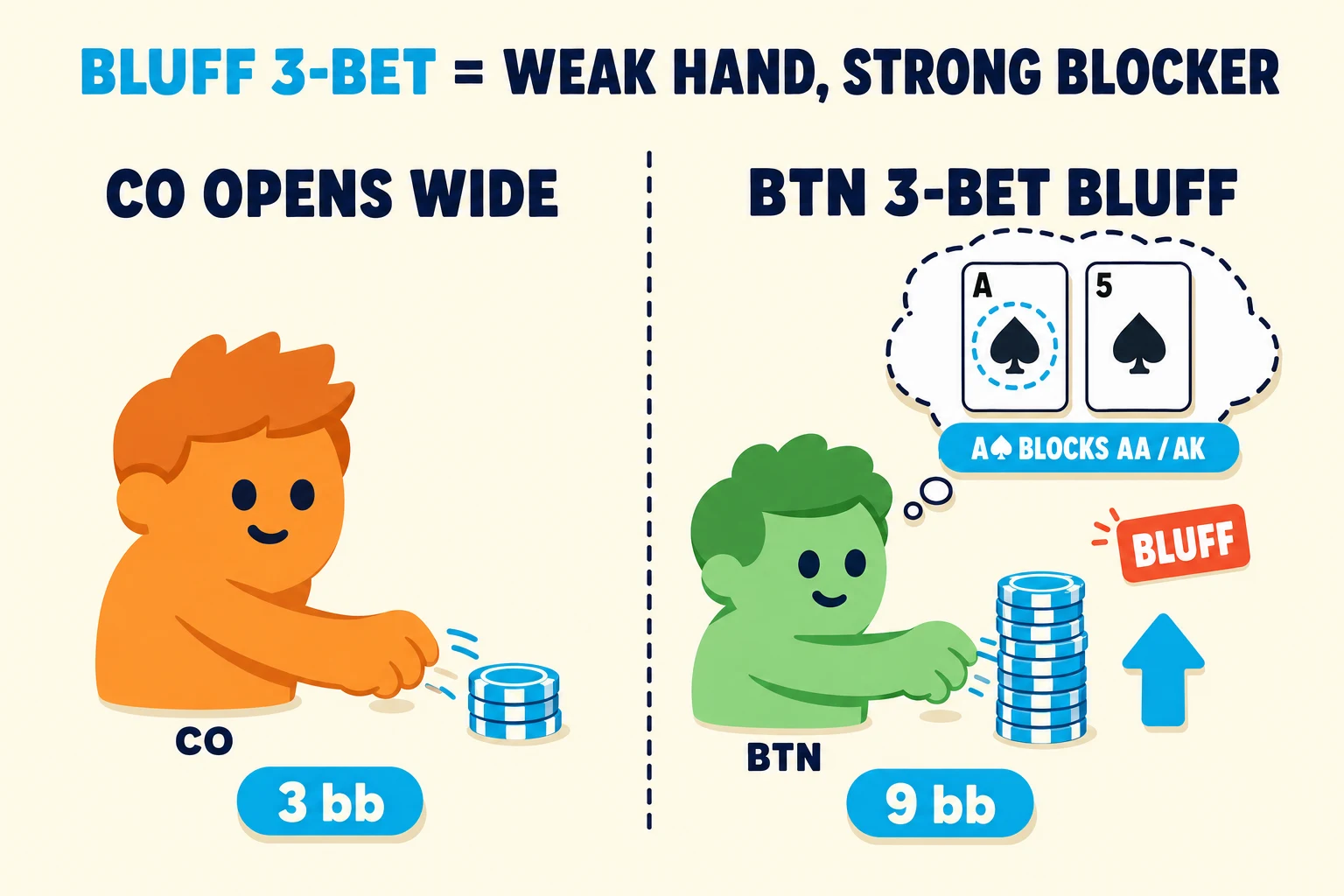
When to pick spots for bluff 3-bets
Pick spots where the opener’s range is wide or they fold to aggression often.
- Late-position openers (button/cutoff): they open wide and don’t love defending against pressure.
- Big blind versus a wide late-position open: cheap price to defend, and the opener’s range is full of fold-out hands.
Skip the line against early- or middle-position openers with tight ranges, and skip it against players who 4-bet light. Aim at opponents who actually fold to 3-bets.
Hands to use as bluff 3-bets
Hands that block premium combos or keep playability when called.
- Blocker hands: offsuit A2-A5 and small suited aces. The ace removes a chunk of villain’s AA and AK combos. (A blocker is a card that makes certain opponent holdings less likely.)
- Suited connectors and weak suited aces (A5s, 76s) keep postflop options when called. Hands that can flop pairs, draws, or showdown value, not pure junk.
Balancing bluffs with value 3-bets
Mix bluffs with value 3-bets so opponents can’t fold you off the bluffs. A simple value base like JJ+ and AQ+ anchors the range. When your 3-bets show up as both value and bluff, villain has to give you credit more often. Tighten value-heavy 3-bets against frequent 4-bettors. Add more bluffs against frequent folders.
Reading opponents and adjusting
Identify villains who fold to 3-bets. They’re the targets. Cut bluffs against players who call 3-bets large or 4-bet light. Use table history: a player who folded the cutoff to button 3-bets will likely fold to yours too. Don’t bluff on autopilot; recalibrate based on recent behavior and stack dynamics.
Execution and expected outcomes
When you 3-bet bluff, size it to represent a real value 3-bet. A decisive size buys fold equity, the chance villain folds to your raise. If they fold, you take the pot down and skip postflop entirely. If they call, you have a hand with either equity or playability and can pick semi-bluff spots from there. Disciplined bluff 3-betting in the right spots, balanced with value, picks up dead money and tightens villain’s calling and 4-betting ranges over time.
Quick checklist
- Target late-position openers and opponents who fold to 3-bets.
- Use blocker hands and some suited connectors or weak A-x as bluffs.
- Mix bluffs with value 3-bets (for example, JJ+/AQ+) to stay balanced.
- Avoid bluffing versus tight early/mid-position openers.
- Make a decisive re-raise to represent strength and maximize fold equity.