


Card Removal
Blockers are cards in your hand that remove those cards from the deck, reducing opponents' chances of specific hands. A "range" means the set of hands an opponent could reasonably hold; your hole cards narrow those combos. Holding the A♣ removes that card from opponents' combos, so hands needing it become less likely. Blockers cause small probability shifts, but they matter most when an opponent's range is already narrow.
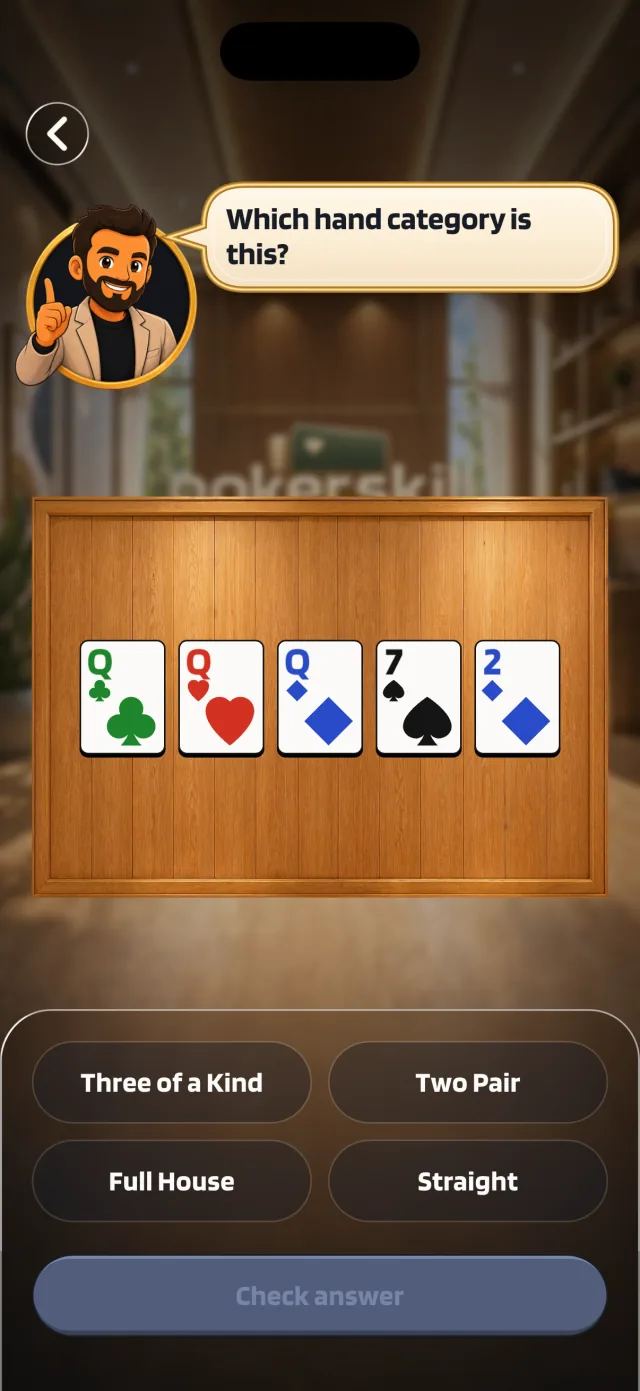
Practice this in Poker Skill. On 7♥ 7♦ 7♠ K♣ 2♦, the Full House & Four of a Kind lesson asks which hands make quads, and with three sevens showing, only the hand holding the last seven does.
Get the free appCard Removal: How Blockers Shape Decisions in No-Limit Hold’em
What card removal (blockers) means
Blockers are cards in your hand that remove those cards from the deck, reducing opponents’ chances of specific hands. A “range” means the set of hands an opponent could reasonably hold; your hole cards narrow those combos. Holding the A♣ removes that card from opponents’ combos, so hands needing it become less likely. Blockers cause small probability shifts, but they matter most when an opponent’s range is already narrow.
How card removal works in practice
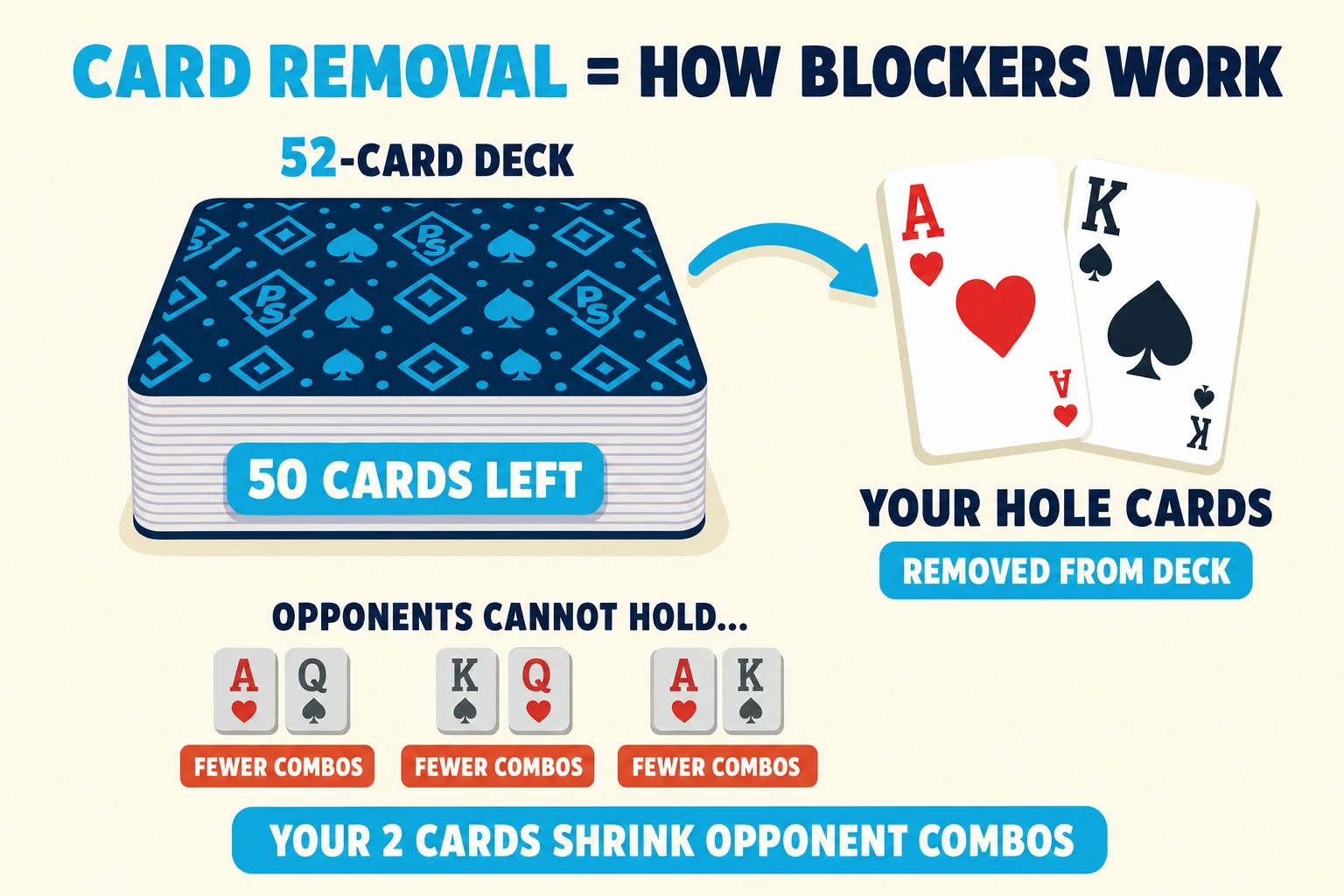
You start the hand knowing two private cards are missing from the 52-card deck. That reduces the available combinations for every specific opponent hand that uses those cards. If an opponent needs A♣X to have the absolute best hand and you hold A♣, zero combinations of A♣X remain. If multiple two-card combos yield the same hand, removing one key card reduces those combos, but doesn’t eliminate them. Early - preflop or on the flop - the effect is subtle because many combos still fit wide ranges. As boards and betting narrow ranges on turn and river, each removed card cuts a larger share of remaining combos.
When card removal matters most
Blockers are most useful in three situations:
- Late streets (turn/river): with more public cards revealed, opponent ranges tighten and each removed combo matters more.
- Marginal decisions: when small probability swings flip a call to a fold or a bluff to value.
- Against polarized lines: when an opponent’s actions suggest either a very strong hand or a bluff, blockers gain value. Blocker effects shrink when opponent ranges remain wide and unconstrained by betting.
Example: on a river that completes a flush, holding the ace of that suit reduces opponent nut-flush combinations. That reduction can swing a close river call in your favor against polarized opponents.
Using blockers to plan bluffs
A blocker reduces the probability of specific strong opponent hands, increasing bluff credibility.
Use this simple process:
- Identify the exact opponent hands your bluff fails against, such as the nut flush or ace-top pair.
- Check whether your hole cards remove those key cards, for example the ace or suit card the opponent needs.
- Use blockers with sizing and range reading; if blockers cut villain value, increase bluff frequency or sizing on rivers.
Example: on K♣7♣2♠J♣ river you hold A♣8♦; the A♣ removes some nut-club combos. That makes a polarized opponent more susceptible to a river bluff, increasing your expected value.
Using blockers for calling and folding (bluff-catching)
On the river, blockers influence whether you call, fold, or turn a thin hand into a value bet.
- If your hand contains blockers that reduce opponents’ nut likelihood, calling becomes materially more attractive.
- If you lack relevant blockers and action points to a narrow value range, folding often is correct.
Apply this checklist before big river decisions:
- Identify key blockers in your hole cards before committing large bets on later streets.
- Prioritize blocker reasoning in marginal river decisions and when facing polarized opponent ranges.
- Combine blocker knowledge with range narrowing from betting history instead of relying on blockers alone.
Blockers won’t decide hands by themselves, but with range reading and history they often decide turn and river spots.