


Card Code
Compact card notation: rank letter plus suit letter, no space. Ah is the Ace of Hearts, JTs is jack-ten suited, 7c2d is the seven of clubs and the two of diamonds.
Card Code (No-Limit Texas Hold’em)
What “card code” means
Card code is the short notation players use to identify cards in written hands and analysis, pairing rank and suit without spaces. Use this concise format to share hands, describe lines, and review play unambiguously. Ranks use single characters: A K Q J T 9 8 7 6 5 4 3 2. Suits use four letters: s (spades), h (hearts), d (diamonds), c (clubs). Example: As means Ace of spades; 10c means Ten of clubs. “Hole cards” are the two private cards dealt to each player. The five community cards form the board and appear across three streets: flop (three cards), turn (one), and river (one).
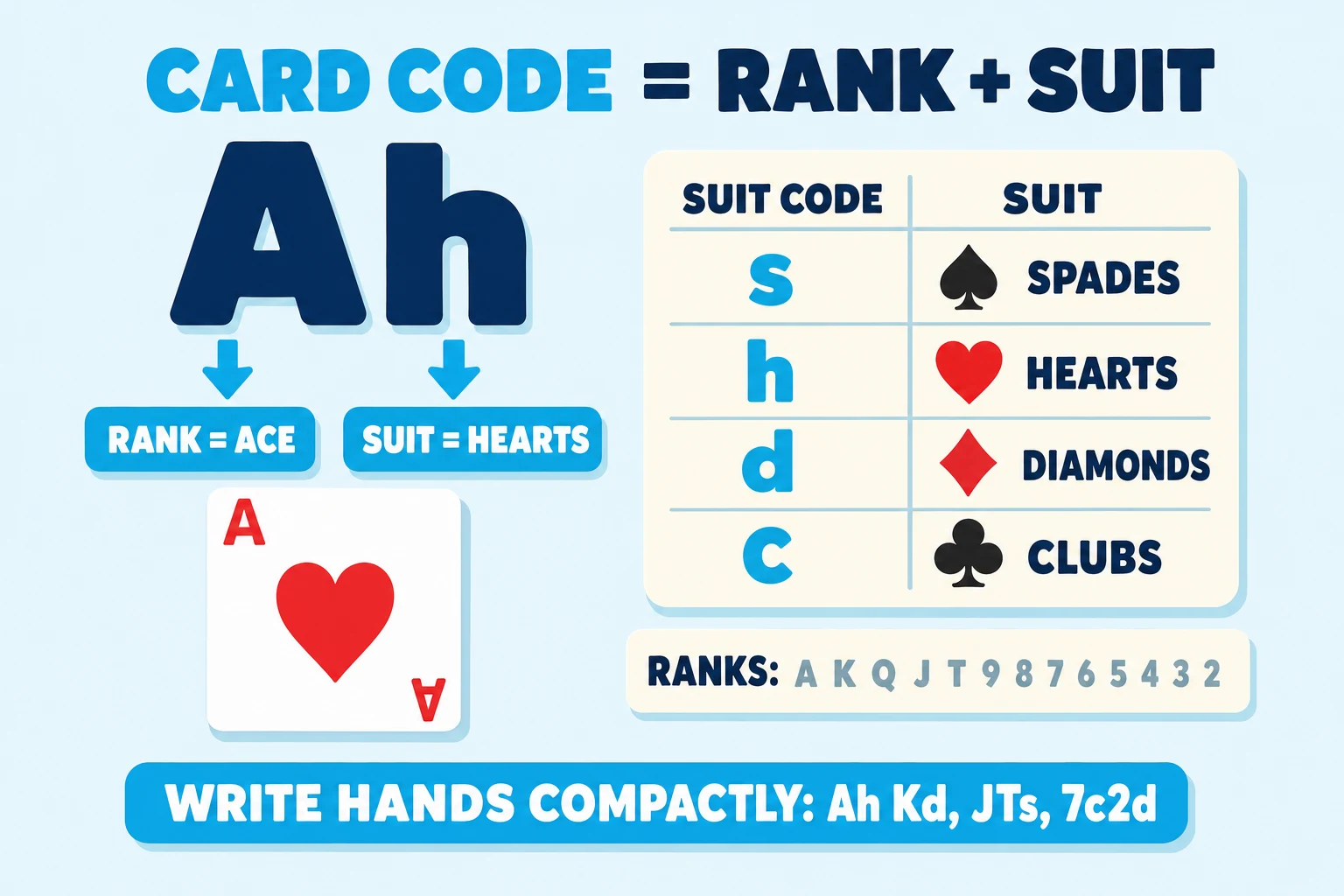
Standard card-code format and examples
Single-card examples:
- As = Ace of Spades
- 10c = Ten of Clubs
- Jh = Jack of Hearts
- 7d = Seven of Diamonds
Two-card hole-card example:
- Ah Kd: Ace of hearts and King of diamonds
Board example across streets:
- flop 7h Ac 9s (three flop cards: Seven of hearts, Ace of clubs, Nine of spades)
- turn Qd (turn card: Queen of diamonds)
- river 2c (river card: Two of clubs)
You’ll often see full hands written compactly, for example:
- Player: Ah Kd; Board: flop 7h Ac 9s; turn Qd; river 2c
How to record hole cards and community cards
Use these simple steps to document a full Hold’em deal:
- Write a player’s hole cards together, rank then suit, with no space inside a card: e.g., Ah Kd.
- Record community cards by street: Flop: three codes, separated by spaces (e.g., flop 7h Ac 9s). Turn: one code (e.g., turn Qd). River: one code (e.g., river 2c).
- Combine hole cards and board to reproduce the deal: Ah Kd; flop 7h Ac 9s; turn Qd; river 2c.
This order and labeling remove ambiguity when multiple players or streets are involved.
Why consistent card codes matter for strategy and analysis
Standardized codes create precise, unambiguous hand descriptions that improve analysis. Use them when:
- Discussing specific lines and outcomes tied to exact cards, like bet sizes or folds.
- Sharing hand histories in study groups, forums, or coaching sessions.
- Tracking play patterns, such as how often you improve on particular boards.
Written in card code, the opening question of Poker Skill’s Best Five Basics lesson fits on one line, 3c 7d on As Qc Th Kd Jh, and its answer is the board’s own straight.
Consistent notation speeds review and makes it easy to search saved hands by board texture or hole-card combinations.
Quick tips for reading and writing card codes
- Write rank first, suit second, with no space inside a card (As, not A s).
- Use T or 10 consistently; many resources use T for Ten.
- Separate multiple cards with spaces and label streets (flop, turn, river).
- For pocket pairs, list both cards: e.g., 9h 9d for pocket nines.
Quick checklist
- Memorize ranks (A K Q J T 9 … 2) and suits (s h d c).
- Practice writing examples: single cards, hole pairs, and full board sequences.
- Use codes consistently when saving or sharing hand histories.
- Label streets (flop/turn/river) to avoid ambiguity.