


Second-Nut Flush Draw
A second-nut flush draw is a draw to the second-highest possible flush on the current board. Usually a king-high suited holding when the ace of that suit is still unaccounted for, so the nut-flush hand can still appear in someone's range.

Practice this in Poker Skill. The Nut Flushes & Monotone Boards lesson draws the line both ways, marking king-high hearts a non-nut draw while the ace is unseen and king-high diamonds the nut draw once the ace of diamonds is on the board.
Get the free appSecond-Nut Flush Draw in No-Limit Hold’em
What a second-nut flush draw is
A second-nut flush draw is a draw to the second-highest possible flush on the current board. The most familiar shape is a king-high suited holding like K♣Q♣ on a board where two clubs are out and the ace of clubs is still unseen. If a third club lands, K♣Q♣ makes a king-high flush — strong, but still beaten by any A♣x♣ in an opponent’s range.
The label is board-relative, not a fixed card rank. If the ace of the suit is already on the board, then the next-highest unaccounted-for card of that suit is what defines the nut flush, and a king-high draw can become the nut draw on that exact board. “Second-nut” only means second-best given what is currently visible.
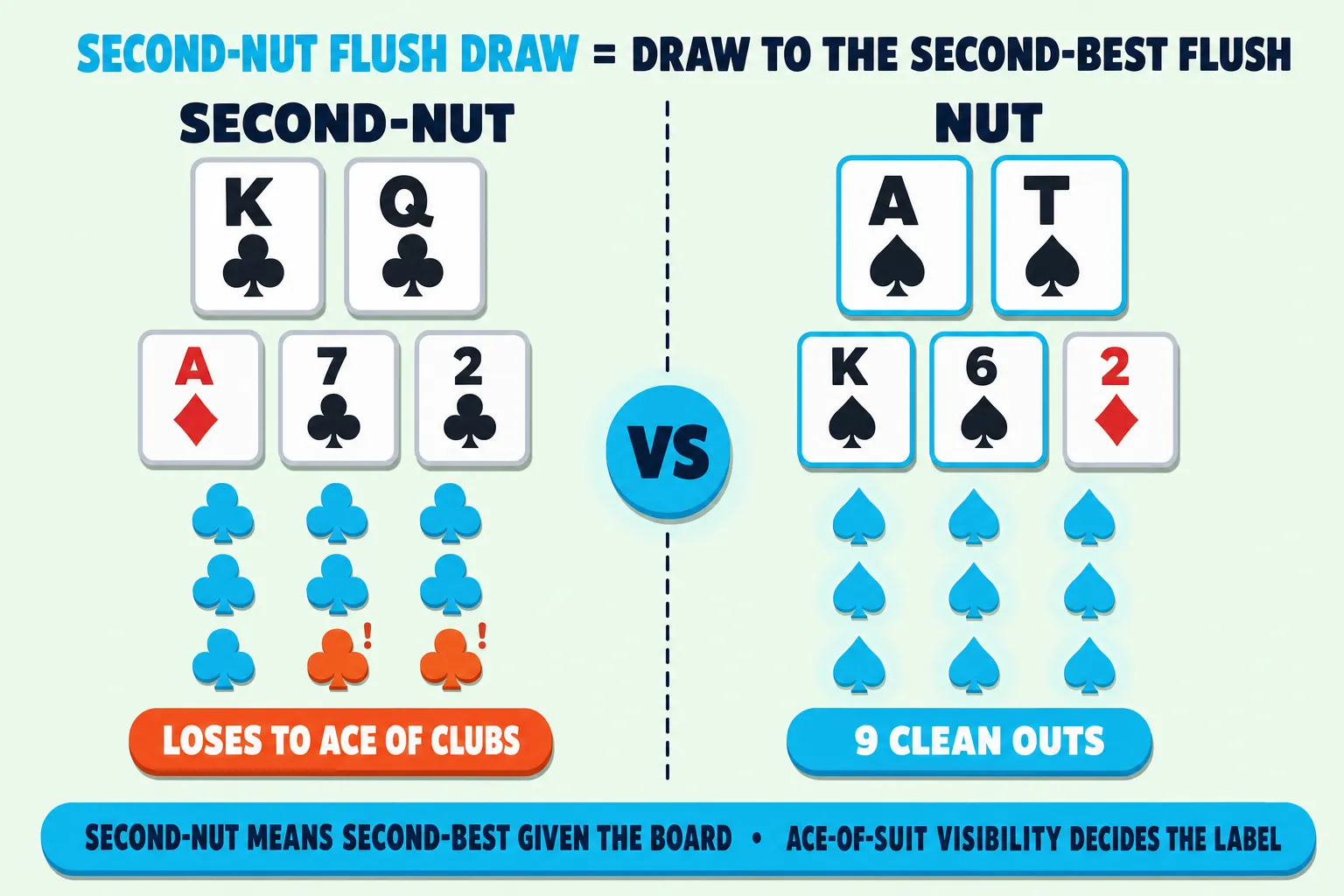
”Second-nut” is about the board, not the card rank
The same king-high flush can be the second-nut draw on one board and the nut draw on the next. Two quick reads make it concrete:
- Ace of the suit unseen. Hold K♣Q♣ on A♦7♣2♣. There are two clubs on the board and the A♣ is still in the deck or in someone’s hand. Any A♣x♣ in villain’s range already has the nut flush draw, and any A♣ alone makes the nut flush if a third club arrives. Hero’s K-high flush draw is second-nut.
- Ace of the suit on the board. Hold K♣Q♣ on A♣7♣2♦. The A♣ is now community, so no opponent can hold the ace of clubs in their hand. The highest unaccounted-for club is the king. Any third club gives K♣Q♣ a hand that no other made flush beats — on this exact board, the same hole cards play as a nut draw, not a second-nut one.
Same hole cards. Different board. Different draw label. The qualifier given the current board is load-bearing every time.
Why a second-nut flush draw plays differently from the nut version
A second-nut flush draw is not a dominated draw by default. It can be the best flush on the river. The catch is what happens when it isn’t. Three things shift relative to the nut version:
- Some outs are partly dirty outs. Every club that completes hero’s flush also completes any A♣x♣ in villain’s range. The 9-out raw count is correct, but the cards that connect into a higher flush should be discounted in spots where the opponent’s range is loaded with A♣x♣ combos.
- Reverse implied odds are real. When the third club hits and hero starts betting it like the nut flush, an A♣x♣ holding can call or raise the river for a bigger pot. The pot you win when villain has nothing is small; the pot you lose when villain has the nut flush is large.
- Bluffing the third-suit river is harder. The card that finally completes hero’s draw is also the card that strengthens the opponent’s range. Barreling that river on a second-nut flush turns hero into a bluff catcher for the nut flush.
The fix is not “fold every K-high flush draw.” The fix is price the draw differently depending on opponent range, position, and stack depth.
Example: K♣Q♣ on A♦7♣2♣
Hero: K♣ Q♣ Flop: A♦ 7♣ 2♣ Setup: single-raised pot, no preflop reraise.
What hero has on the flop:
- A second-nut flush draw — nine club outs, but the A♣ is unseen.
- A backdoor straight draw with broadway connectors.
- No top pair, since the ace is on the board, not in hand.
Now branch by opponent.
Heads-up vs a wide late-position opener
Villain raised the cutoff or button preflop. Their range is full of broadway combos, suited connectors, and weaker pocket pairs. A♣x♣ combos exist but are a small slice of the total range. Most of the time villain holds a hand that does not have a higher flush draw.
This is the friendlier branch:
- The draw plays as a check-call or check-raise candidate at the right price.
- Implied odds are reasonable when hero hits, since villain still pays off most of the rare A♣x♣ runouts but pays small overpairs on a worse flush sometimes.
- A turn semi-bluff with the K♣Q♣ structure can fold out the weaker parts of villain’s range.
Multiway against an early-position raiser
Three players see the flop after a UTG open. UTG’s range is tight and ace-heavy: A♣K♣, A♣Q♣, A♣J♣, A♣T♣ are exactly the suited combos a tight opener still has after the flop. Both extra players also have ranges that contain ace-x suited.
This is the brittle branch:
- The chance someone already holds A♣x♣ goes up materially as players are added.
- Even if no one currently has the nut flush draw, the third club lands hero into a hand that will pay off any A♣x♣ that does have it.
- Bet sizing on the river collapses: a big bet runs into the nut flush; a check gives up value when hero is actually best.
The same hole cards on the same flop should not be priced the same heads-up against a wide CO opener and three-way against an UTG raiser. The draw quality is different.
Deeper stacks
At 100bb effective, the maximum loss when hero hits second-best is capped by the stack. At 250bb effective, the same hand has multi-street commit potential — and the higher flush collects on more streets than it does at 100bb. Reverse implied odds scale with stack depth, so a second-nut flush draw deep is harder to price than the same draw shallow.
These ranges and pricings are illustrative, not solver claims. They show the texture of the spot, not exact frequencies.
What still has to line up
A second-nut flush draw is a continuing hand on most boards, not a fold-by-default holding. Three reads still need to be true to keep chips going in:
- Price. Compare the draw’s hit chance to pot odds. Discount the apparent 9 outs against ranges that can hold A-of-suit.
- Position. Acting last lets hero realize equity and pick the rivers to barrel. Out of position, the same draw under-realizes raw equity and pays off the nut flush more often.
- Range read. A wide late-position opener has many fewer A♣x♣ combos than a tight UTG raiser. The same hand against the same draw plays differently against those two ranges.
Skip any one of those and a “draw to a flush” headline can hide a marginal call.
Common mistakes with second-nut flush draws
1. Treating it the same as the nut flush draw
Both have nine raw outs. Only one of them wins every time it hits. Pricing a second-nut flush draw at nut-flush-draw equity is the most common leak in the spot.
2. Bluffing the third-suit river
The river that completes hero’s flush is the same river that strengthens any A-of-suit in villain’s range. Big rivers bets on that texture turn hero into a bluff catcher rather than a credible representor.
3. Pricing it the same multiway as heads-up
Each extra player adds another range that can hold the A-of-suit combo. A draw that prices fine heads-up can be a clear fold three-way against a tight opener, especially deep.
4. Forgetting the blocker effect on the K-of-suit
Holding the K-of-suit blocks K♣x♣ flush draws in the opponent’s range, but it does not block any A♣x♣ holdings. The blocker math helps less than it does for an ace-high suited holding.
5. Confusing “second-nut” with “dominated”
Second-nut means second-best on a given board. Dominated means the draw structure itself is behind in the matchup. A second-nut flush draw against a range with very few A-of-suit combos is not really dominated — it just has a small downside hand.
FAQ
What is a second-nut flush draw in poker?
A second-nut flush draw is a draw to the second-highest possible flush given the current board. The most common shape is a king-high suited holding when the ace of that suit is still unaccounted for. If a third card of the suit hits, the draw makes a flush — usually best, but still losing to any A-of-suit holding in the opponent’s range.
Is a king-high flush draw always a second-nut flush draw?
No. The ranking is board-relative. If the ace of the suit is already on the board, then the king-high suited holding draws to the best possible flush on that exact board, so it plays as the nut draw. If the ace of the suit is unseen, the same hole cards are a second-nut flush draw.
Is a second-nut flush draw the same as a dominated draw?
Not always. Dominated means the whole draw is structurally behind hands inside the opponent’s range. A second-nut flush draw against a wide range with few A-of-suit combos is not really dominated. The same draw against an early-position raiser whose range is heavy on A-of-suit suited combos starts to look dominated in practice.
How should I play a second-nut flush draw multiway?
More cautiously than heads-up. Each extra player adds another range that can hold the nut flush draw or the made nut flush. Price the call against pot odds with a real discount on the outs that connect into a higher flush, and lean toward smaller pots on the third-suit rivers.
Why does stack depth matter for a second-nut flush draw?
Reverse implied odds scale with stack depth. At 100bb, the maximum loss when hero hits second-best is capped. At 250bb, the higher flush has more streets to extract on after the third-suit card lands, so the same draw under-realizes equity by more.
Final takeaway
A second-nut flush draw is the second-best possible flush given the current board, and the qualifier given the current board does the work. The draw can be a clean continuing hand heads-up against a wide opener, and a brittle one multiway against a tight ace-heavy range. Count the raw outs, then discount them against the part of villain’s range that holds the A-of-suit, then price the call against pot odds, position, and stack depth before treating it like the nut flush draw.