


Pot-Limit Omaha (PLO)
Pot-Limit Omaha (PLO) is the four-card Omaha variant played with pot-limit betting. You receive four hole cards instead of two, and you must use exactly two of them plus exactly three board cards to make every five-card hand at showdown. The pot-limit rule caps every raise at the size of the current pot, so PLO does not allow the all-in overbets that define No-Limit Hold'em. Six two-card combinations per hand instead of one, more nut and near-nut hands in everyone's range, and tighter equities turn a game that looks like Hold'em with extra cards into a different game with its own rules of thumb.
Pot-Limit Omaha (PLO): the four-card variant where you must use exactly two hole cards
What PLO is and how the rules work
Pot-Limit Omaha is the four-card Omaha variant played with pot-limit betting. Each player receives four hole cards instead of the two dealt in Hold’em, and the betting rounds match Hold’em: a preflop round, a three-card flop, a turn, and a river. The defining hand-construction rule is that you must use exactly two of your four hole cards plus exactly three community cards to make your final five-card hand. Not one, not three; exactly two from your hand and exactly three from the board, every time. Pot-limit means the largest legal raise is the size of the current pot after you call any bet that is in front of you; you cannot move all-in for arbitrary amounts the way No-Limit Hold’em allows. For a fuller walkthrough of the rules, the pot-raise math and the Hold’em habits that do not transfer, see how to play Pot-Limit Omaha. The split-pot sibling has its own guide: Omaha hi-lo rules and strategy.
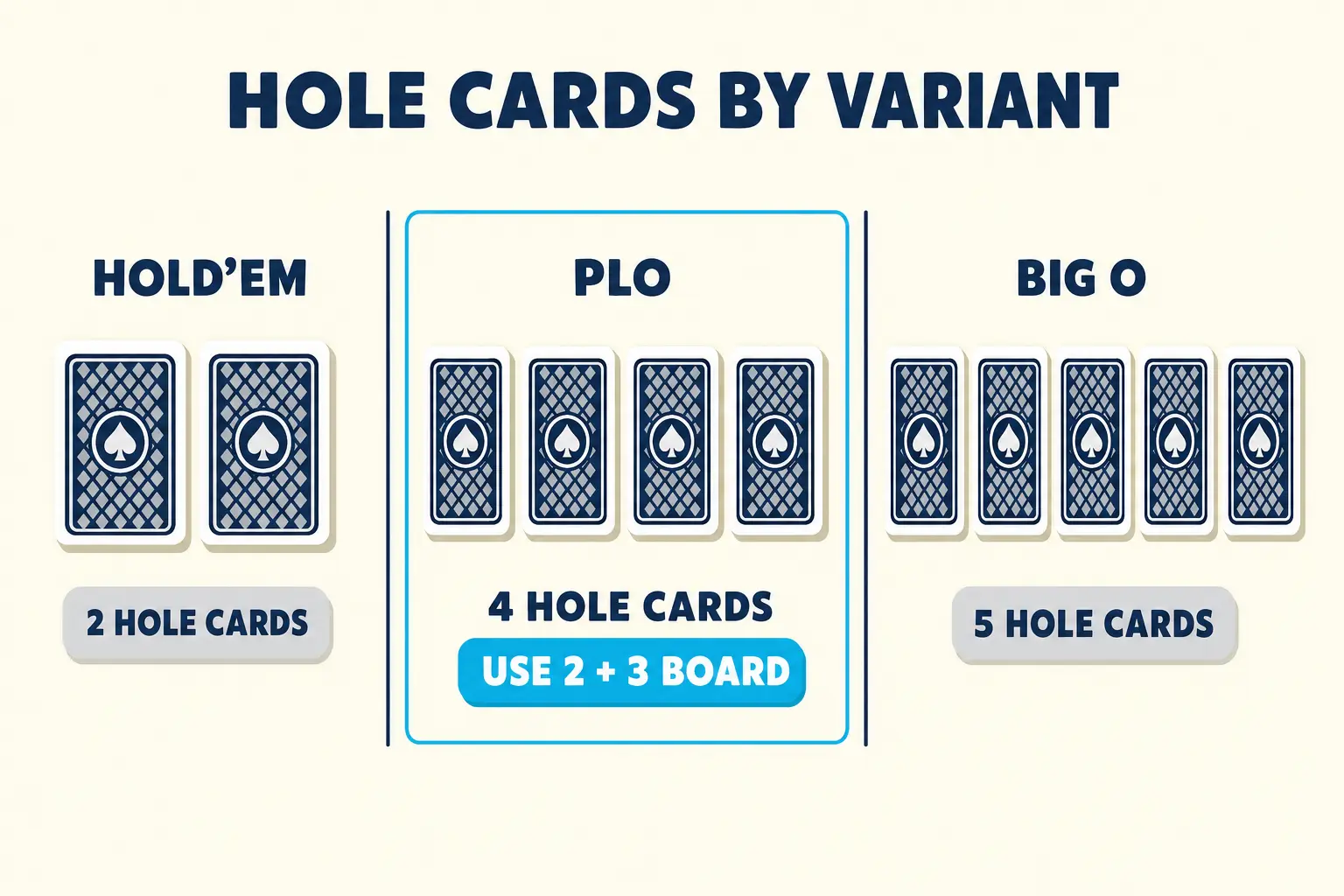
PLO vs Hold’em vs Big O at a glance
The rules look small on paper. The strategic gap they open between PLO and the games on either side is what makes the variant feel different.
| Trait | Hold’em | PLO | Big O |
|---|---|---|---|
| Hole cards | 2 | 4 | 5 |
| Two-card combos per hand | 1 | 6 | 10 |
| Hand construction | Any 5 from 7 | 2 hole + 3 board | 2 hole + 3 board |
| Betting structure | No-limit | Pot-limit | Pot-limit |
| Pot split | High only | High only | High + qualifying low |
| Typical action | Often heads-up by the turn | Multi-way, big pots | Multi-way, split pots |
The two-card combos number is the one to keep in mind. With six combinations per opponent in PLO, somebody almost always has a hand close to the nuts. That is why PLO play centers on nut-leaning hands and nut draws first, and on betting lines second.
When the must-use-two rule changes your decisions
The “exactly two hole cards plus exactly three board cards” rule sounds like a footnote and is the single biggest source of beginner mistakes for players moving over from Hold’em. Three places it bites:
- Flushes need two suited cards in your hand. A board with four hearts does not give a player who holds a single heart a flush. In Hold’em, one heart in your hand plus four hearts on the board gives you a flush; in PLO that hand has nothing. You need at least two hearts in your hand, and the flush uses exactly two of them with three of the board’s hearts.
- Straights need two connecting cards in your hand. A Hold’em player holding a single jack or six has a straight on a board of 7-8-9-10. A PLO player needs two cards from the hand that complete the run with three from the board, such as 6-7 with 8-9-10 or 10-J with 7-8-9.
- A pair on the board uses two of your three board cards. If the board is K-K-7-2-2 and you hold A-K-Q-J, your best hand is three kings: K-A from your hand plus K-K-7 from the board. You cannot claim kings full of twos, because that would take one card from your hand and four from the board.
Hold’em players read their own two cards instinctively and then add the board. In PLO you have to do the opposite: pick two from your four, then pick three from the board, and check that those two pairs of choices give you a legal five-card hand. The arithmetic feels awkward at first; it becomes automatic by the second or third session.
Example: building a hand in PLO
You hold A♣ K♣ Q♠ J♠. The board comes K♥ 9♣ 4♣ 5♥ 2♣.
A Hold’em player looking at this hand would see top pair top kicker (kings with an ace) and two clubs in their hand against three clubs on the board. That player would call the hand a flush and feel confident. Only one of those reads holds up in PLO. You have to apply the must-use-exactly-two rule before naming the hand.
The flush works, but only because the math lines up. You hold exactly two clubs in your four-card hand: A♣ and K♣. The board shows three clubs: 9♣, 4♣, and 2♣. So you take A♣ K♣ from your hand plus 9♣ 4♣ 2♣ from the board and make A♣ K♣ 9♣ 4♣ 2♣ — the nut flush. Five clubs, two from your hand and three from the board, exactly. That is the strongest hand available, and it is the hand you play.
Top pair top kicker is weaker than it looks. With your A♣ and K♣ from your hand plus K♥ on the board, you can make K-K with an ace kicker. In Hold’em that is often a calling hand against a single bet. In PLO, with six combinations per opponent, K-K with an ace kicker is hardly ever ahead by the time real money goes in. The flush is on the equity ladder above it.
The straight is not actually there. A Hold’em-trained eye sees K-Q-J in the hand and a 9 on the board and starts looking for a 10. It does not arrive. K-Q-J-T-9 needs a 10 from somewhere; you do not have one in your four hole cards, and the board does not have one either. The straight read is a phantom, and reaching for it on a board where the flush is already nut is a way to lose chips.
The lesson the example carries: in PLO you list the candidate hands, apply the two-from-hand-and-three-from-board test to each, then keep the strongest one that survives. The ranking that matters is the hand you can legally build, not the hand that looks strongest at first glance.
Common PLO mistakes
- Treating top pair top kicker as a strong hand. With six two-card combos per opponent, somebody usually has a draw, a wrap straight draw, two pair, or a set. One pair almost never wins a contested pot, no matter how good the kicker is.
- Drawing to non-nut flushes. A king-high flush draw is a trap when the ace of that suit is live. Pot-sized bets in PLO are usually made by the nut hand or a draw to the nut; calling a pot-sized bet with the second-best flush draw is one of the most expensive habits a Hold’em player carries into PLO.
- Drawing to the bottom end of a straight. Holding 6-3 on a 10-5-4 board gives you the lower end. If a 7 falls, you make the seven-high straight, and a player holding 8-6 makes the eight-high one above it. The fix is drawing to the top end, and Poker Skill makes the point with Q♥ K♥ on 10♦ J♣ 2♦: the hand needs an ace or a nine, and either card makes the best straight possible on that board.
- Forgetting the must-use-two rule on the river. New PLO players announce a flush that requires using one or three cards from their hand and learn the rule the painful way. A short pause to count cards before declaring a hand is not optional in this game.
- Calling pot-sized bets with second-best anything. Pot-limit means a pot-sized bet is the maximum, and players who size up to the pot in PLO almost always have the nuts or a strong nut draw. Calling with a hand that beats only bluffs is a slow leak; against a population that bluffs less in PLO than in No-Limit Hold’em, it is a fast one.
PLO checklist
- Count your hole cards: four, not two.
- Build hands using exactly two from your hand plus exactly three from the board, every time.
- Treat the nut flush draw and the nut straight draw as your real currency; weaker draws are usually folds.
- Read pot-sized bets as nut-leaning by default. The bluff frequency in PLO is lower than in No-Limit Hold’em.
- Pause before saying “I have a flush” or “I have a straight” — count, then call the hand.
Where PLO fits in the variant family
PLO is the parent of two close cousins. Omaha hi-lo eight-or-better (sometimes shortened to PLO8 or O8) shares the four hole cards and the must-use-two rule but splits the pot between the best high hand and the best qualifying low (five unmatched cards eight or below); if no qualifying low is made, the high hand wins everything. Big O is the five-hole-card hi-lo cousin: same must-use-exactly-two rule, one extra hole card per hand, ten two-card combinations per hand, and the same hi-lo pot split. Players who already know Hold’em pick up PLO faster than the hi-lo variants because the high-only showdown is familiar and only the hand-construction rule has to be retrained. Players who already know PLO pick up Big O and PLO8 faster than Hold’em-only players for the same reason.
For how the split pot and the eight-or-better low qualifier actually work in those cousin games, see the hi-lo entry.
PLO sits at the center of the Omaha family by every measure that matters: the largest variant population, the most published material, the most software support, and the bridge into the hi-lo games for players who want to keep moving. Hold’em is the gateway. PLO is the next room over.