
3-Bet Pot (No-Limit Hold’em)
What creates a 3-bet pot
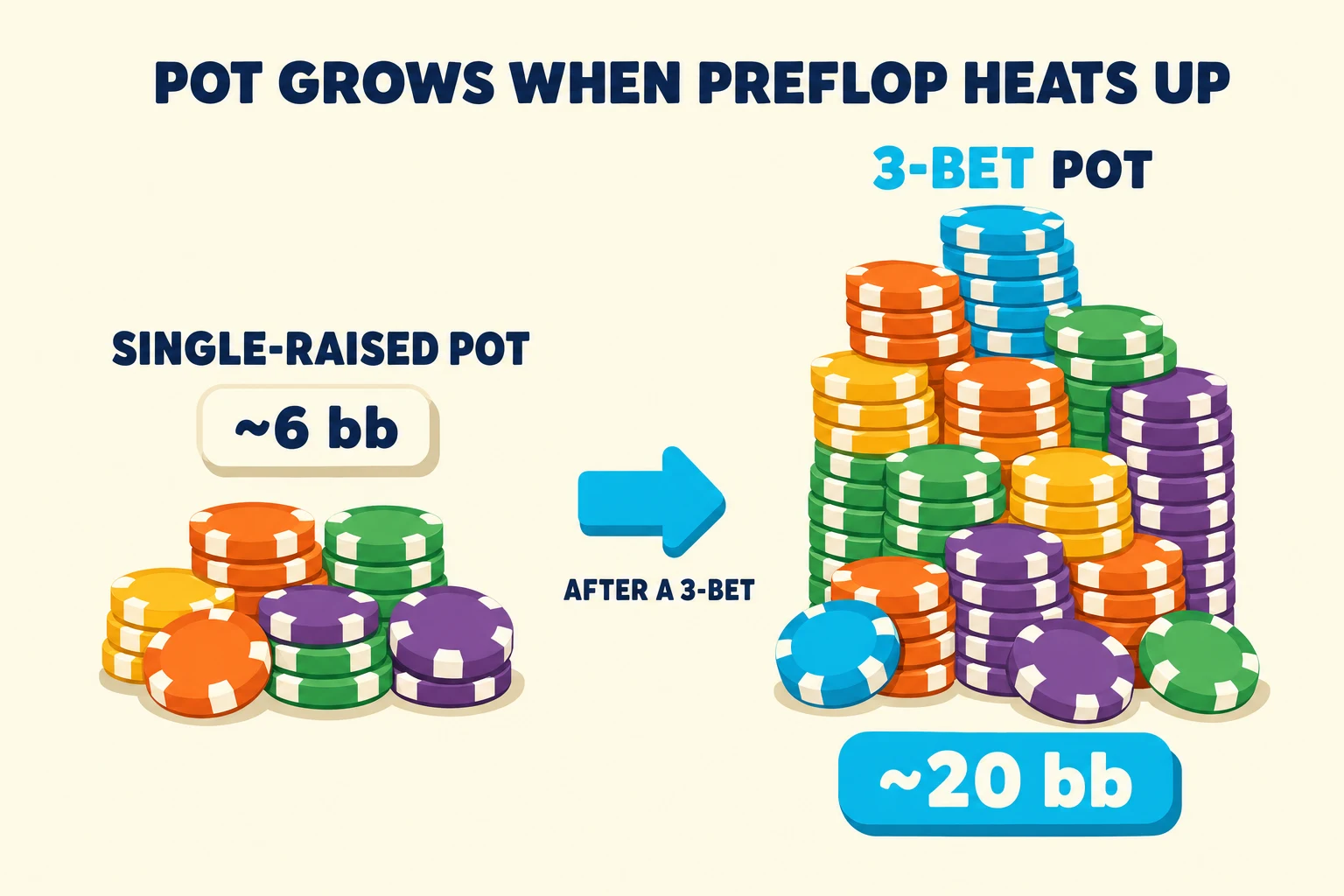
A 3-bet pot is what you get after an initial preflop raise meets a re-raise: the third distinct bet in the sequence. Example: UTG opens, the button re-raises (the 3-bet). That extra aggression tightens both ranges, inflates the pot, and makes the postflop decisions harder than a single-raised pot. Three-bet pots carry more fold equity and stronger ranges, so the opponent across from you is either holding the goods or running a deliberate bluff. Plan for tougher multi-street spots.
For the preflop definition and sizing sequence, start with 3-bet. For the call-or-raise choice before the pot gets built, read Cold call vs 3-bet.
Why 3-bet
- Apply pressure: A well-timed 3-bet forces the original raiser into difficult decisions; many hands that call a single raise fold to a re-raise.
- Extract value: With premium hands you 3-bet to build the pot and seize initiative for post-flop aggression; for example, 3-betting AK denies cheap flops and extracts value from weaker aces and broadways.
- Balance and bluffing: Add selective bluffs and semi-bluffs to keep your 3-bet range balanced. Blockers are cards that reduce the chance opponents hold certain strong hands. Holding A5, for example, lowers an opponent’s chance of AA or AK, making A5 a useful semi-bluff.
Pre-flop sizing, position, and stack-size rules
Position matters: a late-position 3-bet differs from one in the blinds. When out of position, use larger 3-bets to compensate for post-flop disadvantages and gain extra fold equity. Stack sizes shape choices:
- Deep stacks let you 3-bet without committing, enabling multi-street play and non-all-in 4-bets.
- With shallower stacks (under about 40 big blinds), 4-bets are usually all-in, so only commit when you intend that action.
- Avoid committing more than roughly one-third of your stack to a 3-bet/fold line to keep later options open. Bet sizing guidance: prefer larger 3-bets from the big blind or when OOP; the small blind may use slightly smaller sizes versus certain opponents. Choose a sizing that forces meaningful decisions and achieves your desired fold equity.
Building and adjusting 3-bet ranges
Start with a value core: JJ+, AJs+, KQs, AQ. These hands you 3-bet mainly for value. Mix in selective bluffs: suited connectors and ace-blocker hands like A2-A5 to exploit fold equity. Adjustments:
- Versus aggressive LAG opponents, widen your 3-bet and expect more 4-bet action; include stronger hands that can value-bet or call down.
- Versus passive callers, tighten your value 3-bet range and reduce pure bluffs; favor hands with good post-flop playability if opponents call too often. Example: if an opponent calls 3-bets frequently, cut small pairs as 3-bet bluffs and add suited connectors that realize equity post-flop.
Post-flop play in 3-bet pots
Many players fold too much to large pre-flop 3-bets, so continue aggression when you have clear value or good bluffing opportunities. If called, play with initiative: continue with hands that have equity (draws, top pair) and with blockers that hinder opponents’ strong holdings. Avoid flatting marginal hands pre-flop only to surrender on the flop. Use flat calls only when you have a planned post-flop line or when stacks and reads justify multi-street play.
Quick checklist
- Remember definition: initial raise -> re-raise = 3-bet pot.
- Use position, stack size, and opponent tendencies to choose sizing and range.
- Core value: JJ+, AJs+, KQs, AQ; include selective bluffs like suited connectors and A2-A5.
- Don’t overcommit to 3-bet/fold lines; plan post-flop actions when you flat or 3-bet.