


Value Range
A value range is the slice of a betting or raising range built from hands that want worse hands to call. It is the set of hands you bet or raise for value, not the single action of one bet. The exact boundary between value and not-value depends on the opponent's calling range and the board, not the absolute label of the hand.
Practice this in Poker Skill. The Value Betting lesson plays a pair of nines both ways, betting it as top pair on a low board and checking it back under paired kings, where only better hands would call.
Get the free appValue Range: the slice of a betting range built from hands that want calls
What a value range is
A value range is the set of hands a player bets or raises for value at a given decision point — the part of an aggressive range that wants worse hands to call. It is the value half of a betting range, paired with the bluff half on most streets and most board textures. A single hand inside that set takes a single value bet; the value range is the whole collection of hands taking that action together.
Two ideas often get smashed together and shouldn’t be. A value bet is an action: one hand, one street, one bet. A value range is a set, every hand in your overall range that you intend to bet or raise for value in this spot. The action is hand-level. The range is strategy-level. You build the range first, then the action follows from which hand you happen to be holding.
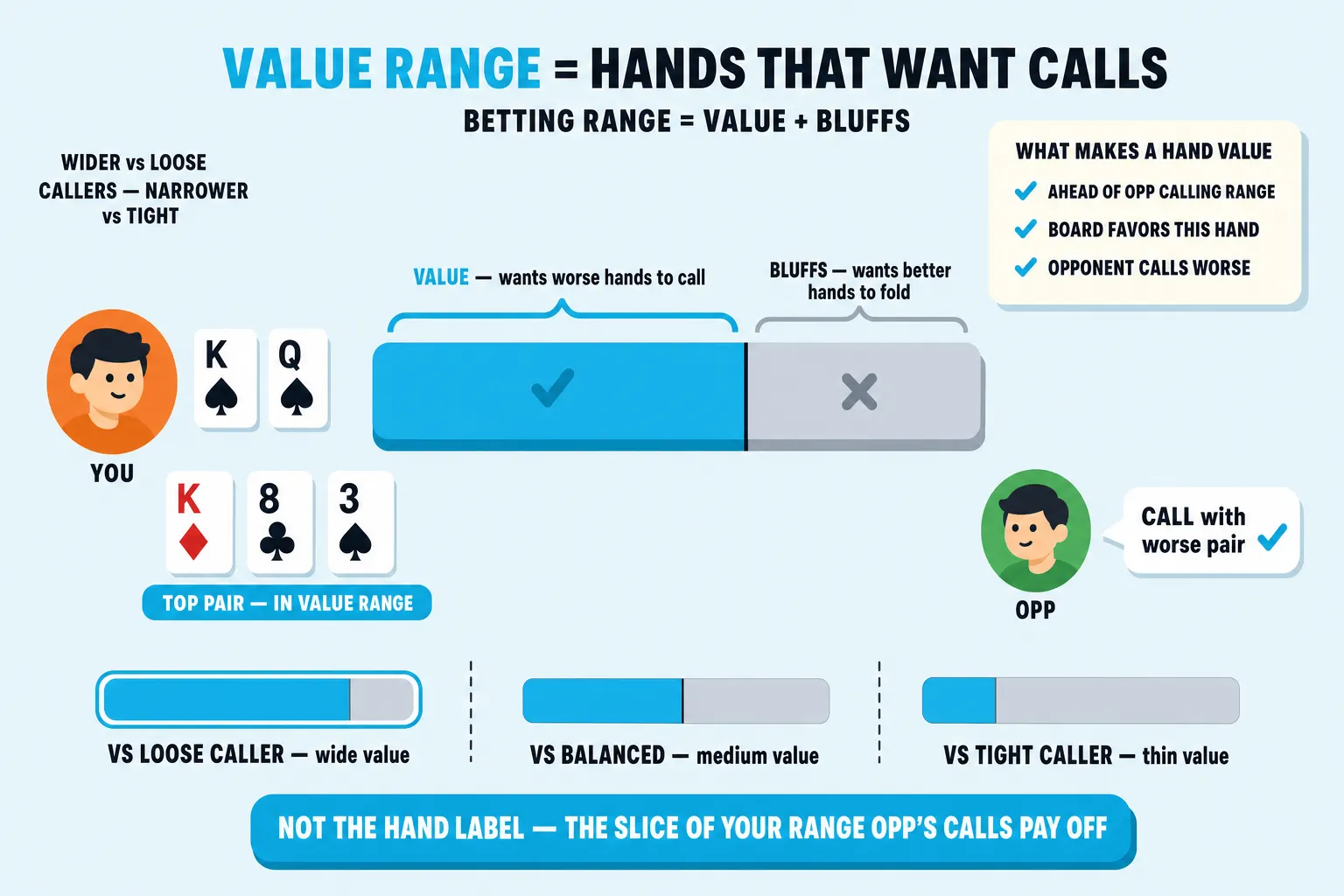
The most common confusion is treating “value” as a property of the hand instead of a property of the matchup. Top pair is not automatically value. It is value when the opponent’s calling range contains enough worse pairs and worse made hands. Against a different calling range on a different board, the same top pair can drop out of the value set entirely.
Related terms
- Range
- Value bet
- Thin value
- Bluff-to-value ratio
- Polarized range
- Merged range
- Showdown value
- Calling range
Value range vs the neighbors people confuse it with
Several terms sit close to “value range” and aren’t synonyms. The distinctions matter because each one points at a different lever.
| Term | What it names | What it does NOT name |
|---|---|---|
| Range | The full set of hands a player could hold at a decision point | Which fork they take with each hand |
| Value range | The slice of the range that bets or raises for value | The single bet, the bluffs, or hands that check for showdown |
| Value bet | The single action of betting to be called by worse | A set — one action, not a collection |
| Thin value | Value with a narrow edge over the calling range | A whole range — one shape inside a range |
| Bluff-to-value ratio | The mix of bluffs to value bets in a betting range | The hands themselves on either side |
| Polarized range | A betting range of nuts and bluffs, no middle | A guarantee about which hands are value vs bluff inside it |
| Merged range | A betting range of strong plus medium-strong hands, no bluffs | A polarized or thin-value-only range |
| Showdown value | A hand’s chance to win at the reveal without betting | Hands that want to bet for value (those want calls, not just to show down) |
| Calling range | The set of hands that calls a bet | The set of hands that bets for value |
The important distinctions inside that table:
- A value bet is one action; a value range is the set of hands that take that action.
- Polarized range and merged range are shapes a betting range can take. A polarized betting range has a value half and a bluff half with a deliberate gap between them. A merged betting range has a value half that already includes medium hands and no bluffs. Both have a value range. The difference is what the value range looks like and whether bluffs sit beside it.
- Showdown value points at hands that want the pot to stay small and reach the reveal without betting. Value range hands want the pot to grow because they expect calls. The two can briefly overlap on hands that have both showdown value and a value bet available, but the action choice splits them: showdown-value hands check, value-range hands bet.
- A calling range and a value range sit on opposite sides of a bet. The bettor’s value range is built to be paid off by part of the caller’s calling range. Reading one without the other leaves out the matchup that decides the call.
What changes the value range
Five inputs do most of the work. None are about the hand label in isolation.
- Opponent’s calling range. This is the dominant input. The value range is whatever beats enough of the calling range that worse hands call more often than better hands do. Wide caller, wide value range. Tight caller, narrow value range. Same hand, different opponent, different answer.
- Board texture. A connected, draw-heavy board shifts hands into and out of the value set. Top pair on K♥9♥7♥ is not the same value-range candidate as top pair on K♣8♦3♠, because the calling range has more two-pair, sets, and made flushes on the wet board. Board texture decides which hands keep a value edge.
- Bet size. Bigger bets tighten the calling range and shrink the value range that wants to bet. A pot-sized river bet folds out hands a half-pot bet would have called. The hand at the bottom of your value range against a small bet may not be in the value range at all against a large one.
- Street and how ranges have narrowed. Earlier streets have wider opponent ranges and wider value ranges; rivers have narrower opponent ranges and narrower, sharper value ranges. As cards run out, the value-range floor rises.
- Position and equity realization. Acting last lifts equity realization, which lets more medium hands stay in the value set across multiple streets. Out of position, the same hand may bet for value once and then drop out of the value range on the next street because it under-realizes.
When the value range matters most
The concept earns its keep in three places.
- Building river bet sizes on polarized boards. When the right strategy is to use one large size, the value range is whatever beats the calling range at that price, full stop. Get the value range right and the bluff side falls out of the bluff-to-value ratio automatically.
- Choosing between merged and polarized lines. A merged range widens the value range and skips bluffs against opponents who call too much. A polarized range tightens the value range and pairs it with bluffs against opponents who fold too much. The decision is a value-range decision before it’s a bluff decision.
- 3-bet and c-bet construction. Earlier-street value ranges are wider because the opponent’s continuing range is wider. The same line on the river would have a tighter value range. Knowing where the value-range floor sits at each street keeps you from over-betting hands that were value on the flop and aren’t value anymore.
It matters less in spots where the right action is rarely “bet for value.” A check-back with showdown value on a tricky river is not a value-range decision; those hands sit outside the value range by construction. A short-stack jam over an open is not a value-range decision either, and the hand selection there is closer to all-in equity math.
Example: the same hand, two different value ranges
6-max NLHE cash, 100bb effective. Same hero hand, two different opponents, two different value ranges. The point is to show that the boundary between value and not-value moves with the calling range, not with the hand label.
River example: a wider value range against a loose caller
You hold K♣J♦ on K♠ 9♣ 5♦ 7♥ 2♠ in position. Pot is $80 on the river after a check-call from the cutoff on flop and turn against your continuation bets.
- Cutoff is a calling station. Their flop and turn calling range is wide: every Kx, every pair from 22-TT, plenty of 9x, gutters, and ace-highs. By the river they show up with King-X-weaker-kicker, second pair, third pair, and a long tail of marginal hands that called twice. Your value range here is wide. K-J-good-kicker is comfortably in it. Even K-T and second pair (a TT or 99) sometimes belong in a smaller-size value range against this caller, because the bottom of their calling range is wide enough to pay off thin sizing. Bet medium-to-large with K-J for value. The value range is “any king, sometimes second pair,” not “only top pair good kicker.”
- Cutoff is a tight regular. Their flop and turn calling range is much narrower: Kx-good-kicker, sets, and a tight handful of draws that turned a pair. By the river, the calling range against a third bet has folded most of its second pairs and bluff-catchers. K-J is now near the bottom of the value range, not the middle. K-Q goes in. K-J is borderline — sometimes a small thin-value bet, sometimes a check-back. Anything below K-J drops out of the value range entirely. The value range narrows to “K-Q-and-better, plus maybe a small dose of K-J at a small size.”
Same hand, same board, same hero. The value range is wide in one matchup and narrow in the other because the calling range is wide in one and narrow in the other. That is what “value is relative to the calling range” means in practice.
Earlier-street example: the value range is wider before the river
Same hero, same K♣J♦, but now it is the flop on K♠ 9♣ 5♦. You opened from the cutoff and the big blind called.
- Big blind defends wide and calls flops loose. The BB calling range pre-flop is the widest in poker, and a loose BB also calls flops with second pair, gutters, ace-highs, and overcards. Your flop value range is correspondingly wide. K-J is in it, but so is K-T, K-9-suited, second pair (any 9x), and any over-pair. You can bet a merged-style range here — every value hand including the medium ones — because the calling range is going to pay off most of them.
- Big blind is a tight defender who folds flops a lot and only calls with real equity. Their flop calling range collapses to top-pair-and-better, second pair with a kicker, and the strongest draws. Your flop value range tightens to over-pairs, top-pair-good-kicker-and-up, and sets. K-J is still in it, but K-T probably isn’t anymore; it gets called by hands that beat it more often than hands worse than it. Second pair drops out of the value range and into the check-back / showdown-value bucket.
The pattern repeats across streets. The earlier the street, the wider the calling range, the wider the value range. The later the street and the larger the bet, the tighter the calling range, the tighter the value range. The hand label doesn’t move. The matchup does.
Common mistakes
1) Treating “value” as a property of the hand instead of the matchup
The most common leak in value-range thinking is labeling hands as value or not-value in the abstract. “Top pair is value.” “Second pair isn’t value.” Neither claim is true without a calling range and a board attached. A value range exists only against a specific opponent’s continuing range; the same hand crosses the value-range line in different directions against different opponents.
2) Building one value range and using it against everyone
Once you’ve decided “this is my flop c-bet value range,” it’s tempting to apply it everywhere. But the calling range you face on a 3♣2♣2♥ flop in a 3-bet pot vs an under-the-gun cold-caller is nothing like the calling range you face on a K♠T♠5♦ single-raised pot vs a big-blind defender. Same board structure, different opponent, different calling range, different value range. The value range tracks the matchup, not the spot label.
3) Confusing value range with polarized or merged shape
Polarized and merged describe the shape of a betting range. Value range describes a slice inside that shape. A polarized range has a value range and a bluff range with a gap. A merged range has a value range and no bluffs. Saying “I’m using a value range” doesn’t tell you whether the surrounding shape has bluffs or not; that’s a separate decision about polarization.
4) Forgetting that bet size moves the value-range floor
Picking the value range first and then choosing a bet size is backwards. Bet size sets the price. Price sets the calling range. Calling range sets the value range. If you start by saying “I’m betting big” without checking which hands still want calls at that size, you’ll find yourself pot-sizing hands that wanted a half-pot bet to get paid. Decide the matchup first, then the size, then check which hands still belong in the value half at that size.
FAQ
Is a value range always the strongest hands in a betting range?
Not always — only against a tight calling range. Against a loose calling range, the value range extends down into medium-strength hands that don’t usually feel like “value” hands in isolation. A merged range is exactly this: a value range that has been widened to include medium hands because the opponent’s calling range is wide enough to pay them off. Against a tight calling range, the value range collapses back to top-pair-and-better and the medium hands check.
Does a value range have to be paired with bluffs?
No. A polarized betting range pairs the value range with bluffs to defend against bluff-catching. A merged betting range deliberately leaves bluffs out and is just the value range, used when the opponent calls too often to make bluffs work and the cleanest plan is to bet only hands that want calls. The pairing decision is downstream of opponent type, not a default rule.
How do I know where my value range ends?
Run the matchup test on each candidate hand: if I bet, will worse hands call me more often than better hands call or raise me? If yes, the hand is in the value range. If no, it isn’t. The hand at the boundary is the one where the answer flips with one small change in the opponent’s calling range or the bet size, and that’s the hand to think about most carefully and the place where most mistakes happen.
Is showdown value the same as value range?
No. Showdown value is a hand’s chance to win at the reveal without betting. Value-range hands want to bet because betting gets called by worse. The two answer different questions. A hand can have showdown value and not be in the value range — that’s the classic “check-back to realize” hand that beats the bluffs in the opponent’s range but loses to the value side, so betting just folds out the bluffs and gets called by better. Showdown value says “show this down for free.” Value range says “bet this for calls.”