


Overlimp
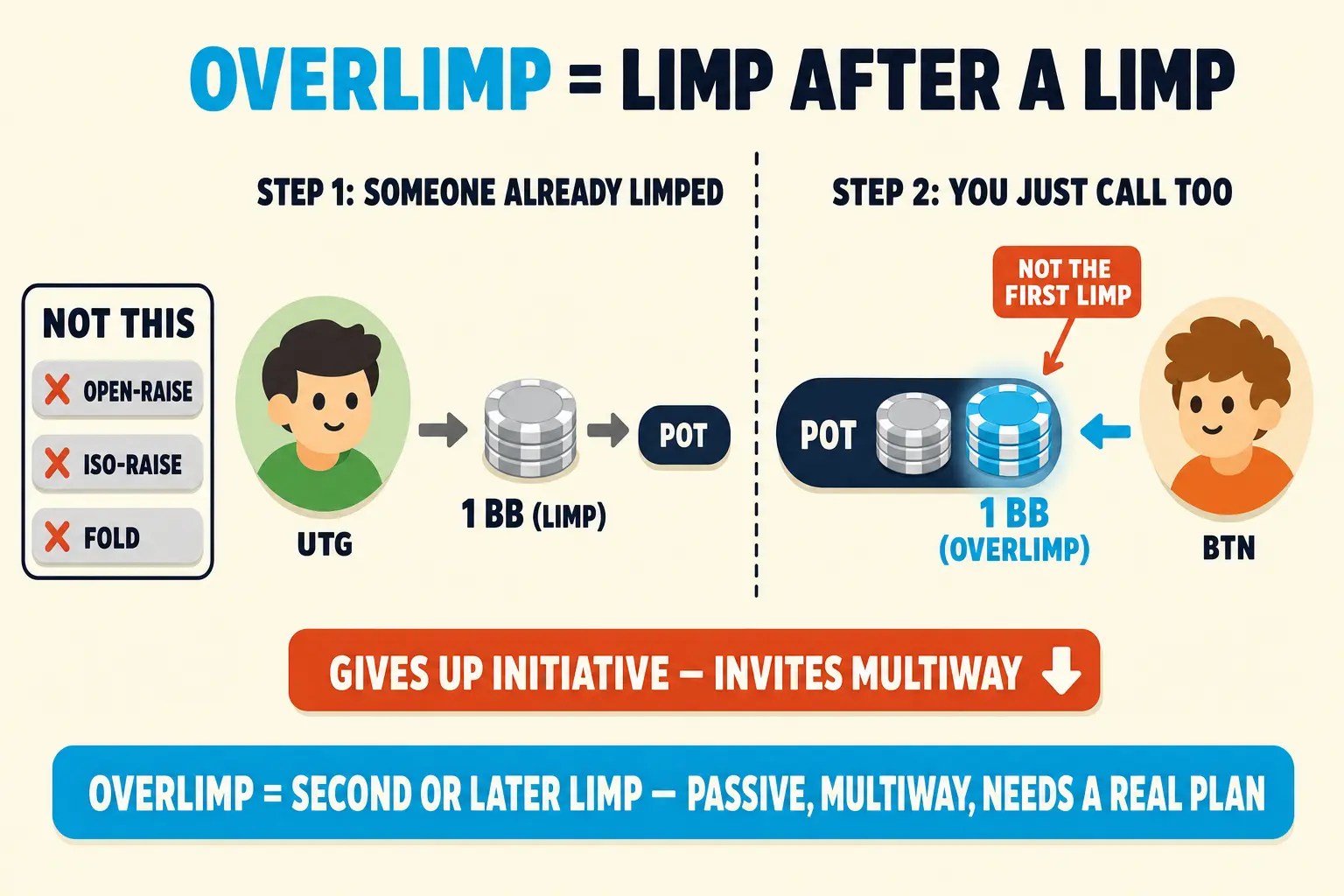
An overlimp is calling the big blind preflop after at least one player has already limped. It is the second (or later) limp into the pot, not the first one. Example: under-the-gun limps for 1 big blind, the cutoff folds, and you call 1 big blind on the button - that call is an overlimp. Overlimping is a passive preflop action: you give up the chance to raise and isolate, take a multiway flop in position, and rely on hitting a strong, disguised hand to win a meaningful pot.
Practice this in Poker Skill. The BTN vs One Caller lesson deals this exact spot, an under-the-gun limp with you on the button: small pairs call behind, while big pairs and suited high cards raise.
Get the free appOverlimp - Definition, When It Makes Sense, and Worked Example
What an overlimp is
An overlimp is calling the big blind preflop after at least one player has already limped. It is the second (or later) limp into the pot, not the first one. Example: under-the-gun limps for 1 big blind, the cutoff folds, and you call 1 big blind on the button - that call is an overlimp. Overlimping is a passive preflop action: you give up the chance to raise and isolate, take a multiway flop in position, and rely on hitting a strong, disguised hand to win a meaningful pot.
Overlimp vs limp, iso-raise, open-raise, and fold
Overlimping is easy to confuse with the other passive and aggressive options. The differences come from who acted first and what you do with that information.
- Limp: you are first into the pot and call the big blind instead of raising. There is no prior action to react to. See limp.
- Overlimp: someone has already limped before you act, and you call the big blind too. You are the second (or later) limper, not the first. The action in front of you is the whole point.
- Iso-raise: someone has already limped, and you raise instead of calling, trying to play heads-up against the limper in position. See iso-raise.
- Open-raise: you are first into the pot and raise. Nobody limped or folded a pot you can attack. See open-raise.
- Fold: nobody contributed value to your hand by limping; you skip the spot.
The same hand can be a limp, an overlimp, an iso-raise, or a fold depending only on what happened before you. An overlimp specifically means: someone limped, you saw it, and you chose to flat the big blind rather than raise or fold.
Why overlimping invites a multiway pot and gives up initiative
When you overlimp, the pot is already small and likely to stay multiway. The original limper is still in. The blinds are getting a discount to come along (the big blind is closing the action for free, and the small blind is closing for half a big blind). Players left to act behind you can also overlimp or iso-raise. The realistic outcome is a multiway pot with no preflop raiser.
That has two consequences worth being honest about.
- You give up initiative. Initiative is the simple advantage of being the player others have to react to. By flatting instead of raising, you let an opponent behind you iso-raise and take that role - now you are the one defending against a raise with a hand you only wanted to see a flop with.
- You play the flop in a multiway pot with a capped range. Top-pair hands and bluffs lose value multiway. Speculative hands that can make the nuts (small pairs to set-mine, suited connectors that can flop straights and flushes) gain value because implied odds go up. The flatting line tells opponents your range is mostly those speculative hands - it is hard to have AA or AK after an overlimp, because those hands almost always raise.
The default in modern cash play is the raise-or-fold baseline. Overlimping is an exception you take on purpose, not a shortcut you take to avoid a decision.
When overlimping can be reasonable
Overlimping has a real, narrow place. The shared theme is: the table is passive, your hand wants a cheap multiway flop more than it wants a heads-up pot, and you have a plan for what happens next.
- Late position behind a passive limper. On the button or cutoff, you act last preflop and last on every postflop street. Position softens the cost of going passive because you get to see what everyone does before you commit chips.
- Speculative hands that thrive multiway. Small pocket pairs that want to set-mine, and suited connectors and suited gappers that want to flop strong draws or two pair. These hands prefer a 4-way limped pot at 1 big blind to a heads-up 8 big blind iso-raised pot.
- Soft, passive games. Live low-stakes and microstakes online tables where many players limp, few players punish limps with iso-raises, and postflop play is straightforward. The discount from overlimping into a passive multiway pot can outweigh the cost of giving up initiative.
- Effective stacks deep enough that implied odds matter. Set-mining and connector hands need a stack behind that pays you off when you hit. With ~100 big blinds on the table this is fine; with 20 big blinds your implied odds are tiny and overlimping looks much worse than raising or folding.
When those conditions break - the table iso-raises limpers often, you are out of position, the stacks are short, or your hand wants a heads-up pot - overlimping stops being defensible and the right call is iso-raise or fold.
Example: EP limps, you are on the button
The under-the-gun player limps for 1 big blind. The middle position and cutoff fold. You are on the button. The blinds behind you have been passive all session - the big blind rarely raises, the small blind almost never iso-raises a limp. Effective stacks are 100 big blinds. Compare three plausible hands.
Hand A: 7♥6♥ on the button. This is a textbook overlimp candidate in this game. Your hand wants exactly what the spot offers: a cheap multiway flop where straights, flushes, and two-pair payoffs win big pots from a passive limper. An iso-raise to 4 big blinds is fine too, especially if the limper is fold-prone, but you do not need fold equity here - you have implied odds. A fold would be too tight against a single passive limper at 100 big blinds in position. Overlimp is reasonable.
Hand B: 4♣4♦ on the button. Set-mining is the plan: you are roughly an 8-to-1 underdog to flop a set, so you need an opponent who pays off with a meaningful chunk of stack when you hit. A passive UTG limper who will call a flop bet on 4-high and a turn bet on most safe runouts is the ideal payoff. Overlimp is reasonable, with the explicit plan: check-fold when you miss, bet for value when you hit, do not bluff this 100-big-blind stack into the limper.
Hand C: A♣J♣ on the button. This hand is not a fit for overlimping. AJ suited wants a heads-up pot in position against a capped limper range, not a 4-way flop where it is one weak top-pair away from being dominated by AQ or AK. Iso-raise to about 4 big blinds (your normal button open size plus 1 big blind for the limper) is the default. Folding is also defensible against a sticky limper who calls everything. Overlimping is the worst of the three options - it gives up initiative with a hand that wanted initiative.
The point of the example: the action in front of you (one EP limp) is identical in all three hands. The right answer changes with the hand and your plan, not with a habit of “always overlimp the button.”
Common mistakes when overlimping
The default failure mode is using overlimp as a way to avoid a real preflop decision. A few specific shapes to watch for.
- Overlimping with hands that want a heads-up pot. Big offsuit aces, KQ, AJ-type holdings prefer iso-raise over overlimp because they want to play one opponent in position, not three opponents who can all flop two pair on you.
- Overlimping out of position. From the small blind or under-the-gun + 1, you do not have the positional discount that makes the line tolerable on the button. Most of the time it is iso-raise or fold from those seats.
- Overlimping into a table that punishes limps. If one or two players behind you iso-raise limpers often, you are not getting a cheap multiway flop - you are setting yourself up to face a raise with a hand you only wanted to flat. That turns the spot into a limp-call decision you usually did not plan for.
- Overlimping at short stack depths. With 20 to 30 big blinds effective, the implied odds that justify set-mining and connector play are not there. The math collapses and overlimping becomes a leak.
- Overlimping as an excuse to “see a flop” with everything. Treating it as a low-cost call regardless of hand turns into a steady chip drip - 1 big blind at a time, hand after hand, in spots where folding or raising would have been better.
FAQ
How is an overlimp different from a limp? A limp is the first limp into the pot; an overlimp is any limp after the first one. Action order is the only difference - the chips put in are the same.
Is overlimping ever the highest expected-value option? In passive games, in late position, with speculative hands and deep stacks, overlimping can be the best of the three available options (overlimp, iso-raise, fold). Treat that as a real but narrow case, not the default.
Can I overlimp with a strong hand to trap? Overlimping with premiums (QQ+, AK) is almost always worse than raising. You give up value, give the field a cheap look, and play a bloated pot multiway with a hand that wanted to define ranges preflop. Iso-raise instead.
What happens if someone iso-raises behind me after I overlimp? You face the same kind of decision as a limp-call spot: fold most hands, call with hands that have the implied odds and post-flop equity to handle a raised multiway-or-heads-up pot, and rarely 3-bet. Plan for this before you overlimp - if it happens often at this table, the overlimp was probably not the right move in the first place.
Does the overlimp change my postflop plan? Yes. Your preflop range after an overlimp is capped (mostly speculative, very few premiums), and you usually have no preflop aggressor. Lean toward straightforward value lines on flops you connect with, fold a lot of marginal made hands when faced with multiway action, and avoid trying to bluff multiple opponents in a small pot.
Quick checklist
- Overlimp means second-or-later limp; the limp in front of you is the whole reason the move exists.
- Default to raise-or-fold; treat overlimp as an opt-in exception with a real reason.
- Reasonable when you have position, a speculative hand, deep stacks, and a passive table.
- Avoid with hands that want a heads-up pot, out of position, at short stacks, or against players who iso-raise limps often.
- Plan ahead for an iso-raise behind you; if that happens a lot at this table, the overlimp was probably the wrong action.