


Limp-Raise
A limp-raise is a two-step preflop line: limp first, face a raise behind you, then re-raise instead of folding or calling. It is the rare aggressive twin of the limp-call, used mostly to trap a very strong hand against an opponent who isolation-raises limpers wide.

Practice this in Poker Skill. The Isolation vs Limpers lessons drill the isolator’s side of this line: a limper who re-raises is telling you about a big hand, and K♦ Q♠ folds to it.
Get the free appLimp-Raise
What a limp-raise is
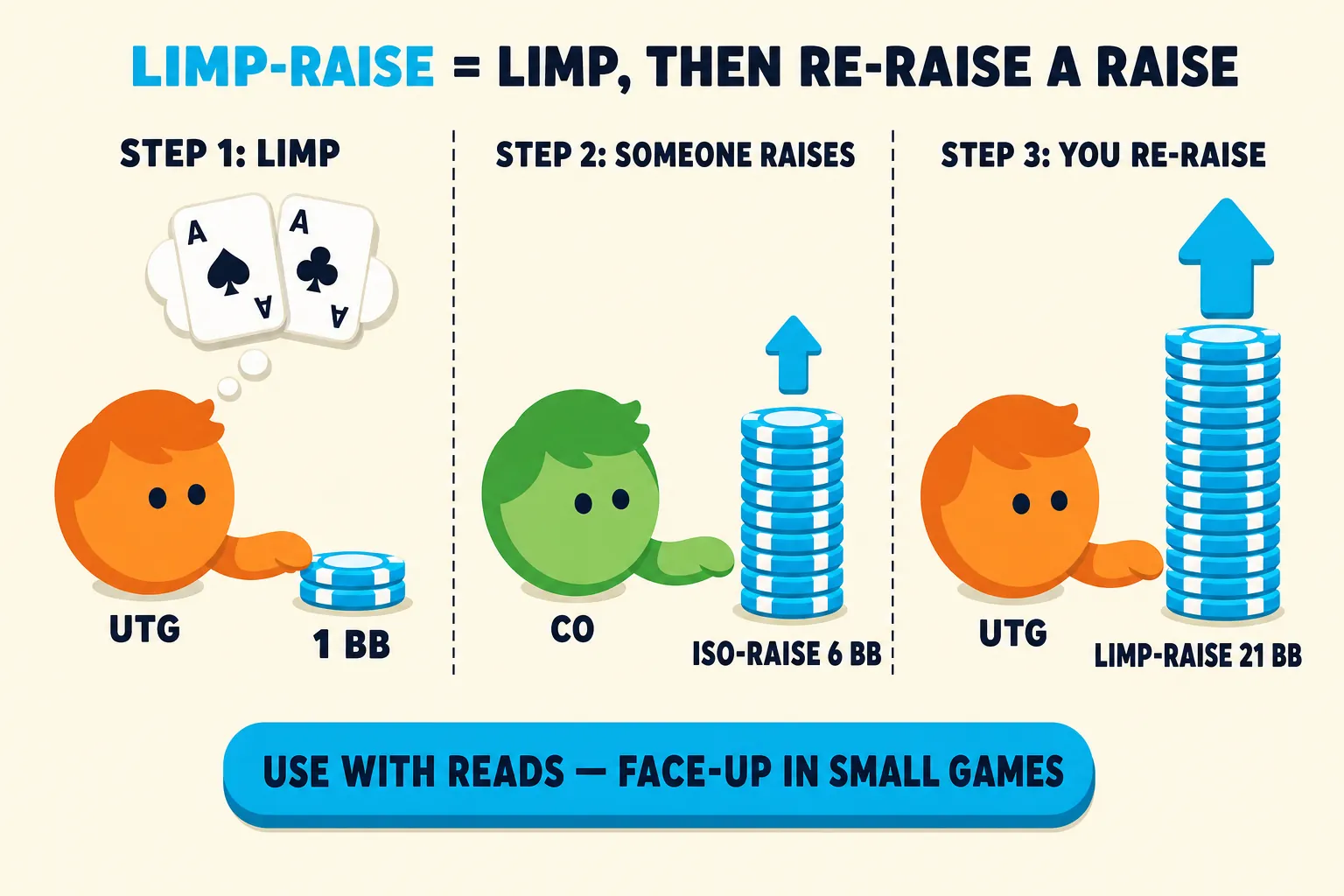
A limp-raise is a two-step preflop line: you limp first by calling the big blind, and then re-raise after another player raises behind you. Limp, face a raise, re-raise. That is the whole shape, and it is the aggressive twin of the limp-call, which limps and then flats the raise instead of pushing back.
Limp-raise vs. nearby preflop lines
- Limp-raise vs. limp-call: Same first step, opposite second step. The limp-caller flats the raise; the limp-raiser re-raises it. The limp-call usually shows medium speculative holdings; the limp-raise usually shows a very strong hand.
- Limp-raise vs. 3-bet: A standard 3-bet starts from an open-raise: raise, then re-raise. A limp-raise starts from a limp: limp, raise, then re-raise. The limp-raise is a 3-bet that walked through a limp first, and most opponents read it that way.
- Limp-raise vs. trap: A trap is a multi-street plan to keep an aggressor firing. A limp-raise is a one-decision preflop line; the trap framing only fits when you specifically expect the player behind you to raise the limpers and you want to use that to put more chips in preflop with your strongest hands.
- Limp-raise vs. iso-raise: An iso-raise is the raise the limp-raiser is responding to: a late-position player isolating the original limper. The limp-raise is the limper firing back over the top.
The limp-raise is the exception, not the baseline. The baseline case, why raising beats limping, covers what an ordinary open buys you and what an ordinary limp costs.
Why anyone limp-raises
Three motives pull players toward the line. Only the first two come up much in practice.
- Trap with a monster against an aggressive isolator. When you sit down with a player who iso-raises limps very wide, limping AA or KK and then re-raising over their isolation often gets more chips in than open-raising and watching them fold the same wide range. The plan needs a known isolator behind you and stacks deep enough that the re-raise still leaves a real pot to play postflop.
- Exploit a wide isolator’s bluff frequency. Some opponents auto-raise any limp from any position with most of their playable range. Against that pattern, a small limp-raise bluff component — suited aces with blocker value, suited broadways — folds out enough of their iso range to make the line worthwhile on its own. This needs evidence the isolator actually folds, not that they always 4-bet light.
- Balance in niche solver spots. A few solver studies show small limp-raise frequencies at very specific stack depths and seats, mostly in tournaments. These are real, but exceptional; the overwhelming majority of cash-game limp-raises are pure exploit, not balance. Treat the frequencies as illustrative rather than universal.
When the line breaks
Three conditions usually have to hold. If any is missing, default to opening.
- An opponent who actually raises limpers. No isolation behind you, no limp-raise. Limping AA into a passive table where everyone flats is just an invitation to the multi-way pot you did not want.
- Stack depth that keeps a real pot behind. The limp-raise builds a big preflop pot fast. At ~100bb in cash you still have plenty of postflop room; at 25–35bb in tournaments the limp-raise is closer to a preflop commitment, and the math collapses into “just open or just shove.”
- A population that does not read the line as face-up. In small-stakes live and online games, limp-raise heads-up almost always means premium pair. Regulars there fold their entire iso range, and the pot you collect is the size of one open. The line travels best against opponents who think a limper is always weak and keep firing into you anyway.
Worked example
You are first to act at a $1/$2 cash game. Effective stacks ~$200 (100bb). The cutoff has been opening every limp at the table for two orbits, sizing big. That is the read you need.
You look down at A♠A♣ and limp $2. As planned, the cutoff iso-raises to $12. Both blinds fold. Pot is $15.
You limp-raise to about $42. Sizes are illustrative and would shift with stack depth and the cutoff’s calling habits. The point is that the re-raise is large enough to define your hand as strong, small enough to keep their wider iso hands in.
Two things can happen. The cutoff folds the bottom of their wide iso range and you collect $15 with no flop, which already beats opening AA into a likely fold from the same player. Or they call with something they think is good against your perceived range — ace-king, pocket tens, a suited broadway — and you play an ~$85 pot in position from the next street with the best preflop hand. Both branches beat open-raising AA and getting folded out of every wide-iso hand.
Now change one input. Replace AA with 9♠8♠. The limp-raise now needs the cutoff to fold and the rest of the table to have already folded, with a hand that does not flop well in big preflop pots. The line still gets folds sometimes, but the math is much thinner; an open or a fold is the cleaner choice.
Common mistakes
1) Limp-raising weak hands for trickiness
Suited junk, small pairs, and offsuit broadways do not gain enough by being disguised to make up for the bigger preflop pot the limp-raise builds. A surprise factor is not a strategy. If a hand is too weak to open, it is usually too weak to limp-raise.
2) Limp-raising without a known isolator behind
The line needs a target. Without a player behind you who reliably raises limps, the plan never gets to step two: you are just limping into a multi-way pot with a hand that wanted heads-up. Open or fold instead.
3) Treating the line as a balanced default
Some books frame a small limp-raise frequency as “balance,” and players borrow the frequency without the conditions. In small-stakes pools the line is so face-up that any frequency at all is a leak. Reserve it for spots with concrete reads on the player behind, not as a baseline.
4) Ignoring stack depth
At short stacks the limp-raise is essentially a preflop commitment move. If you would not be willing to get the rest in against a 4-bet, the line is wrong. Either open big enough to capture the same chips in one step, or fold.
5) Confusing it with a limp-call
The first step is the same; the second step is the opposite. Decide before you put the limp in which line you are setting up: the limp-raise plan needs a target you expect to raise; the limp-call plan needs a hand that wants to see a multi-way flop. Drifting between the two on the fly is how this becomes a leak.
Quick checklist
- Use the limp-raise mostly for trapping AA or KK against a known wide isolator behind you.
- Skip the line entirely when nobody behind you reliably raises limps.
- Keep stack depth in mind; the limp-raise needs a real postflop pot behind it.
- Avoid limp-raising weak hands for “trickiness” — at small stakes the line is face-up.
- Pick the line before you put the chip in: limp-raise needs a target; limp-call needs a hand that wants a multi-way flop. Do not float between the two.