


Blind vs Blind (BvB)
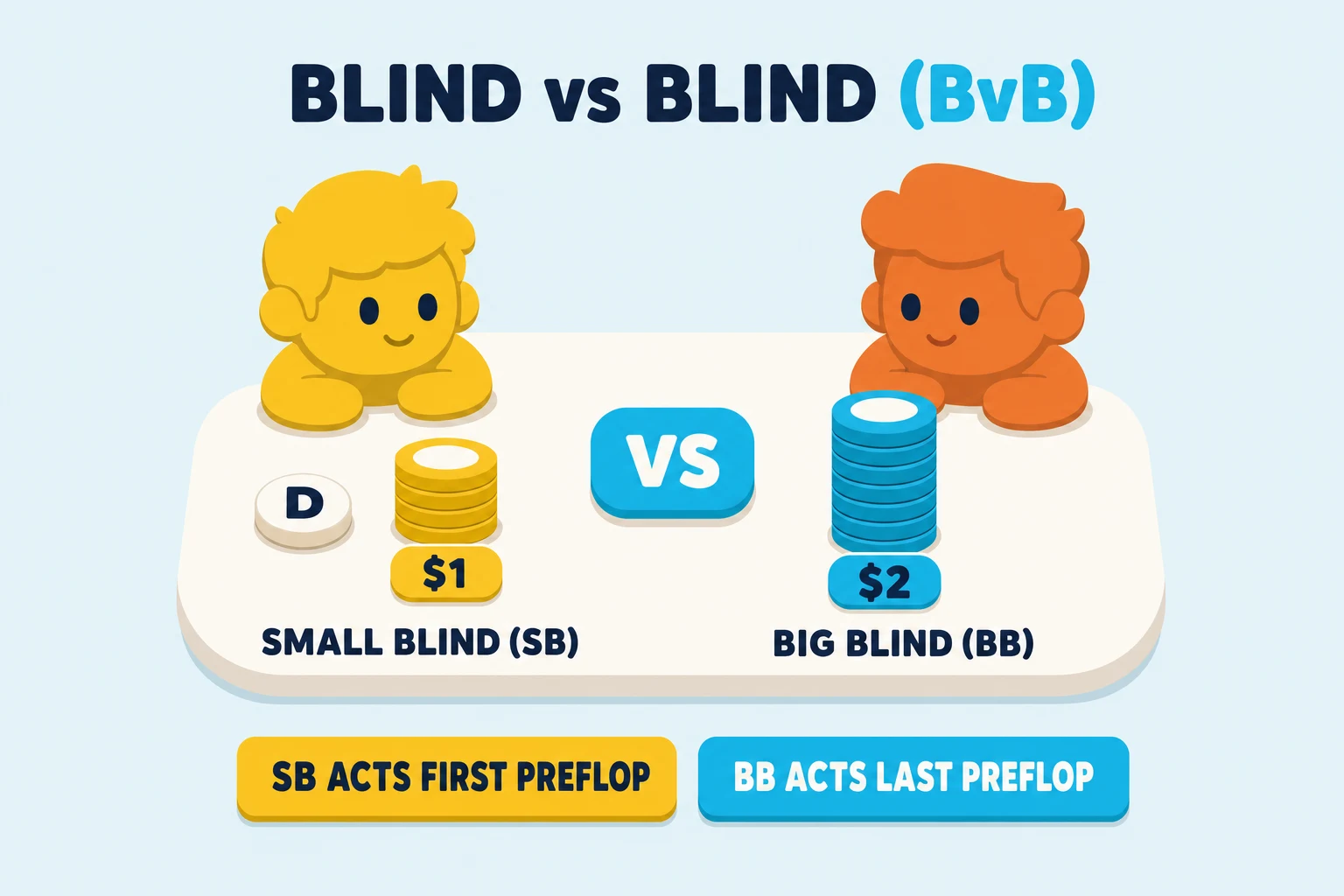
Blind vs Blind (BvB) occurs when only the Small Blind (SB) and Big Blind (BB) remain in the hand. Those forced bets create a live pot and incentivize contesting with marginal hands. The SB acts first pre-flop and on every post-flop street, a lasting disadvantage. The BB acts last pre-flop and post-flop, gaining pot odds when deciding whether to defend after an SB open. With two players, both ranges widen and strategic lines like raises, completes, floats, and check-raises gain importance.
Practice this in Poker Skill. The Small Blind: Raise or Fold lesson starts every hand folded to you, the moment a blind-versus-blind pot begins: K♣ Q♣ and A♥ 9♥ raise, while K♦ 3♥ and 9♠ 4♦ fold.
Get the free appBlind vs Blind (BvB): Quick Guide
BvB basics - define the scenario and its core implications
Blind vs Blind (BvB) occurs when only the Small Blind (SB) and Big Blind (BB) remain in the hand. Those forced bets create a live pot and incentivize contesting with marginal hands. The SB acts first pre-flop and on every post-flop street, a lasting disadvantage. The BB acts last pre-flop and post-flop, gaining pot odds when deciding whether to defend after an SB open. With two players, both ranges widen and strategic lines like raises, completes, floats, and check-raises gain importance.
Pre-flop decisions - how SB and BB should approach opening, defending, and sizing
Use this simple framework to guide opening, defending, and sizing decisions:
- SB choices: raise or complete. Raise to apply pressure and force the BB into tougher, often fold-or-showdown decisions. Complete (limp - call the big blind) to see a cheap flop. This suits speculative hands such as suited connectors and small pocket pairs.
- BB responses: fold, call, or 3-bet (re-raise). Defend a large portion of hands, since calling requires adding less relative to the pot size. This gives favorable pot odds to see flops with draws and medium-strength hands. 3-bet selectively to punish wide SB opens or seize initiative using hands with good equity and key blockers (cards that reduce opponent combos).
- Sizing considerations: Smaller SB opens or completes invite multi-street play and keep weak BB hands in. Larger SB opens force folds and punish loose BB callers; tailor sizing to opponent tendencies and stack depth.
Example: SB holds A8s. Against a passive BB, limp to see a flop. Against a very loose BB who calls frequently, raise to extract more value.
Post-flop dynamics - using position and common lines
After the flop, the BB has positional control and can use it:
- SB: continuation bets (c-bets) make sense on boards that miss the BB’s wide range, and even out of position they extract thin value or force folds.
- BB: raise the SB’s c-bets on boards that favor your calling range. Float by calling on the flop intending to take the pot later. Acting last post-flop helps you defend with many hands.
Balance value lines and bluffs. The SB must avoid overbluffing on textures that help the BB’s wide calling range. The BB should pick clear spots to apply aggression, for example raising when the board disfavors a natural SB c-bet range.
Stack depth & tournament context - adapting ranges and shove/re-steal incentives
Stack size changes everything:
- Short stacks: shove and shove-fold scenarios dominate; steals and re-steals become frequent and decisive.
- Medium/deep stacks: post-flop skill matters more; expect more multi-street lines, bluffs, and nuanced floats or raises.
- Tournaments: pay jumps and ICM (tournament equity pressure) tighten stealing ranges, making players cautious about re-raises late.
Simple practical strategies - quick, actionable rules to use at the table
- SB: open slightly wider than from other positions. Use sizes that keep weak BB hands honest for post-flop play.
- BB: defend liberally with calls and use selective 3-bets for hands with equity and blockers (cards that reduce opponent combos). Bluff more when board textures disfavour the SB’s likely c-bet range.
- Observe and adapt: against passive opponents, raise more; against overly aggressive players, call down and punish post-flop.
Quick checklist
- SB acts first pre-flop and post-flop; BB is last pre-flop and post-flop.
- Default to wider ranges but adjust for stack size and opponent tendencies.
- Use SB raises to pressure; use BB position and pot odds to defend.
- In tournaments, factor in shove/re-steal dynamics and ICM when changing ranges.