
A pot splits when two or more players reach showdown with the same best five-card hand, and the chips are divided evenly. The harder case is the all-in pot, which breaks into a main pot and one or more side pots where only some players are eligible for each layer. This is the procedure, with three worked examples and the odd-chip rule.
The short version
A split pot is a tied pot. Build each player’s best five-card hand from their two hole cards plus the five community cards, compare ranks, and if the top hands match exactly, divide the pot equally among the tied players. A side pot is a separate pot built when one player is all-in and others keep betting. The all-in player can only win the chips they could match. Anything above their all-in goes into a side pot they cannot touch.
Quick reference
| Pot type | When it forms | Who’s eligible | How it splits |
|---|---|---|---|
| Single pot | No all-ins, or every active player has matched every bet | All remaining players at showdown | Best hand wins; ties chop equally |
| Main pot | At least one player is all-in for less than the current bet | Every active player, including the all-in | Best eligible hand; ties chop |
| Side pot 1 | Someone keeps betting after a shorter all-in | Only players who put chips into this layer | Best eligible hand; ties chop |
| Side pot 2+ | Another all-in or another short stack inside the side pot | Only contributors to this layer | Best eligible hand; ties chop |
| Odd chip | Pot doesn’t divide evenly | All tied winners | Smallest chip goes to the player nearest the dealer’s left |
The most common cause of a chop is a board that plays. The most common cause of a side pot is a short stack shoving and at least two deeper stacks calling.
How a chop is decided
At showdown, each remaining player makes their best five cards out of seven: two hole cards plus five board cards, in any combination, including using only the five community cards if that is best. That is the best-five-of-seven rule, and it is the engine behind every chop. If the top hands tie on rank, you compare the next-highest cards in the hand (the kickers) one at a time. If every card matches, the players tie.
Concrete chop. Board K♠ 9♥ 7♣ 4♦ 2♠. Player A has A♣ J♦, Player B has A♥ J♠. Each plays A-K-J-9-7: ace high, then king, jack, nine, seven. Identical five-card hands, so the pot chops 50/50. Suit does not break ties in standard Hold’em; only the rank of the five cards matters.
Three side-pot scenarios
These three layouts cover most multi-way all-in pots you will see at a home game or online table. Read them in order; each adds one more layer.
Scenario 1: Two players, one all-in. No side pot
Alice has 200 chips, Bob has 600. Preflop, Alice shoves 200. Bob calls 200. Alice is now all-in. Bob still has 400 chips behind, but he has nobody else to bet against, since there are only two players in the hand. The hand goes to showdown with one pot of 400, both eligible.
If only two players are in a hand and one is all-in, no side pot ever forms, no matter how much deeper the other stack is. Best hand wins the 400; if they tie, it chops 200/200.
Scenario 2: Three players, one all-in. Main pot plus one side pot
Now add a third player. Pat has 100, Quinn has 300, Riley has 500. Preflop, Pat shoves 100. Quinn calls 100. Riley raises to 300. Quinn calls the extra 200, so Quinn and Riley both have 300 in. Pat is locked at 100. The dealer breaks this into two pots:
- Main pot. 100 from each of the three players, capped at Pat’s all-in. 100 × 3 = 300. Everyone is eligible, including Pat.
- Side pot. The 200 each that Quinn and Riley put in above Pat’s all-in cap. 200 × 2 = 400. Only Quinn and Riley are eligible.
Total chips: 300 + 400 = 700, which matches the 100 + 300 + 300 the players put in. At showdown, the side pot is awarded first, between Quinn and Riley. Then Pat’s hand is compared against the side-pot winner for the main pot. Pat can win 300, but never the 400 sitting next to it.
Scenario 3: Three all-ins, three different sizes. Main pot plus two side pots
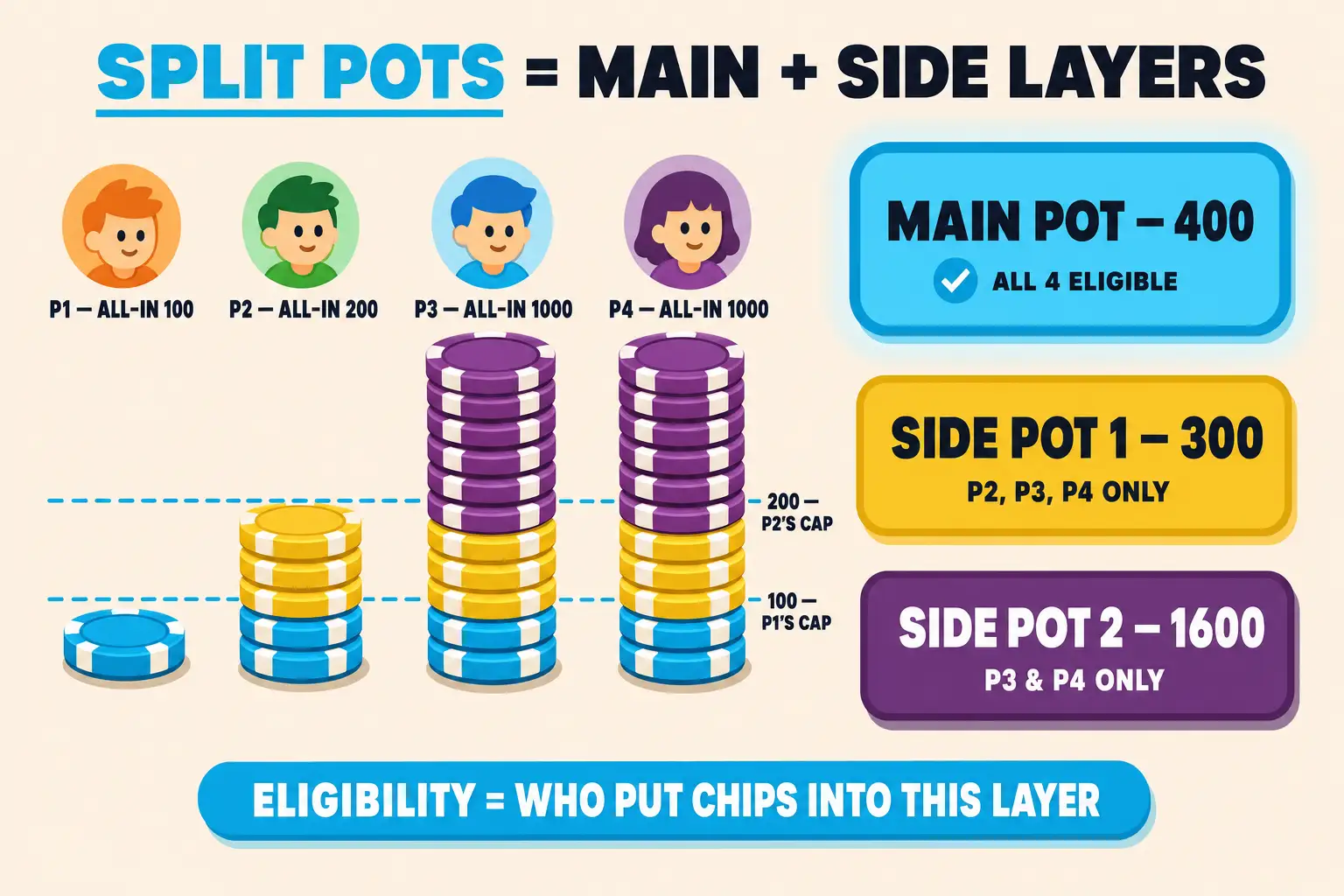
Four players. Stacks are P1 = 100, P2 = 200, P3 = 1,000, P4 = 1,000. Everyone gets it in. The pot has to split into three layers, because there are three different all-in caps:
- Main pot. Capped at 100 (smallest stack). 100 × 4 = 400. All four eligible.
- Side pot 1. From 100 up to P2’s cap of 200. 100 × 3 = 300. P2, P3, and P4 are eligible.
- Side pot 2. From 200 up to 1,000. 800 × 2 = 1,600. Only P3 and P4 are eligible.
Total: 400 + 300 + 1,600 = 2,300, matching the contributions 100 + 200 + 1,000 + 1,000. Showdown order is reversed, biggest side pot first: side pot 2 between P3 and P4, then side pot 1 among P2, P3, and P4, then the main pot among everyone. One player can win all three pots if they have the best hand against every set of contestants. P1 can only win the 400 main, no matter how good their hand is.
The odd-chip rule
If a pot doesn’t divide evenly, the dealer cannot round. A 101-chip pot between two tied winners becomes 50 and 51. The extra chip goes to the tied player nearest the dealer’s left, first to act clockwise from the button. That is the standard cash-game rule, and most cardrooms use it for tournaments too.
A few rooms run the tournament-strict version, where the odd chip goes by best card by suit (spades, hearts, diamonds, clubs). For cash games and home tables, the left-of-dealer rule is what you’ll see; in tournaments with real payouts on the line, ask the floor before the all-in.
The odd-chip rule applies inside every pot separately. If the main pot chops, the main odd chip goes left. If a side pot chops, that side pot’s odd chip goes left too, chosen only from among the side pot’s eligible winners.
When the rule isn’t quite the rule
A few spots fool home-game players because the answer feels like it should be different.
The board plays. If the five community cards already form the best five-card hand and no hole cards improve on it, the pot chops among every player at showdown. Board A♠ K♥ Q♦ J♣ T♥ is the canonical example: Broadway, all five on the board. Every active player plays the same A-K-Q-J-T straight, and the pot chops evenly.
Kickers run out before the cards do. Two players each hold an ace and the board pairs underneath. Board Q♣ J♦ 9♠ 9♥ 5♦. Player A has A♣ 7♣, Player B has A♦ 6♠. Both play 9-9-A-Q-J: pair of nines, then ace, queen, jack as kickers. The second hole cards (the 7 and the 6) never enter the five-card hand because the board’s queen and jack already outrank them. Same five cards, chop.
A flush on the board. Board 8♥ 5♥ 3♥ 2♥ K♥, all five hearts on community cards. The board flush is K-8-5-3-2. Any heart in either player’s hand replaces the 2♥ in the five-card hand and makes a higher flush, so to chop on this board, neither player can hold a single heart. When neither does, both play the board’s K-8-5-3-2 and split the pot.
The paired river makes a full house for everyone. Board K♣ 7♦ 4♠ 4♥ 4♣. Three fours on the board. Player A has K♠ 5♣, Player B has K♦ 8♥. Both make 4-4-4-K-K, fours full of kings, pairing their hole-card king with the board’s K♣. The second hole card (the 5 and the 8) doesn’t enter, since a full house only needs five cards. Identical, chop.
A live-play pattern
When a multi-way all-in is brewing, run this in your head before you call:
- Count the all-in caps. How many different stack sizes are about to go in?
- Build the layers. Smallest cap times the number of contributors is the main pot. Each next-bigger cap layer times its contributors is the next side pot.
- Name your pots. If you are the short stack, you compete for the main only. If you cover the field, you compete for everything.
- Compute equity against the right pot. Don’t price your call against chips you can’t win.
If you are the all-in short stack, you are playing for the main pot only, and your equity math should reflect that.
Where this fits in your decision
Splits are not rare. Paired boards, shared straights, and board-plays-the-pot situations show up often enough that you will see one most sessions. The harder discipline is reading multi-way all-in spots correctly: knowing which layers you can win and which ones you can’t. For the long version of how rank ties resolve, the glossary entry on tie walks through it. The shortcut for everything else: build the layers, name your pot, then make your call.
Frequently asked questions
Can the player who’s all-in win the side pot? No. A player can only win pots they contributed to. The side pot is built from chips above the all-in cap, so the all-in is locked out. They can still win the main pot if they have the best hand among everyone eligible.
What happens if the chips don’t divide evenly? The smallest chip in play goes to the tied winner nearest the dealer’s left. A 101-chip pot between two winners becomes 50 and 51, with the extra chip going to whichever winner is first in clockwise rotation from the button. The same rule applies inside any side pot that has to be chopped.
Does the dealer split if every player at showdown has the exact same hand? Yes. The pot is divided as evenly as possible among every tied winner. A three-way tie chops the pot into thirds, and any odd chip goes left of the dealer.
Does this work the same way in Omaha? Side-pot mechanics are identical; they’re a betting concept, not a game-specific one. The chop side differs in Omaha hi-lo (8-or-better), where the pot splits between the best high and the best qualifying low, and one half can split again (called quartering) if two players tie on the low.