


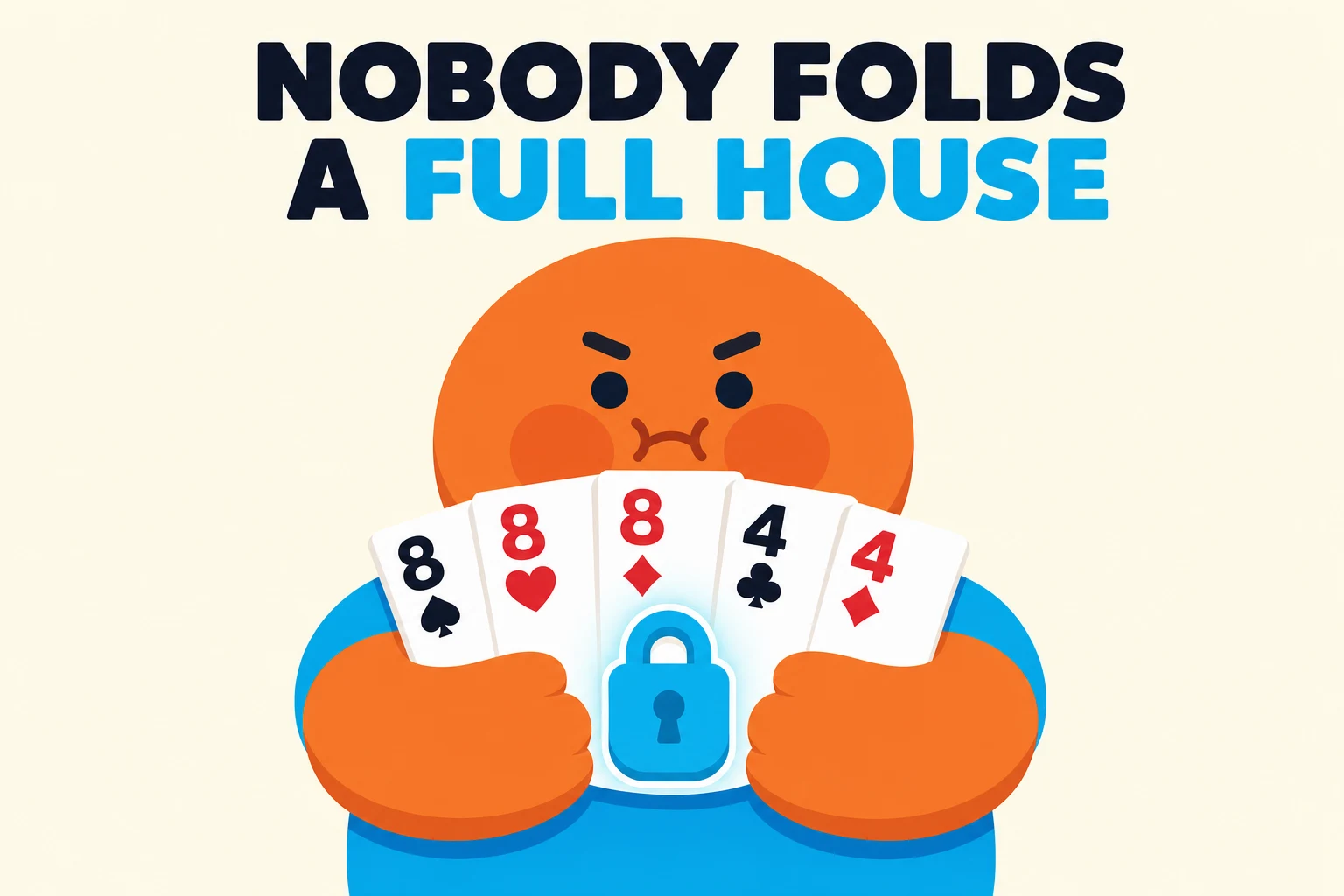
Zeebo’s theorem says: no player is capable of folding a full house on any betting round, for any size of bet. It comes from the mid-2000s online era, named for the player Zeebo, and it has survived because it keeps being true. Two adjustments follow from it: never bluff someone whose line says full house, and when you hold the better one, bet the biggest number they can physically call.
The theorem in one line
If your opponent probably has a full house, they are not folding. Plan your bets, your bluffs, and your sizing around that certainty instead of fighting it.
Why nobody folds a boat
Start with how rare the hand is. Playing any two cards to the river, you make a full house about 2.6 percent of the time. A player who sees thirty hands an hour and plays a quarter of them to the river might see one boat every couple of sessions. When it finally arrives, it beats every flush, every straight, and every overpair that has been paying them all night. The hand feels like a paycheck.
Now add what the hand looks like from inside. A boat is nearly invisible to downgrade. Top pair can look at an ace on the river and feel sick. A flush can watch the board pair and slow down. A full house looks at almost any runout and sees nothing wrong, because the only hands that beat it are bigger boats, quads, and straight flushes, and nobody sits there picturing those. Rarity plus invisibility plus the memory of every boat that got paid means the chips are going in. That is not a leak unique to beginners. It is close to a law of the game, which is why it earned the name theorem instead of tip.
The two adjustments that make it money
The theorem describes your opponent. The profit comes from what you do about it.
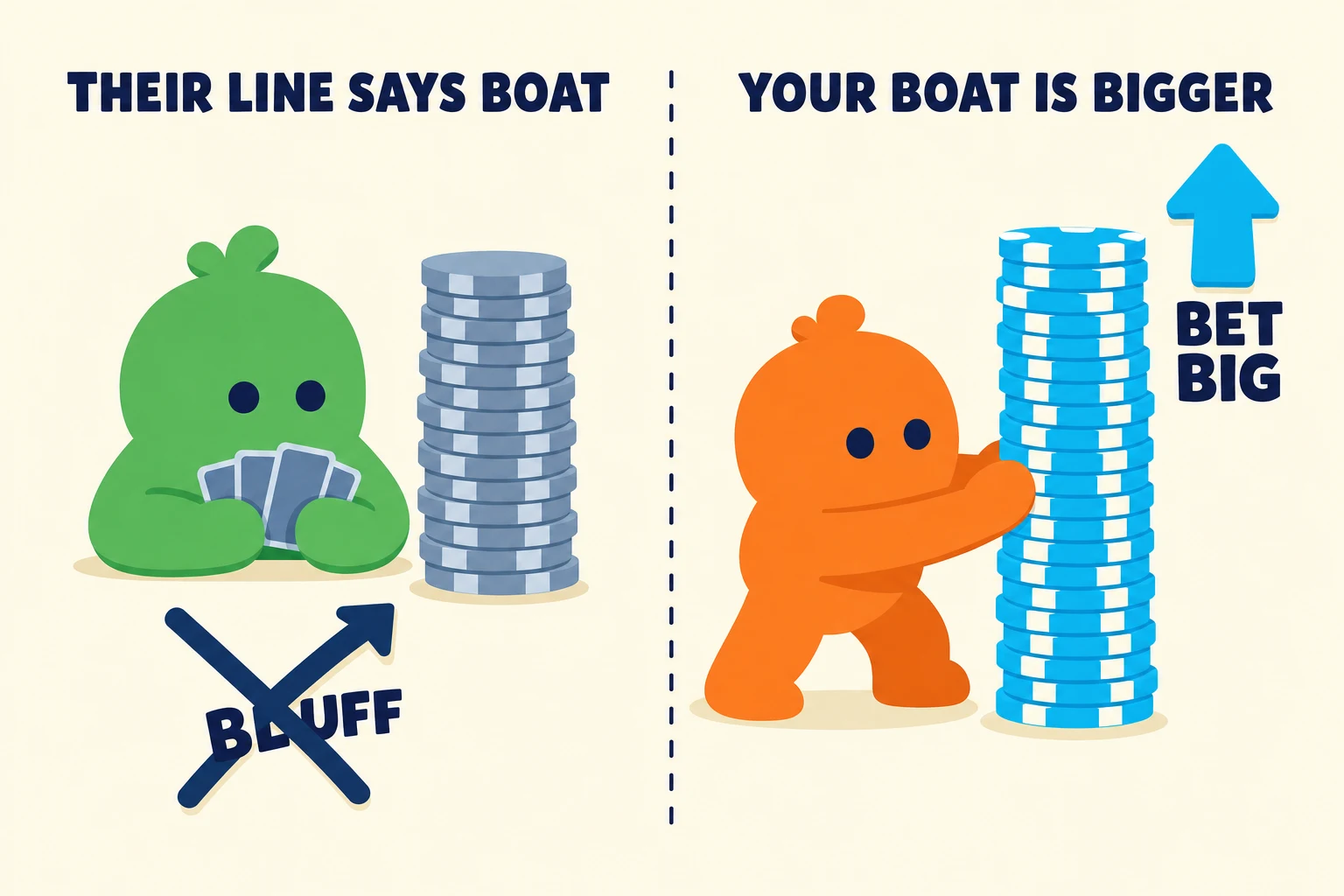
Never bluff a probable boat
You open Q♠Q♣, the big blind calls, and the board runs out 8♦8♣3♠, turn 3♥. Your opponent check-calls the flop, then leads into you when the board double-pairs. Stop and read the story: they called a raise from the blind, peeled a paired flop holding something that liked it, and started betting the moment the second three arrived. Every 8x hand in that line just became eights full, and pocket threes became quads. Your overpair is now two pair on a board where their betting range is stuffed with boats. If the river bricks and they keep betting, the one play with no future is the bluff-raise. A player whose line says boat is calling with the boat every single time, at every size. Your raise only gets called by hands that beat you and folds out nothing that matters. Save the chips. Bluffing works on hands that can let go; a full house is not one of them, and that is the entire theorem.
Bet the maximum with the better boat
Flip it around. You hold 3♥3♦ on that same 8♦8♣3♠ flop, which means you flopped threes full of eights. Your opponent’s line says they have an eight. Zeebo’s theorem now reads as an invitation: a player with trips who improves to a boat, or who simply refuses to believe yours, cannot fold, so every chip you leave unbet is a chip you chose not to win. This is the spot for the biggest bet the stacks allow, and against most players that means sizing up street by street until the last bet is all in. The usual worry about big bets, that they fold out everything worse, does not apply here. Worse full houses and trips call because of the same psychology the theorem describes. If there was ever a moment to stop being subtle about value betting, a boat-over-boat board is it.
One caution inside the good news: make sure yours is the better one. On 8♦8♣3♠, your pocket threes make threes full of eights, but 8♥3♣ exactly makes eights full of threes, and any later card that pairs the board again can promote a bare eight past you. The trips rank decides the winner, so the question is never whether you are full. It is whether you are fuller.
The theorem also has a listening side. Since nobody folds a boat, nobody raises one politely either: when a passive player raises your river bet on a paired board, the raise is the full house announcing itself. The same certainty that makes them impossible to bluff makes their big-money actions unusually honest. A player who would call any bet with their boat has no reason to raise without one, so treat river raises on paired boards as boats until you have seen that specific player prove otherwise. Calling those raises with one pair “to keep them honest” is paying to confirm what the theorem already told you for free.
When the theorem lies to you
Three spots deserve real doubt.
First, strong players folding small boats. The theorem was coined about how people actually play, not how they should. A seasoned regular holding the bottom full house on a double-paired board can find a fold when the fourth raise goes in, because they have done the range math and know an underfull is a bluff-catcher at best there. Against thinking opponents at meaningful stakes, downgrade the theorem from law to strong tendency.
Second, boards where a full house is not the top of the deck. On something like 9♠9♥9♦4♣4♠, everyone technically holds a full house and none of it means anything; quads and bigger pocket pairs rule the hand. The theorem is about players who believe they hold a monster. When the board itself supplies the boat, that belief evaporates and folding gets easy again.
Third, using the theorem to excuse overplaying your own weak boat. It says your opponent will not fold theirs. It does not say yours is good. When the betting goes nuclear on a paired board and your full house is the smallest one available, you are the customer in someone else’s Zeebo story.
A live-play pattern
Before you bet into a paired or double-paired board, run three questions. Does their line say trips or better? If yes, delete the bluff from your menu. Is my full house the best one the board allows, or close to it? If yes, size up and keep sizing up. If mine is the weak boat, what am I beating that calls? If the honest answer is nothing, calling beats raising and folding beats calling more often than it will ever feel like it should.
Where this fits
Zeebo’s theorem is the oldest of the named theorems, and the reason it outlived the others is that it needs no memorization, just the discipline to believe it in the moment. It pairs naturally with knowing why a full house is called a boat and with the full ladder on the poker hand rankings page, because every application of the theorem starts with reading which boats a board makes possible. That read is drilled in Poker Skill’s board-reading lessons, down to which two cards make the best full house on Q♥Q♦6♠6♦A♠: pocket aces, for aces full of queens.
Frequently asked questions
Who is Zeebo? Zeebo was the screen name of an online player from the mid-2000s forum era, best known as the namesake of this theorem. The observation was named during the period when players catalogued recurring truths as theorems, and this one proved the most durable.
Should you ever fold a full house? Rarely, and almost never on a single bet. The genuine folding spots involve massive multi-raise action on boards where your boat is near the bottom of the possible full houses, against opponents capable of folding themselves. If you are not sure you are in that spot, you are not.
Does the theorem apply to trips or flushes? No, and that is the useful part. Players do fold trips and flushes to enough pressure, so bluffing them stays viable and value sizing against them needs more care. The theorem draws the line at the full house because that is where folding stops being psychologically available.
Does the theorem still hold online and at low stakes? More than anywhere. The lower the stakes and the faster the games, the more literally players follow it, because folding a rare monster requires a discipline that casual play never builds. The exceptions live at high stakes among professionals, and even there they are exceptions.
What other named theorems exist? The same era produced the Baluga theorem, which says to re-evaluate one-pair hands when raised on the turn. Most of the others aged badly. Zeebo’s aged best because it describes human nature rather than a strategy trend.