


Double-Paired Board
A flop or runout where two ranks each appear paired, like 7-7-4-4-Q. Hand strength compresses, so most one-pair holdings get weaker and bluffs lose credibility.
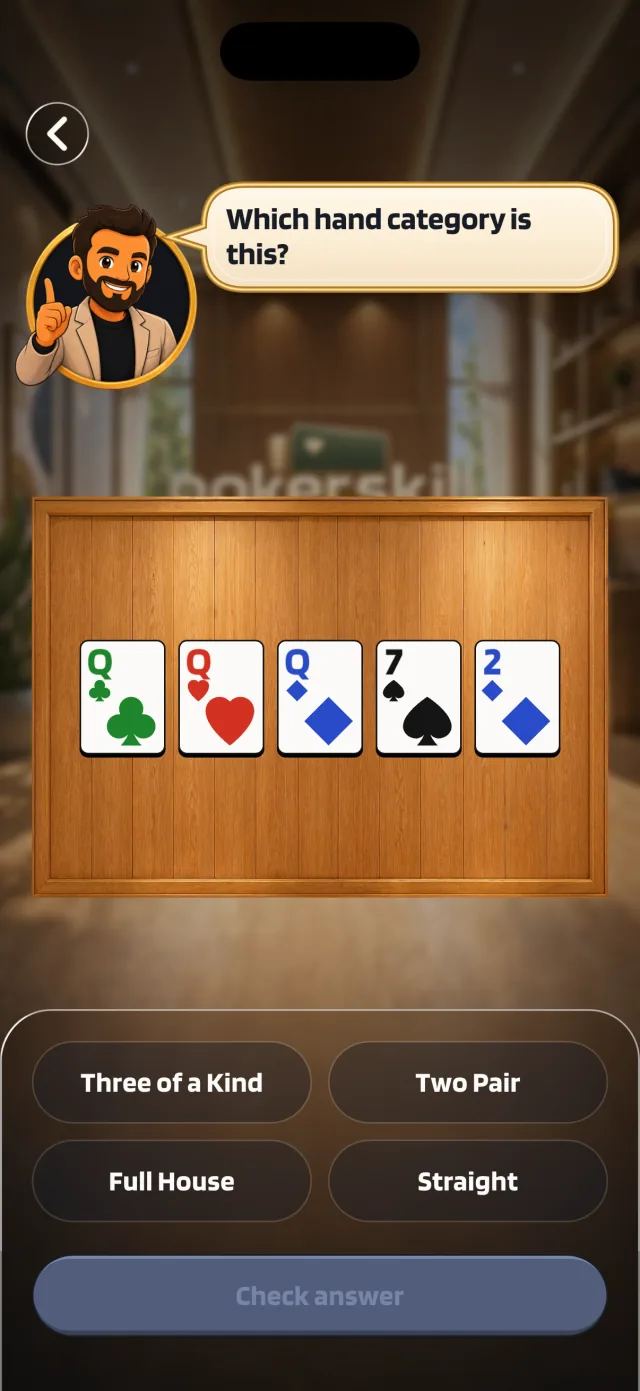
Practice this in Poker Skill. On K♦ K♣ 9♠ 9♥ Q♦, one of its board-reading lessons shows where kickers still count, since J♥ 5♠ just plays the board while A♠ 2♠ beats it with an ace kicker.
Get the free appDouble-Paired Board
What a double-paired board is A double-paired board has two different ranks that each appear as pairs among community cards. Example: 7♠-7♥-4♠-4♦-Q♣. This texture compresses hand classes into the same visible results, like playing the board, one pair, full houses, or quads.
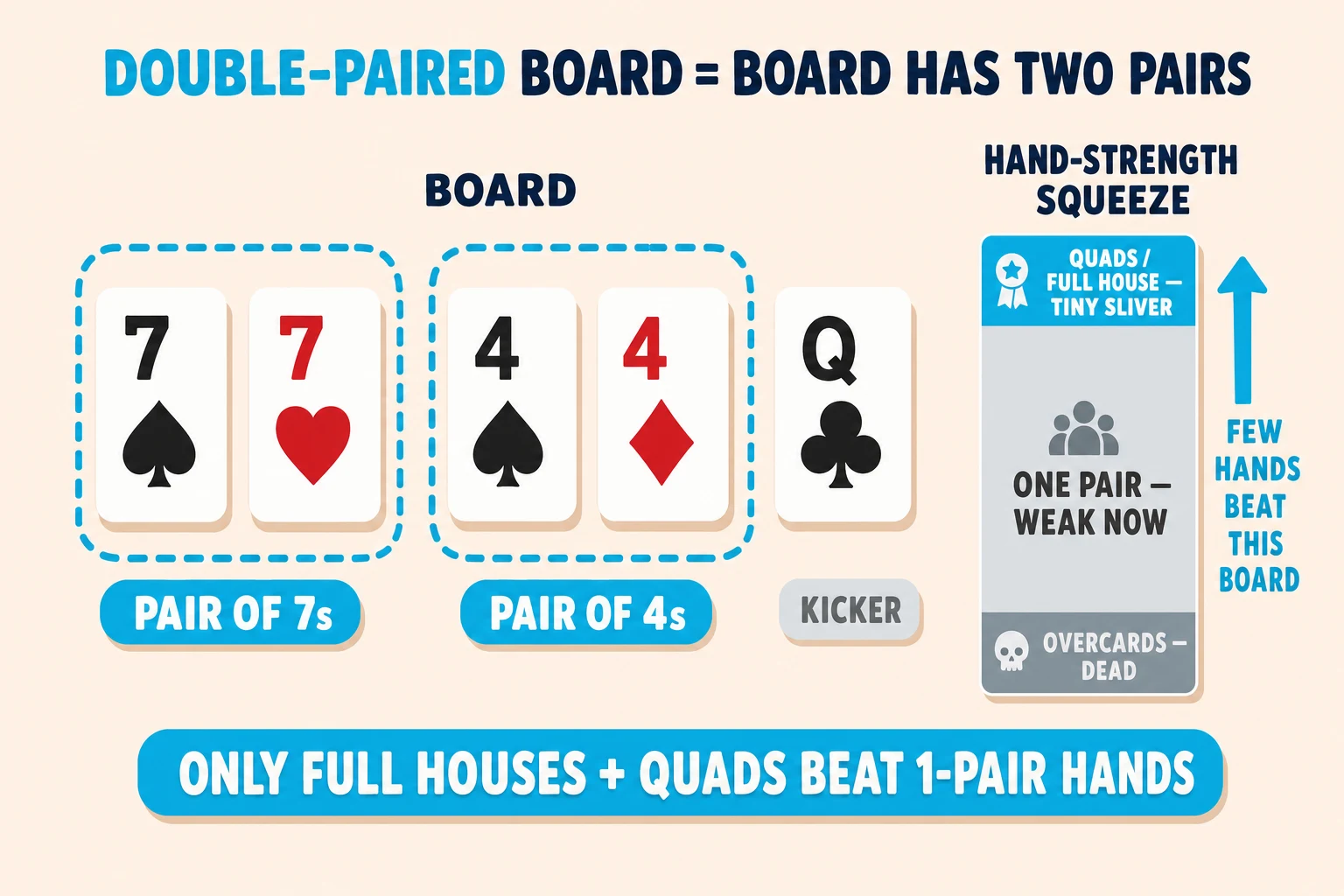
How hand strength changes on double-paired boards These boards polarize hand strength: full houses and quads sit at the top. Most other holdings, like one pair or overcards, become relatively weak by comparison. Example: 7♣7♦ on 7♠-7♥-4♠-4♦-Q♣ makes quads; 7♣4♥ makes a full house. By contrast, A♠Q♦ only has one pair of queens, a marginal holding versus full houses or quads.
Kicker (the extra card that breaks ties between same-ranked pairs) value shrinks on double-paired boards. A king kicker that matters on many boards often becomes irrelevant when the board already shows full-house or quads possibilities. Thus, one-pair and marginal hands lose practical value and deserve cautious play.
Position and betting strategy (in position vs out of position) In position (IP) means acting after your opponent on later streets; out of position (OOP) means acting before them.
Out of position guidance
- Default to checking; donk bets into the preflop aggressor are generally poor on double-paired boards.
- Check to protect weaker range parts; overcards and small pairs avoid getting farmed by IP aggression.
- Attack only with a clear plan: strong blocker bluffs with turn/river backup or disguised full houses.
In position guidance
- Exploit checks; IP often realizes equity and extracts value when OOP checks forward.
- Value-bet selectively, only with clear full houses, quads, or rare top-of-range hands.
- Use small, controlled bluffs rarely; small sizings can fold out air, but bluff frequency stays low.
Bluffing and value-betting on double-paired boards Bluff equity falls because believable value hands narrow to quads, full houses, and occasional top hands. Reserve value-bets for clear winners. Bluffs work only with strong blockers that reduce opponents’ full-house or quads combos, and they rarely succeed without reads.
Equity and expected-value implications On many double-paired, no-donk-bet flops, OOP’s average equity sits near 39%. When OOP checks most of their range, their realized share of the pot tends to align with that equity. This dynamic gives IP a structural advantage, letting them realize more equity and extract more value.
Quick checklist
- Assume marginal hands are weak on double-paired flops unless you hold a full house or quads.
- OOP: default to checking, avoid routine donk bets, and be selective with bluffs.
- IP: value-bet only with very strong hands and exploit OOP’s checking when appropriate.