


Double Gutshot
A double gutshot (double belly-buster) is two separate inside-straight gaps in the same hand, totaling 8 outs - the same hit-rate as an open-ended straight draw, but disguised. Two different ranks each complete a different straight, so opponents reading the board see only gutshot texture and miss the second gap. The math matches an OESD; the way the board looks to your opponent does not.
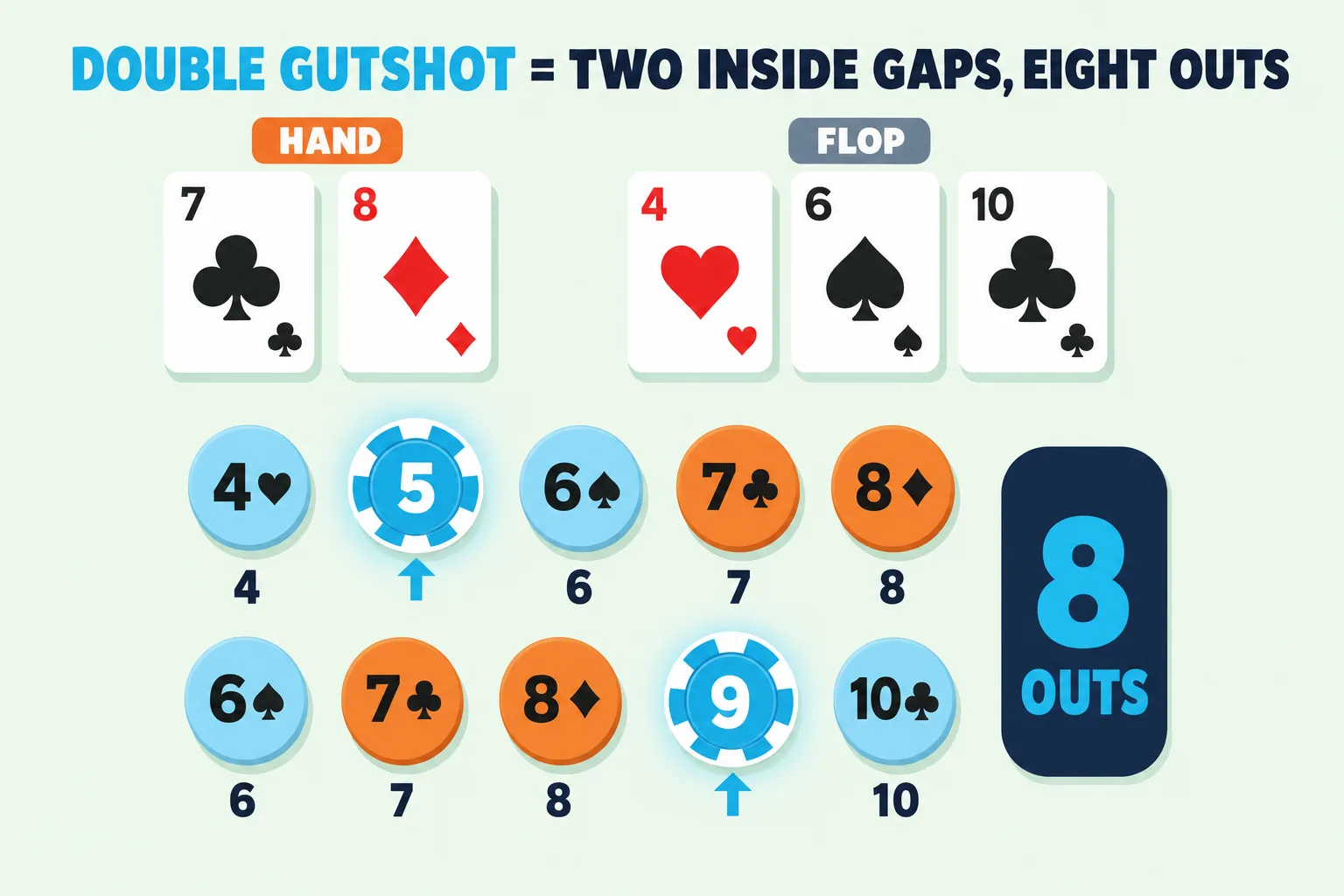
Practice this in Poker Skill. A 5 or a 9 fills 7♣ 8♦ on a 4-6-10 flop, the double gutshot in the lesson on straight chances, for eight outs from two different gaps.
Get the free appDouble Gutshot (double belly-buster straight draw)
What a double gutshot is and how to spot it
A double gutshot is a hand that has two separate inside-straight gaps at the same time, where each gap is filled by a different rank and each completion makes a five-card straight. You count outs the same way you count any draw: 4 cards of one rank for the first gap + 4 cards of the other rank for the second gap = 8 outs. That’s the same outs count as an open-ended straight draw, but the board doesn’t read like one. Players around the table see what looks like gutshot texture and misread your draw.
How to spot one at the table:
- Sort your two hole cards plus the three flop cards by rank. You’re looking at a five-card window with two missing inside ranks.
- Each missing rank, on its own, completes a different five-card straight.
- The two completion ranks can’t be the same rank; that would just be a single gutshot with 4 outs.
- Neither completion can come from filling an end of the sequence; that would make the hand an OESD.
Related terms
- Gutshot — the single-gap version, 4 outs.
- Straight draw — the parent type covering both shapes.
- Outs — how the 8-out count works.
- Implied odds — the hidden-payoff lever this draw turns on.
- Semi-bluff — the betting line a disguised 8-out draw enables.
Double gutshot vs gutshot vs OESD
Same family, different prices.
| Draw | Outs | % by river (Rule of 4) | How obvious to opponents |
|---|---|---|---|
| Gutshot | 4 | ~16% | Sometimes obvious |
| Double gutshot | 8 | ~32% | Hidden, reads as a gutshot |
| Open-ended straight draw | 8 | ~32% | Obvious, connector texture screams straight |
Two takeaways. First, a double gutshot has the same equity as an OESD: 8 outs is 8 outs, and the Rule of 4 and 2 gives ~32% from flop to river either way. Second, the disguise gap is real and worth money. Opponents who would shut down on a coordinated 8-9-10 board often barrel through a 4-6-10 board, because the texture doesn’t trigger their straight alarm.
When this matters most
The double gutshot earns its keep in spots where being misread is worth the price of a draw:
- Disconnected boards with one middle card. Flops like 4-6-10 or 5-9-J look like brick paint to most opponents. A turn that fills your inside gap won’t scare them off the way a connector turn would.
- Multiway pots with implied odds. When two or three players see the flop, the future-bet ceiling rises. A disguised completion in position can pay off across the turn and river.
- In position with a single bettor. Calling cheap with a double gutshot in position lets you realize the full 8-out equity and apply pressure on bricks. Use the semi-bluff line on turns that further conceal your range.
- When the made straight is the nuts. A double gutshot where one completion is the nuts is a dream spot. A double gutshot where both completions are second-best is a trap.
It matters less when the texture exposes you anyway (on a 5-7-9 flop, 6-3 in hand is technically a double gutshot, but a 4 or an 8 doesn’t fool anyone) or when stacks are too shallow to extract on the made hand.
Worked example
You have 7♣ 8♦ on the button. Three players limp, you raise, the small blind and one limper call. Three-way to the flop.
Flop: 4♥ 6♠ 10♣
Sort the cards: 4-6-7-8-10. Two inside gaps:
- A 5 completes 4-5-6-7-8.
- A 9 completes 6-7-8-9-10.
That’s 4 fives + 4 nines = 8 outs. The Rule of 4 gives you ~32% by the river, the same as an OESD. But to the small blind, this looks like a 4-6-10 brick board. They’re not folding top pair to a turn 9. They’re not slowing down when a 5 comes off, either.
If the small blind leads small on the flop, calling in position is fine. If they check, a half-pot bet from the button works as a semi-bluff: you fold out the worst hands, set up a barrel on bricks, and have 8 clean outs when called. When the 5 or 9 hits, the disguise is what gets paid off.
Common mistakes
1) Drawing to the wrong end
Not every double gutshot makes the nuts on both completions. With J-9 on a K-10-7 board, an 8 makes the nut straight, but a queen completes 9-10-J-Q-K, and any opponent holding A-J has you crushed. Identify the non-nut end before you commit. If only one completion is the nuts, treat the draw as 4 useful outs, not 8.
2) Miscounting on a flush board
If two of the flop cards share a suit, some of your 8 outs are dirty. A 9 that completes your straight but also completes an opponent’s flush is closer to half an out. Read the board before counting; phantom outs cost real money.
3) Calling a big raise as if you have an OESD
A double gutshot has the same hit-rate as an OESD, but the mistake is leaning on that math without the implied-odds payoff to back it up. Against a tight player who’ll shut down on a turn 5 or 9, the disguise becomes a curse: they fold to your bet on the made hand, and you don’t get paid. The implied odds carry the price; without them, an 8-out call gets thin fast.
4) Over-betting the made straight
When your inside card hits, the disguise that helped you on the draw works against you on a big bet. Sizing a pot-sized shove on the river often folds out exactly the calling range that didn’t see the straight coming. Sizing 40-60% of pot keeps the disguise alive and the call wide.
FAQ
How many outs is a double gutshot?
Eight. Two distinct inside-straight gaps, four cards of one rank and four of the other, totals 8 outs, identical to an open-ended straight draw.
Is a double gutshot the same as an open-ended straight draw?
The math is the same: 8 outs, ~32% by river. The texture is not. An OESD lives on connected boards (think 8-9 with a flop of 6-7-K), and opponents read those boards quickly. A double gutshot lives on broken boards where opponents see only a gutshot’s worth of danger. Same equity, different price tag at the table.
Why is a double gutshot called a double belly-buster?
“Belly-buster” is older table slang for a single inside-straight draw, where you’re shooting at the belly of the sequence rather than either end. A “double belly-buster” is two of those stacked in one hand. Modern coverage uses “double gutshot” or “double-gutter” interchangeably.